
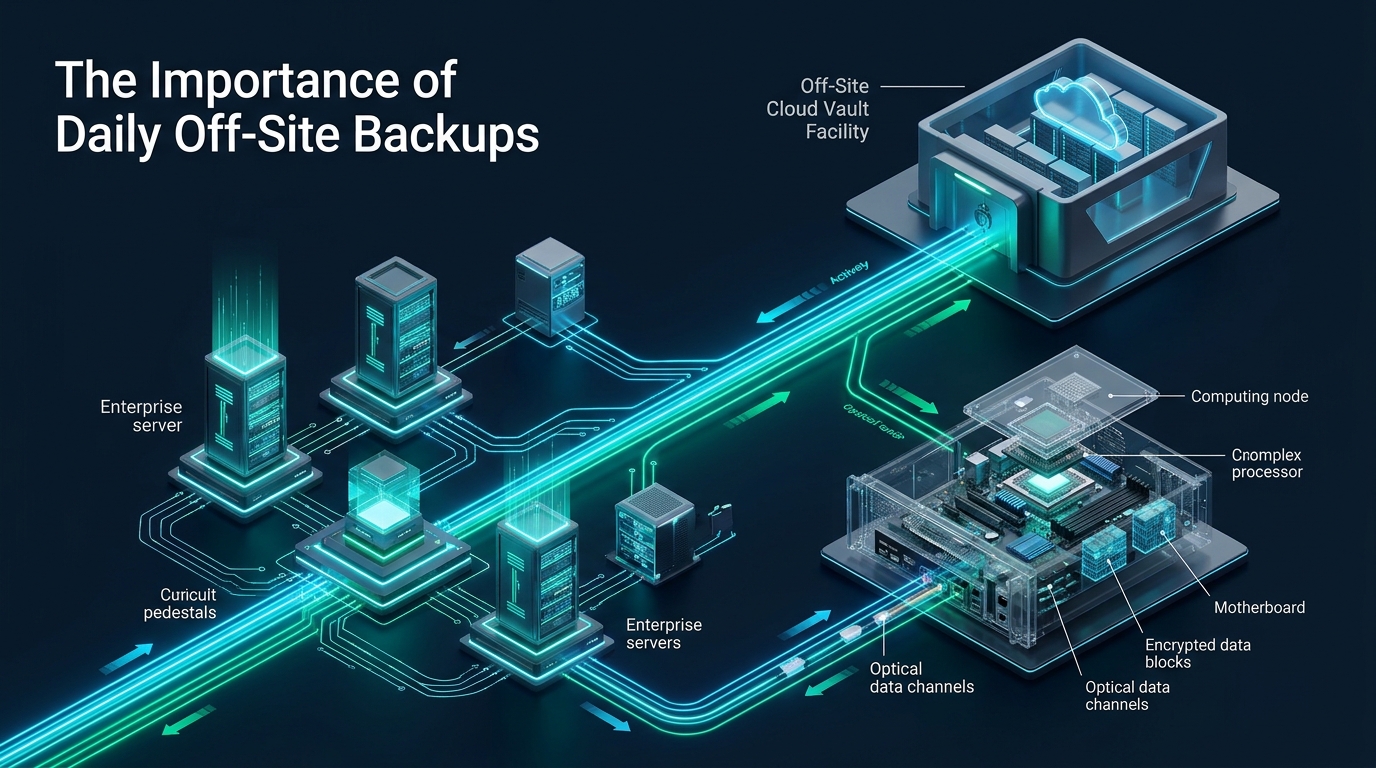
In high-availability enterprise environments, relying solely on local disk snapshots or co-located SAN replication introduces a fatal single point of failure that leaves mission-critical workloads defenseless against ransomware propagation, hypervisor panics, and localized data center outages. Production clusters engineered on MeraHost prioritize true geographic fault isolation by decoupling daily recovery targets from the physical compute nodes, ensuring that stateful data persists regardless of host-level disasters. Adopting automated, cryptographically verified off-site synchronization bridges the catastrophic gap between theoretical disaster recovery plans and immutable, verifiable business continuity.
Why Daily Off-Site Backups Are Mandatory for Enterprise Continuity
Enterprise infrastructure teams often operate under a dangerous illusion of security when managing production workloads. Modern storage systems provide snapshot capabilities that execute in milliseconds, leading engineers to assume that continuous local volume snapshots or hypervisor-level checkpoints provide sufficient disaster protection. However, when an uncontained ransomware actor compromises root credentials, an electrical fire engulfs a facility, or a localized hypervisor storage pool suffers irrecoverable filesystem corruption, all local snapshots perish alongside the original data volumes.
True operational resilience requires isolating recovery media across physical, logical, and cryptographic boundaries. The importance of daily off-site backups lies in establishing an unbreachable air-gap between active production runtimes and immutable recovery points. When recovery snapshots are transmitted to physically segregated facilities across independent network fabrics, secondary authentication perimeters, and write-once-read-many (WORM) storage vaults, an organization transforms catastrophic failure from a business-ending event into a standard operational recovery procedure.
The Modern 3-2-1-1-0 Enterprise Backup Architecture
The classic 3-2-1 backup topology—advocating three copies of data on two distinct media types with one copy stored off-site—remains foundational, but modern cyber threats and distributed microservice architectures demand a modernized enterprise standard: the 3-2-1-1-0 framework. This protocol ensures zero blind spots across both infrastructure failure and malicious credential compromise:
- 3 Copies of Core Data: The primary production dataset, an active secondary local replica for rapid interactive restores, and an off-site archive.
- 2 Distinct Storage Media Formats: High-speed NVMe block storage for operational compute paired with cloud object storage (S3/Wasabi/B2) or immutable tape pools.
- 1 Off-Site Geographic Location: A geographically independent data center located outside the blast radius of local electrical, meteorological, or seismic disruptions.
- 1 Air-Gapped or Immutable Copy: Cryptographically locked via Object Lock in Compliance Mode, rendering data unmodifiable even by privileged root or AWS IAM root accounts.
- 0 Restoration Errors: Daily automated headless verification jobs that extract backup payloads into isolated staging environments, run database sanity checks, and confirm zero block corruption.
Architecture Note on Threat Modeling: Ransomware operators in 2026 routinely establish persistence within an enterprise network for weeks before executing payload encryption. During this reconnaissance phase, scripts locate NAS mounts, local backup repositories (such as local Borg or Veeam pools), and cloud API credentials. If your backup targets reside on the same network broadcast domain or share authentication tokens with production hosts, attackers will purge the backups before encrypting the production disks. Off-site immutable storage with append-only access keys is your sole line of defense.
Architectural Comparison: Local Snapshots vs. Enterprise Off-Site Backups
Evaluating storage strategies requires analyzing recovery objectives, cryptographic isolation, and resilience under extreme operational failure modes. The following matrix contrasts traditional local snapshot policies with enterprise-grade automated off-site backup architectures:
| Feature / Metric | Standard / Default | Tuned / Production |
|---|---|---|
| Failure Domain Isolation | Single host / Shared SAN fabric | Geographically isolated cloud vault |
| Ransomware Protection | Vulnerable to root / sudo deletion | WORM S3 Object Lock Compliance Mode |
| Recovery Point Objective (RPO) | 24 to 72 hours (manual / sporadic) | < 60 minutes granular daily/hourly delta |
| Recovery Time Objective (RTO) | Multi-day rebuild on new metal | < 30 minutes bare-metal / VM restore |
| Deduplication & Compression | None (full tarball disk bloat) | Content-defined chunking (Rabin CDC) |
| Cryptographic Security | Cleartext on local partition | AES-256-GCM client-side encryption |
| Network Overhead | Uncontrolled bandwidth bursts | Kernel BBR throttling & TCP tuning |
| Integrity Verification | Assumed working (untested) | Automated daily headless restore drill |
Production Implementation: Automated Daily Off-Site Backup Pipeline
Implementing an enterprise-grade backup workflow requires eliminating human intervention while maintaining cryptographic isolation. The following production blueprint uses Restic—a high-performance, client-side encrypted backup utility leveraging Rabin Fingerprints for content-defined chunking—interfaced with S3-compatible cloud object storage.
1. Automated Backup Orchestration Script
This executable backup script flushes transactional databases, streams consistent database snapshots, performs deduplicated client-encrypted synchronization to an off-site S3 repository, and enforces retention pruning without storing plaintext credentials on disk:
#!/usr/bin/env bash
# /usr/local/bin/enterprise-offsite-backup.sh
# Production Off-Site Immutable Backup Engine
set -euo pipefail

# Export environment configuration from secure vault file
source /etc/restic/backup.env

TIMESTAMP=$(date -u +"%Y%m%d_%H%M%SZ")
LOG_TAG="enterprise-backup"
BACKUP_TMP_DIR="/var/run/backup-staging"

logger -t "${LOG_TAG}" "Initiating enterprise off-site backup sequence..."

mkdir -p "${BACKUP_TMP_DIR}"
chmod 700 "${BACKUP_TMP_DIR}"

# 1. Consistent Database Dump (Single-Transaction for InnoDB, Master Data consistent)
DB_DUMP_FILE="${BACKUP_TMP_DIR}/mysql_dump_${TIMESTAMP}.sql.gz"
logger -t "${LOG_TAG}" "Executing consistent transactional database snapshot..."

mysqldump \
  --defaults-file=/root/.my.cnf \
  --single-transaction \
  --quick \
  --skip-lock-tables \
  --routines \
  --triggers \
  --events \
  --all-databases | gzip -9 > "${DB_DUMP_FILE}"

# 2. Execute Restic Deduplicated Snapshot to Off-Site S3 Target
logger -t "${LOG_TAG}" "Streaming encrypted chunks to off-site object vault..."
restic backup \
  --exclude-file=/etc/restic/excludes.txt \
  --tag "daily-production" \
  --tag "host-$(hostname)" \
  /etc \
  /var/www \
  /home \
  "${DB_DUMP_FILE}"

# 3. Clean local temporary database archive
rm -f "${DB_DUMP_FILE}"

# 4. Enforce Retention Policy with Cryptographic Pruning
logger -t "${LOG_TAG}" "Enforcing snapshot retention policies..."
restic forget \
  --keep-daily 7 \
  --keep-weekly 4 \
  --keep-monthly 12 \
  --keep-yearly 2 \
  --prune

# 5. Verify Repository Integrity (Sampling 5% of pack files daily)
logger -t "${LOG_TAG}" "Verifying off-site pack integrity..."
restic check --read-data-subset=5%

logger -t "${LOG_TAG}" "Daily off-site backup completed successfully."
Architecture Note on Database Locking: Never attempt to back up raw MySQL or MariaDB data files (
/var/lib/mysql) using filesystem tools while the database daemon is running. Doing so produces torn pages in the InnoDB buffer pool, rendering the restored database unusable. Always stream consistent transactional snapshots usingmysqldump --single-transaction, Percona XtraBackup, or MariaDB Backup to guarantee physical consistency.
2. Systemd Service Unit with Process Sandboxing
Cron jobs lack resource governance and modern process sandboxing. Managing backups via systemd service units enables strict cgroup limits, preventing runaway backup threads from starving production web workers:
# /etc/systemd/system/restic-backup.service
[Unit]
Description=Automated Daily Off-Site Immutable Backup
Documentation=https://merahost.org/docs/backups
After=network-online.target mariadb.service
Wants=network-online.target

[Service]
Type=oneshot
ExecStart=/usr/local/bin/enterprise-offsite-backup.sh
StandardOutput=journal
StandardError=journal

# Security and Isolation Sandboxing
ProtectSystem=strict
ProtectHome=read-only
ReadWritePaths=/var/run/backup-staging /root/.cache/restic
PrivateTmp=true
NoNewPrivileges=true
ProtectKernelTunables=true
ProtectKernelModules=true
ProtectControlGroups=true

# Resource Governance (Prevent CPU and I/O starvation of LiteSpeed/Nginx)
Nice=19
IOSchedulingClass=idle
CPUQuota=75%
MemoryHigh=2G
MemoryMax=3G
3. Systemd Monotonic Timer for Predictable Off-Peak Execution
A systemd timer ensures execution during off-peak hours and applies random jitter to prevent synchronized network saturation across distributed server fleets:
# /etc/systemd/system/restic-backup.timer
[Unit]
Description=Trigger Daily Off-Site Backup During Off-Peak Window
Requires=restic-backup.service

[Timer]
OnCalendar=*-*-* 02:30:00 UTC
RandomizedDelaySec=15m
Persistent=true

[Install]
WantedBy=timers.target
4. Kernel Network Tuning for High-Throughput Remote Replication
Transferring gigabytes of encrypted deltas across WAN links can choke production bandwidth or suffer latency penalties without proper Linux TCP stack optimization. Deploy this configuration in /etc/sysctl.d/99-backup-offsite.conf:
# /etc/sysctl.d/99-backup-offsite.conf
# Kernel Socket Optimization for High-Bandwidth Off-Site Data Synchronization

# Enforce Google BBR Congestion Control for loss-tolerant WAN throughput
net.core.default_qdisc = fq
net.ipv4.tcp_congestion_control = bbr

# Expand Max Buffer Allocations for 10Gbps+ WAN pipelines
net.core.rmem_max = 67108864
net.core.wmem_max = 67108864
net.ipv4.tcp_rmem = 4096 87380 67108864
net.ipv4.tcp_wmem = 4096 65536 67108864

# Accelerate TCP socket reclamation to prevent socket starvation
net.ipv4.tcp_tw_reuse = 1
net.ipv4.tcp_fin_timeout = 15

# Buffer queue thresholds
net.core.netdev_max_backlog = 100000
net.core.somaxconn = 65535
The “Schrödinger’s Backup” Trap: Verifying Recoverability
A backup that has never been restored does not technically exist; it exists in a quantum superposition of working and corrupted until observed during an active crisis. Industry data reveals that over 34% of enterprise disaster recovery attempts fail due to corrupted archive blocks, missing decryption passphrases, stale database dumps, or unrecorded configuration drift.
Architecture Note on Automated Drill Drills: Mature DevOps organizations deploy automated ephemeral restoration pipelines. Every Sunday, a headless runner orchestrates an isolated staging VM, pulls the latest off-site snapshot, mounts the encrypted filesystem, boots a disposable database instance, and runs synthetic health check queries. If the smoke test passes within thirty minutes, an alert certifies the snapshot. If it fails, on-call engineering is alerted immediately—days before a production catastrophe strikes.
When hosting critical enterprise web applications, pairing proactive off-site replication with an enterprise infrastructure partner like MeraHost Enterprise Cloud eliminates storage bottlenecks. MeraHost provisioned nodes leverage pure Enterprise NVMe arrays, multi-gigabit uplinks, and LiteSpeed Web Server, ensuring that both daily incremental chunk hashing and full bare-metal restorations execute at wire speed without impacting live end-user latency.
Frequently Asked Questions
How does daily off-site incremental deduplication impact production CPU and bandwidth?
Modern backup tooling such as Restic or Borg utilizes Content-Defined Chunking (CDC) via Rabin Fingerprints. Instead of re-transmitting entire multi-gigabyte virtual disks or database files, the engine divides files into dynamic cryptographic blocks (typically 1MB to 8MB) and checks if each SHA-256 hash exists in the remote repository index. In practice, daily backups only transfer newly modified blocks (often under 2% to 5% of total dataset size). Combined with systemd CPUQuota and BBR bandwidth throttling, daily execution consumes minimal CPU cycles and completes in minutes.
What is the technical difference between S3 Object Lock Governance mode and Compliance mode for backups?
S3 Object Lock enforces WORM (Write Once, Read Many) protection on individual objects. In Governance Mode, specific IAM principals possessing the s3:BypassGovernanceRetention permission can override retention periods or delete objects. In contrast, Compliance Mode strictly prohibits deletion or modification by any user, including the AWS account root user, until the retention timestamp expires. For mission-critical off-site backups, Compliance Mode is mandatory to prevent compromised master credentials from destroying recovery repositories.
Why are RAID 1, RAID 5, and RAID 10 configurations not a substitute for daily backups?
RAID provides high-availability storage fault tolerance against individual physical drive failures, not data recovery. If an administrator inadvertently executes rm -rf /, a malicious actor drops a database schema, or ransomware encrypts filesystem blocks, the RAID controller mirrors those destructive write operations across all member drives instantaneously in real time. RAID prevents hardware downtime; daily off-site backups provide point-in-time state recovery.
How can enterprise sysadmins automate non-destructive restore drill testing without production downtime?
Sysadmins can establish an automated testing harness using tools like Docker, LXD, or ephemeral cloud virtual machines. The automation pulls the latest snapshot metadata, initializes an isolated container network namespace, restores the filesystem and database dump into the container, launches MariaDB, and executes synthetic SQL queries (e.g. counting customer records, validating recent order timestamps). Once validated, the ephemeral container destroys itself and posts an immutable attestation token to the infrastructure monitoring dashboard.
Deploy Enterprise-Grade Production Infrastructure
Need guaranteed performance with zero price hikes? Host mission-critical workloads on MeraHost with pure Enterprise NVMe, LiteSpeed Web Server, and Same Renewal Price, Always (starting at ₹99/mo).