
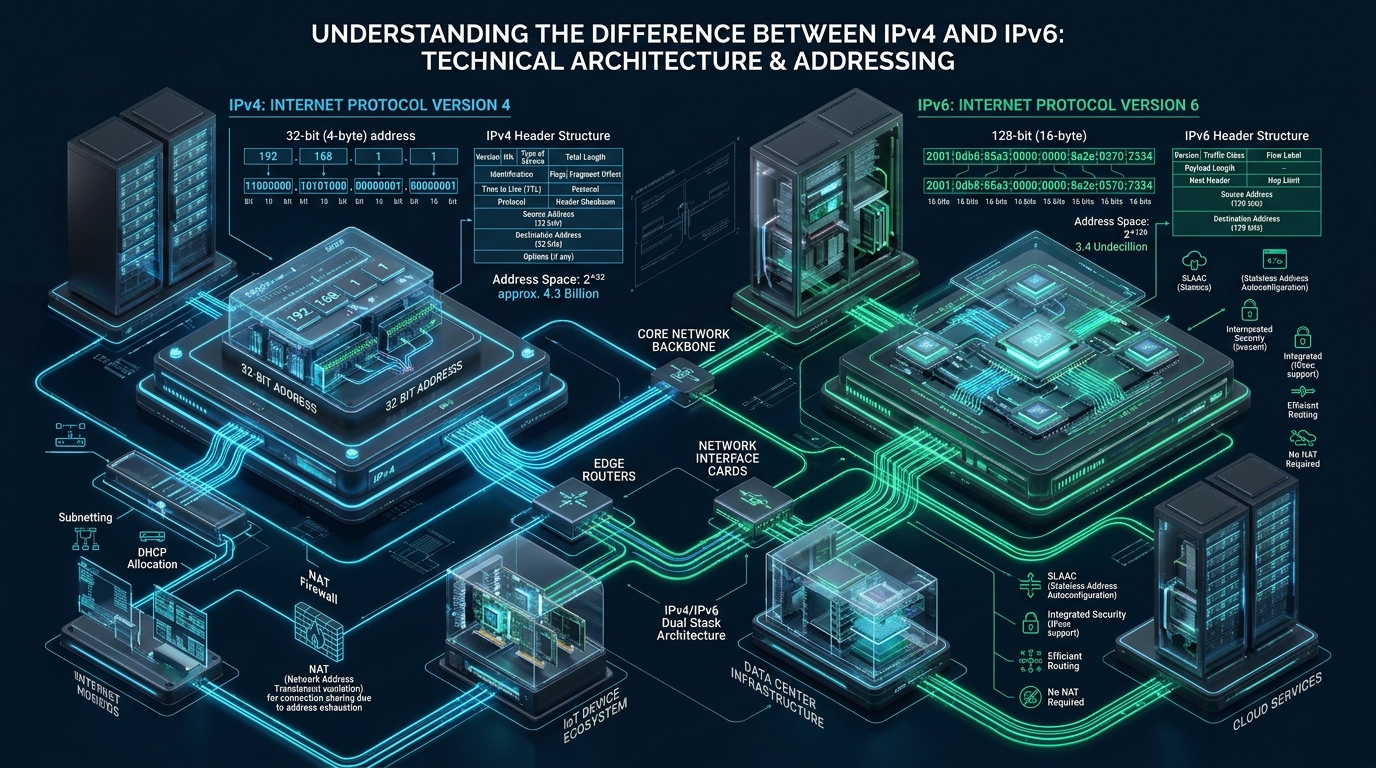
As enterprise infrastructure scales across distributed multi-cloud nodes and high-density container fabrics, the architectural limitations of legacy 32-bit addressing—ranging from stateful NAT conntrack bottlenecks to severe IPv4 routing table fragmentation—impose severe latency penalties on high-throughput workloads. Modern high-availability systems hosted on MeraHost increasingly demand native dual-stack and IPv6-first topologies to bypass stateful middleboxes, eliminate carrier-grade NAT translation overhead, and streamline packet processing across high-frequency NVMe infrastructure. Understanding the protocol-level differences between IPv4 and IPv6 is no longer an academic exercise; it is the cornerstone of designing resilient, deterministic, and future-proof production networks.
What Is the Difference Between IPv4 and IPv6?
Direct Answer: The fundamental difference between IPv4 and IPv6 lies in addressing scale, packet structure, and routing efficiency: IPv4 uses a 32-bit address space (4.29 billion addresses) requiring stateful Network Address Translation (NAT), whereas IPv6 utilizes a 128-bit address space (3.4×1038 addresses), streamlined fixed 40-byte headers, mandatory Path MTU Discovery, and stateless autoconfiguration (SLAAC) to eliminate middlebox translation bottlenecks.
To evaluate the evolution from IPv4 (standardized in RFC 791 in 1981) to IPv6 (formalized in RFC 8200 in 2017), systems engineers must look beyond the obvious expansion in address length. While IPv4 gave the early Internet approximately 4.294 billion addressable endpoints, rapid enterprise digitization, Internet-of-Things (IoT) deployments, mobile computing, and microservice containerization exhausted the IANA free pool by 2011. The interim workarounds—primarily Classless Inter-Domain Routing (CIDR) and Network Address Port Translation (NAPT)—extended IPv4’s lifespan at the cost of protocol elegance, end-to-end transparency, and deterministic network latency.
In contrast, IPv6 was re-engineered from the ground up to solve not merely address exhaustion, but the fundamental inefficiencies plaguing Layer 3 packet switching. By standardizing header lengths, offloading checksum computations to transport and link layers, replacing broadcast floods with targeted multicast groups, and mandating end-to-end Path MTU Discovery, IPv6 achieves significant hardware acceleration inside modern silicon switch fabrics and Linux kernel routing paths.
Architectural Comparison: IPv4 vs. IPv6
The architectural differences between the two protocols impact memory utilization, CPU interrupt frequency, and forwarding latency. Below is an enterprise comparative matrix detailing the engineering metrics governing both protocol suites:
| Feature / Metric | IPv4 (Standard / Default) | IPv6 (Tuned / Production) |
|---|---|---|
| Address Space & Bit Length | 32 bits (4,294,967,296 unique addresses; globally exhausted) | 128 bits (3.402 × 1038 addresses; virtually limitless) |
| Header Architecture | Variable length (20 to 60 bytes, includes options & padding) | Fixed 40 bytes (standardized 64-bit alignment for ASIC hardware parsing) |
| Header Checksum Overhead | Mandatory (recalculated at every hop due to TTL decrement) | Eliminated (integrity delegated to L2 Ethernet CRC and L4 TCP/UDP) |
| Address Resolution Protocol | ARP Broadcasts (all hosts on L2 broadcast domain interrupt CPU) | ICMPv6 NDP Multicast (solicited-node multicast filters unneeded NIC interrupts) |
| NAT / Conntrack State Tables | Mandatory NAT44 / CGNAT (nf_conntrack state churn & lock contention) | Native End-to-End Routing (zero stateful middlebox rewriting required) |
| Packet Fragmentation Handling | Supported at intermediate routers (causes CPU bufferbloat & drops) | End-host only via PMTUD (routers drop oversized packets directly with ICMPv6 Type 2) |
| Configuration & Provisioning | Manual static assignment or stateful DHCPv4 server | SLAAC (RFC 4862) with Router Advertisements or DHCPv6 |
| Global BGP Routing Table Churn | Severe fragmentation (>960,000 active prefixes in DFZ) | Hierarchical aggregation (~210,000 prefixes, smaller FIB memory footprint) |
Packet Header Analysis: Fixed 40 Bytes vs. Variable Overhead
The internal packet anatomy represents one of IPv6’s greatest engineering triumphs. In IPv4, every router along a packet’s transmission path must parse a variable-length header ranging between 20 and 60 bytes depending on IP options. Furthermore, because IPv4 includes a 16-bit Header Checksum field and an 8-bit Time to Live (TTL) counter that decrements by at least 1 at every forwarding hop, each intermediate router must recalculate the 1’s complement checksum before transmitting the packet. On multi-gigabit and 100Gbps interfaces, this introduces measurable CPU interrupt overhead and restricts fast-path line-rate ASIC pipeline execution.
IPv6 replaces this complex format with a streamlined, fixed 40-byte base header. The header contains exactly 8 fields:
- Version (4 bits): Set to binary
0110(6). - Traffic Class (8 bits): Replaces IPv4 Type of Service (ToS) / DiffServ, enabling explicit Quality of Service (QoS) classification and ECN signaling.
- Flow Label (20 bits): Allows edge nodes to label packet sequences belonging to specific microservices or TCP/UDP flows. Intermediate switches and load balancers can distribute packets across Equal-Cost Multi-Path (ECMP) links using the Flow Label directly, without deep-packet inspection into Layer 4 headers.
- Payload Length (16 bits): Indicates the length of data following the 40-byte base header, including any extension headers.
- Next Header (8 bits): Specifies the protocol type of the header immediately following (e.g., TCP, UDP, or an IPv6 Extension Header). This replaces IPv4’s
Protocolfield. - Hop Limit (8 bits): Replaces IPv4’s
TTL, decrementing by 1 at each forwarding hop. - Source Address (128 bits): 16-byte source endpoint.
- Destination Address (128 bits): 16-byte destination endpoint.
By removing the header checksum entirely (relying on Layer 2 Ethernet CRC-32 frames and Layer 4 TCP/UDP pseudo-header checksums for transmission integrity) and aligning the entire header to 64-bit boundaries, modern network processors process IPv6 packets with zero bit-shifting penalties.
Architecture Note on Extension Headers: Unlike IPv4 where optional fields are crammed into the primary header, IPv6 isolates non-standard instructions (such as Hop-by-Hop Options, Routing Headers, Fragment Headers, and Encapsulating Security Payload) into daisy-chained Extension Headers placed between the 40-byte base header and the Layer 4 transport payload. Routers along the path ignore extension headers unless explicitly designated by the
Next Headerpointer, keeping the switching fast-path uninhibited.
Address Resolution: Neighbor Discovery Protocol (NDP) vs. ARP
In IPv4 local area networks, mapping an IP address to a physical MAC address relies on the Address Resolution Protocol (ARP, RFC 826). ARP operates by broadcasting an Ethernet frame to the destination address FF:FF:FF:FF:FF:FF. Consequently, every single physical network interface card (NIC) within the broadcast domain must capture the frame, trigger a hardware interrupt, and force the operating system kernel to inspect the packet to determine if it owns the target IP address. In high-density enterprise virtualization nodes and container clusters containing thousands of virtual interfaces, broadcast storms and ARP table exhaustion degrade throughput and introduce latency jitter.
IPv6 completely eradicates broadcast addressing. In its place, the Neighbor Discovery Protocol (NDP, RFC 4861) runs atop ICMPv6 using targeted multicast groups. When an IPv6 host needs to resolve the link-layer address of a neighbor, it calculates the target’s Solicited-Node Multicast Address by prefixing ff02::1:ff00:0/104 to the lower 24 bits of the target’s IPv6 address.
At the hardware level, network adapters filter incoming multicast traffic via NIC hardware hash filters. Only the specific target machine whose lower 24 bits match the solicited-node multicast address accepts the frame and wakes the kernel. All other hosts on the physical segment discard the packet at the hardware PHY/MAC layer without interrupting the CPU. This architectural shift provides superior stability for enterprise cloud instances deployed on MeraHost Enterprise Cloud infrastructure.
The Performance Impact of Eliminating NAT and Conntrack Overhead
Due to IPv4 address scarcity, nearly all corporate, residential, and cloud environments deploy Network Address Translation (NAT44) and Carrier-Grade NAT (CGNAT / RFC 6598). Under NAT, private addresses within RFC 1918 allocations (10.0.0.0/8, 172.16.0.0/12, 192.168.0.0/16) share a limited pool of public IP addresses by dynamically remapping source ports.
From a systems engineering perspective, NAT incurs severe operational penalties:
- Linux Connection Tracking Contention: The Linux kernel’s
nf_conntracksubsystem must track every active TCP, UDP, and ICMP stream in a global hash table. Each outbound packet requires atomic lock acquisitions, hash lookups, IP header rewrites, and TCP/UDP checksum recalculations. Under high concurrency (>200,000 active sockets), conntrack table saturation drops packets and consumes excessive CPU cycles. - Broken End-to-End Transparency: NAT breaks protocols that embed IP addresses within their application payloads (e.g., SIP, WebRTC, FTP), necessitating complex Application Layer Gateways (ALGs) or external STUN/TURN traversal servers.
- CGNAT Port Depletion: Telco and ISP-level CGNAT limits clients to fixed port allocations (e.g., 500–1,000 ports per subscriber), resulting in socket exhaustion when modern web applications spawn dozens of parallel connections for microservices, WebSockets, and media streaming.
Benchmark Reality: In production CDN and hyperscale telemetry studies (including metrics from Meta, Google, and Akamai), pure IPv6 traffic consistently demonstrates a 10% to 15% reduction in latency compared to IPv4. This speedup is not because IPv6 packets travel faster through fiber optic cables, but because IPv6 packets bypass CGNAT translation hops, avoid state table lookups at transit gateways, and traverse modern router ASICs with fixed-header fast-path execution.
Production Configuration: Kernel Dual-Stack Network Hardening
To optimize a production Linux server for enterprise dual-stack operations (IPv4 and IPv6), default operating system parameters must be reconfigured. By default, Linux allocates modest neighbor discovery table limits and uses conservative socket buffers. Deploy the following tuned configuration to /etc/sysctl.d/99-enterprise-dualstack.conf:
# /etc/sysctl.d/99-enterprise-dualstack.conf
# Enterprise IPv4 and IPv6 Kernel Socket, Routing, and Security Optimization
# Compatible with Ubuntu 22.04/24.04 LTS, Debian 12, RHEL 9, and AlmaLinux 9

# --- IPv6 Base Protocol Enablement & Privacy Extensions ---
net.ipv6.conf.all.disable_ipv6 = 0
net.ipv6.conf.default.disable_ipv6 = 0
net.ipv6.conf.lo.disable_ipv6 = 0

# Enable RFC 4941 IPv6 Privacy Extensions (Outbound temporary addresses for host privacy)
net.ipv6.conf.all.use_tempaddr = 2
net.ipv6.conf.default.use_tempaddr = 2

# Accept Router Advertisements (RA) for autoconfiguration while acting as a server
net.ipv6.conf.all.accept_ra = 1
net.ipv6.conf.default.accept_ra = 1
net.ipv6.conf.all.autoconf = 1
net.ipv6.conf.default.autoconf = 1

# Disable IPv6 Routing (host mode; prevent server from acting as an unauthorized router)
net.ipv6.conf.all.forwarding = 0
net.ipv4.ip_forward = 0

# --- IPv6 Neighbor Discovery (NDP) & ARP Table Tuning ---
# Prevent neighbor table overflow during high-concurrency traffic surges
net.ipv6.neigh.default.gc_thresh1 = 2048
net.ipv6.neigh.default.gc_thresh2 = 4096
net.ipv6.neigh.default.gc_thresh3 = 8192
net.ipv4.neigh.default.gc_thresh1 = 2048
net.ipv4.neigh.default.gc_thresh2 = 4096
net.ipv4.neigh.default.gc_thresh3 = 8192

# --- Path MTU Discovery (PMTUD) & TCP Congestion Control ---
# Enable TCP BBR Congestion Control with Fair Queueing (FQ)
net.core.default_qdisc = fq
net.ipv4.tcp_congestion_control = bbr

# Enforce Path MTU Discovery across IPv4 and IPv6
net.ipv4.ip_no_pmtu_disc = 0
net.ipv4.tcp_mtu_probing = 1

# --- Enterprise TCP/IP Socket Buffer Tuning (Up to 16MB) ---
net.core.rmem_max = 16777216
net.core.wmem_max = 16777216
net.core.rmem_default = 1048576
net.core.wmem_default = 1048576
net.core.optmem_max = 2048576
net.core.somaxconn = 8192
net.core.netdev_max_backlog = 16384

net.ipv4.tcp_rmem = 4096 87380 16777216
net.ipv4.tcp_wmem = 4096 65536 16777216
net.ipv4.tcp_max_syn_backlog = 8192
net.ipv4.tcp_slow_start_after_idle = 0
net.ipv4.tcp_tw_reuse = 1
net.ipv4.tcp_fin_timeout = 15

# --- Defense-in-Depth against Spoofing & Route Manipulation ---
net.ipv4.conf.all.rp_filter = 1
net.ipv4.conf.default.rp_filter = 1
net.ipv4.conf.all.accept_source_route = 0
net.ipv4.conf.default.accept_source_route = 0
net.ipv6.conf.all.accept_source_route = 0
net.ipv6.conf.default.accept_source_route = 0
net.ipv4.conf.all.accept_redirects = 0
net.ipv4.conf.default.accept_redirects = 0
net.ipv6.conf.all.accept_redirects = 0
net.ipv6.conf.default.accept_redirects = 0
Activate the sysctl configuration immediately without rebooting:
sudo sysctl --systemProduction Firewall: Dual-Stack Stateful nftables Ruleset
A critical pitfall in enterprise IPv6 deployments is the accidental dropping of essential ICMPv6 packets. In IPv4, sysadmins frequently block all ICMP echo requests for “stealth” security. In IPv6, blocking all ICMPv6 breaks Neighbor Discovery, Duplicate Address Detection, and most dangerously, Packet Too Big (Type 2) messages required for Path MTU Discovery. When PMTUD breaks, small TCP handshakes succeed, but larger data packets exceeding the path MTU are silently discarded, creating a mysterious “black hole” connection freeze.
The following production /etc/nftables.conf establishes an enterprise dual-stack firewall using the modern inet family table, applying unified stateful inspection across both IPv4 and IPv6:
#!/usr/sbin/nft -f
# /etc/nftables.conf
# Unified High-Performance Dual-Stack Firewall Policy

flush ruleset

table inet filter {
    # Rate-limited ICMP logging to prevent log starvation
    chain icmp_v4_rules {
        icmp type { destination-unreachable, time-exceeded, parameter-problem } accept
        icmp type echo-request limit rate 10/second accept
        drop
    }

    chain icmp_v6_rules {
        # CRITICAL: Path MTU Discovery and Error Signaling
        icmpv6 type { destination-unreachable, packet-too-big, time-exceeded, parameter-problem } accept

        # CRITICAL: Neighbor Discovery Protocol (NDP) - Solicited and Advertised
        icmpv6 type { nd-router-solicit, nd-router-advert, nd-neighbor-solicit, nd-neighbor-advert } accept

        # Multicast Listener Discovery (MLD)
        icmpv6 type { mld-listener-query, mld-listener-report, mld-listener-done } accept

        # Echo request with strict rate-limiting
        icmpv6 type echo-request limit rate 10/second accept
        drop
    }

    chain input {
        type filter hook input priority filter; policy drop;

        # 1. Accept Established and Related Conntrack States
        ct state established,related accept

        # 2. Drop Invalid Conntrack Packets
        ct state invalid drop

        # 3. Allow Loopback Traffic
        iifname "lo" accept

        # 4. Route ICMP / ICMPv6 to dedicated security chains
        meta nfproto ipv4 icmp type { destination-unreachable, time-exceeded, parameter-problem, echo-request } jump icmp_v4_rules
        meta nfproto ipv6 meta l4proto ipv6-icmp jump icmp_v6_rules

        # 5. Allow SSH (Port 22) with Brute-Force Rate Limiting
        tcp dport 22 ct state new limit rate 15/minute accept

        # 6. Allow Web Traffic (HTTP 80 and HTTPS 443) on Both Stacks
        tcp dport { 80, 443 } ct state new accept
    }

    chain forward {
        type filter hook forward priority filter; policy drop;
    }

    chain output {
        type filter hook output priority filter; policy accept;
    }
}
Web Server Architecture: NGINX Dual-Stack Server Block
When hosting web services in a dual-stack architecture, web servers must bind explicitly to both IPv4 and IPv6 sockets while preserving original client IP addresses for analytics, rate limiting, and security compliance. In NGINX, the listen [::]:443 directive binds to IPv6; depending on operating system defaults, setting ipv6only=on ensures clean multi-socket binding without conflicting with IPv4 listeners.
Deploy the following production block in /etc/nginx/sites-available/production-dualstack.conf:
# /etc/nginx/sites-available/production-dualstack.conf
# High-Throughput Production Dual-Stack NGINX Virtual Host

server {
    listen 80;
    listen [::]:80 ipv6only=on;
    server_name example.com www.example.com;

    # Universal 301 Redirect to TLS
    return 301 https://$host$request_uri;
}

server {
    # Explicit IPv4 and IPv6 Listeners with HTTP/2 and SSL
    listen 443 ssl http2;
    listen [::]:443 ssl http2 ipv6only=on;
    server_name example.com www.example.com;

    # SSL TLS Configuration
    ssl_certificate /etc/letsencrypt/live/example.com/fullchain.pem;
    ssl_certificate_key /etc/letsencrypt/live/example.com/privkey.pem;
    ssl_protocols TLSv1.2 TLSv1.3;
    ssl_ciphers 'ECDHE-ECDSA-AES128-GCM-SHA256:ECDHE-RSA-AES128-GCM-SHA256:ECDHE-ECDSA-AES256-GCM-SHA384:ECDHE-RSA-AES256-GCM-SHA384';
    ssl_prefer_server_ciphers off;
    ssl_session_cache shared:SSL:20m;
    ssl_session_timeout 1d;
    ssl_session_tickets off;

    # Enterprise Security Headers
    add_header Strict-Transport-Security "max-age=63072000; includeSubDomains; preload" always;
    add_header X-Content-Type-Options "nosniff" always;
    add_header X-Frame-Options "SAMEORIGIN" always;
    add_header Referrer-Policy "strict-origin-when-cross-origin" always;

    root /var/www/production/public;
    index index.html index.php;

    location / {
        try_files $uri $uri/ /index.php?$args;
    }

    # Pass client IP (IPv4 or IPv6) accurately to application upstreams
    location ~ \.php$ {
        include fastcgi_params;
        fastcgi_pass unix:/run/php/php8.3-fpm.sock;
        fastcgi_param SCRIPT_FILENAME $document_root$fastcgi_script_name;
        fastcgi_param REMOTE_ADDR $remote_addr;
        fastcgi_param REMOTE_PORT $remote_port;
        fastcgi_param SERVER_ADDR $server_addr;
        fastcgi_param SERVER_PORT $server_port;
    }
}
Security Note on IPv6 Subnet Sizing: In IPv4, subnet allocations are strictly constrained (e.g.
/29or/28) due to scarcity. In IPv6, standard end-user and server assignments follow RFC 6177, providing a/64subnet per link. A single/64subnet provides 18,446,744,073,709,551,616 host addresses. This massive host space renders brute-force network scanning functionally impossible; scanning a single/64at 1 million probes per second would require over 584,000 years to map.
Frequently Asked Questions (FAQs)
Does IPv6 inherently reduce network latency compared to IPv4?
Yes, in real-world production environments, IPv6 frequently achieves a 10% to 15% reduction in Round-Trip Time (RTT). While transmission over optical fiber occurs at the same physical speed, IPv6 packets avoid the processing delays of Carrier-Grade NAT (CGNAT) gateways, eliminate router checksum recalculation at each hop, and utilize fixed 40-byte headers that modern switches process directly in ASIC hardware fast-paths.
Why is dropping ICMPv6 packets dangerous in an enterprise network?
In IPv4, ICMP is often treated as optional diagnostic traffic. In IPv6, ICMPv6 is fundamental to core protocol functionality. Dropping ICMPv6 breaks Neighbor Discovery Protocol (NDP), Stateless Address Autoconfiguration (SLAAC), and crucially, Path MTU Discovery (PMTUD). Because IPv6 routers never fragment packets on transit links, an oversized packet is discarded and an ICMPv6 Type 2 “Packet Too Big” message is returned to the sender. If this message is blocked by a firewall, the sending server never discovers the path MTU, resulting in silent connection stalls (“black holes”).
How does the “Happy Eyeballs” algorithm (RFC 8305) work in dual-stack environments?
When a client application (such as Chrome, Firefox, or cURL) queries a dual-stack domain returning both IPv4 (A) and IPv6 (AAAA) DNS records, it executes the Happy Eyeballs algorithm. The client initiates a TCP connection over IPv6 first; if no SYN-ACK response is received within a brief threshold (typically 250 milliseconds), it concurrently initiates a second connection attempt over IPv4. Whichever handshake completes first is selected for application traffic, preventing broken or misconfigured IPv6 paths from degrading end-user experience.
Can an enterprise migrate directly to IPv6-only infrastructure?
While internal data center fabrics and Kubernetes clusters can run pure IPv6-only, public-facing services still require dual-stack support or transition mechanisms. Thousands of legacy client networks and regional ISPs remain on IPv4. Enterprise architectures typically deploy dual-stack edge load balancers, or utilize NAT64/DNS64 stateful gateways to allow internal IPv6-only servers to communicate seamlessly with external legacy IPv4 endpoints.
Deploy Enterprise-Grade Production Infrastructure
Need guaranteed performance with zero price hikes? Host mission-critical workloads on MeraHost with pure Enterprise NVMe, LiteSpeed Web Server, and Same Renewal Price, Always (starting at ₹99/mo).