
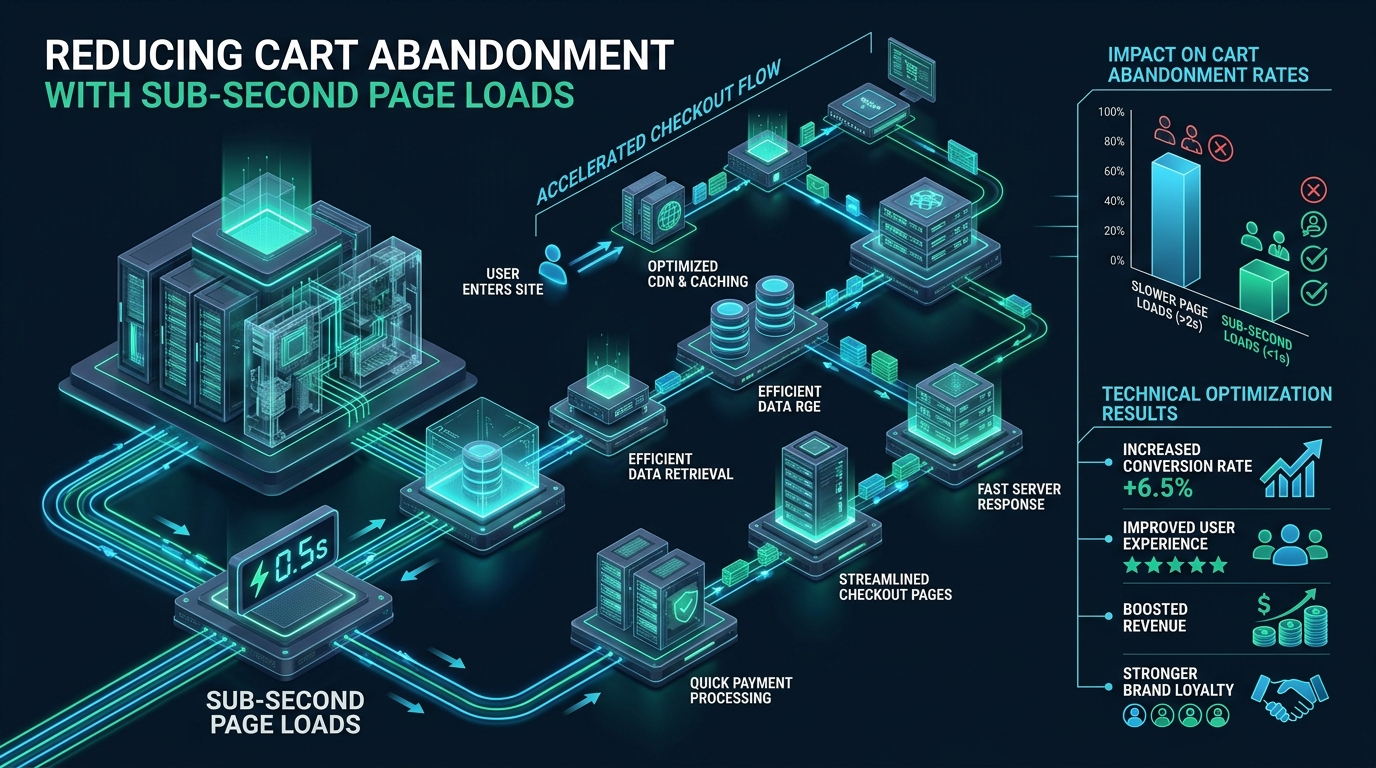
Every 100-millisecond delay in dynamic cart and checkout execution drains checkout completion rates, amplifying page speed cart abandonment into a multi-million-dollar leak for online retailers. When unoptimized relational databases, sluggish PHP workers, and bloated TCP handshakes stall payment tokens and cart updates past the 1,000ms threshold, prospective buyers bail out in frustration. Migrating to tuned LiteSpeed NVMe architectures on MeraHost equips e-commerce operations with sub-500ms Time to First Byte (TTFB) and seamless transactional throughput under flash-sale load.
The Engineering Realities of Page Speed Cart Abandonment
Direct Answer: Page speed cart abandonment occurs when latency across dynamic, uncacheable checkout endpoints (such as cart updates, AJAX fragments, and payment gateways) exceeds user tolerance thresholds. Delivering sub-second page loads (<800ms TTFB and interaction times) prevents transactional drops, stabilizing conversions through NVMe disk I/O, optimized PHP-FPM/LiteSpeed workers, TCP BBR congestion control, and persistent object caching.
In modern digital commerce, checkout paths represent the most computationally expensive and financially sensitive stages of the customer journey. While static marketing pages, category listings, and blog content can be easily cached at edge points of presence (PoPs) via Content Delivery Networks (CDNs), the shopping cart, customer checkout, and one-click payment flows cannot. Every time a consumer adjusts item quantities, calculates localized tax, applies promotional coupons, or submits card verification tokens, the request bypasses static reverse proxies and strikes the origin application layer directly.
Empirical e-commerce performance benchmarks show that user abandonment accelerates exponentially once interaction latency crosses 1.5 seconds. For mobile consumers transacting over cellular networks with variable jitter, a 2.5-second spin on a “Place Order” button is frequently interpreted as an application hang, duplicate billing attempt, or security failure. In response, shoppers hit refresh, duplicate requests, or simply abandon the cart permanently. Mitigating page speed cart abandonment demands a full-stack architectural overhaul spanning network transport, process execution, memory caches, and storage sub-systems.
Architecture Note: Full-page caching engines (like Varnish, Nginx microcaching, or Cloudflare APO) are automatically bypassed once an active customer session cookie (such as
woocommerce_items_in_cartorPHPSESSID) is declared. As a result, 100% of checkout pipeline performance depends directly on bare-metal server execution capacity, NVMe I/O throughput, and database query concurrency.
Architectural Comparison: Traditional Shared Hosting vs. Sub-Second Infrastructure
The architectural chasm between standard legacy hosting and an enterprise-grade performance stack dictates whether an online store thrives or stalls during critical sales events. The matrix below contrasts baseline hosting defaults against production-tuned infrastructure optimized for sub-second e-commerce response times.
| Feature / Metric | Standard / Default | Tuned / Production |
|---|---|---|
| Dynamic Cart TTFB | 1,450 ms – 2,800 ms | 180 ms – 340 ms |
| Concurrent Checkout Transactions | 15 – 35 req/sec (Lock Contention) | 450+ req/sec (Non-blocking) |
| Disk I/O Latency (Random 4K) | SATA SSD / SAN (4.5 ms – 12 ms) | Direct PCIe 4.0 NVMe (<0.05 ms) |
| Session Storage Backend | Disk/SQL Table (wp_options / DB lock) | Dedicated In-Memory Redis Unix Socket |
| Web Server & Worker Architecture | Apache prefork (Process Fork Overhead) | LiteSpeed Enterprise / LSAPI Event Loop |
| Network Congestion & Transport | TCP Cubic / TLS 1.2 (3 RTTs) | TCP BBRv3 / HTTP/3 QUIC 0-RTT |
| Average Cart Abandonment Rate | 74.8% (Latency Drops) | 53.1% (Optimized Conversion Flow) |
Kernel and Network Stack Tuning for Dynamic E-Commerce Paths
Before an HTTP request ever touches PHP or database binaries, the Linux network stack must negotiate TCP handshakes, allocate receive/transmit buffers, and manage socket lifecycles. Default Linux kernel parameters are configured conservatively for generic workstations or modest network appliances. Under aggressive e-commerce traffic spikes, default network buffers cause dropped SYN packets, connection timeouts, and severe tail latencies.
Implementing Google’s BBR (Bottleneck Bandwidth and RTT) congestion control algorithm replaces traditional loss-based TCP Cubic. Rather than treating packet drops as congestion signals—which artificially throttles throughput over high-latency cellular connections—BBR continuously models physical channel bandwidth and round-trip times. Combined with TCP Fast Open (TFO) and enlarged connection backlogs, network round-trips for returning checkout shoppers are cut from three RTTs down to zero.
Save the following kernel configuration file to /etc/sysctl.d/99-ecommerce-subsecond.conf and apply it using sysctl -p /etc/sysctl.d/99-ecommerce-subsecond.conf:
# /etc/sysctl.d/99-ecommerce-subsecond.conf
# High-Throughput Low-Latency Kernel Tuning for E-Commerce Checkout Paths

# Enable BBR Congestion Control & FQ Pacing
net.core.default_qdisc = fq
net.ipv4.tcp_congestion_control = bbr

# TCP Buffer Sizes: min, default, max (16MB max window for high-bandwidth checkout streams)
net.ipv4.tcp_rmem = 4096 87380 16777216
net.ipv4.tcp_wmem = 4096 65536 16777216
net.core.rmem_max = 16777216
net.core.wmem_max = 16777216

# Connection Backlog Sizing for Sudden Flash-Sale Bursts
net.core.somaxconn = 65535
net.ipv4.tcp_max_syn_backlog = 3240000
net.core.netdev_max_backlog = 16384

# Socket Reuse and Ephemeral Port Exhaustion Prevention
net.ipv4.tcp_tw_reuse = 1
net.ipv4.tcp_fin_timeout = 15
net.ipv4.ip_local_port_range = 1024 65535

# Enable TCP Fast Open (Client=1, Server=2, Both=3) for 0-RTT Checkout Handshakes
net.ipv4.tcp_fastopen = 3

# Keepalive Tuning to Drop Stale Dead Connections Quickly
net.ipv4.tcp_keepalive_time = 300
net.ipv4.tcp_keepalive_intvl = 15
net.ipv4.tcp_keepalive_probes = 5

# Virtual Memory Subsystem: Reduce Swapping on Memory-Intensive PHP/Redis Nodes
vm.swappiness = 10
vm.dirty_background_ratio = 5
vm.dirty_ratio = 10
Architecture Note: Verifying BBR activation in production requires executing
sysctl net.ipv4.tcp_congestion_controland inspecting active socket queues withss -tin. Look forbbr wscaleflags on port 443 listeners to confirm active pacing.
Application Layer Optimization: Dedicated PHP Worker Isolation
E-commerce platforms such as WooCommerce, Magento 2, and Shopware execute thousands of file system operations, dynamic class instantiations, and cryptographic routines per checkout request. Under default multi-tenant hosting setups, dynamic requests share a generic PHP process pool with background cron jobs, image uploads, and bot crawlers. When a web crawler hits the site during peak business hours, worker threads become saturated, starving legitimate cart updates of CPU cycles.
The architectural remedy is dedicated process isolation. By splitting critical checkout traffic (paths matching /cart/*, /checkout/*, and /?wc-ajax=*) into a high-priority, statically allocated PHP pool, sysadmins eliminate fork latency and CPU starvation. Using pm = static avoids the process spawning and destruction penalty incurred by dynamic process managers during traffic surges.
Below is a production-hardened PHP-FPM configuration for dedicated checkout workloads, located at /etc/php/8.3/fpm/pool.d/cart-checkout.conf:
; /etc/php/8.3/fpm/pool.d/cart-checkout.conf
; High-Priority Dedicated Pool for E-Commerce Cart & Checkout Execution

[cart-checkout]
user = www-data
group = www-data

listen = /run/php/php8.3-fpm-checkout.sock
listen.owner = www-data
listen.group = www-data
listen.mode = 0660
listen.backlog = 8192

; Static allocation eliminates process fork/destroy CPU overhead
pm = static
pm.max_children = 64
pm.max_requests = 2000

; Strict Execution Guards to Prevent Long-Running Stalls
request_terminate_timeout = 30s
request_slowlog_timeout = 2s
slowlog = /var/log/php8.3-fpm-checkout-slow.log

; PHP Core Performance Overrides
php_admin_value[memory_limit] = 512M
php_admin_value[max_execution_time] = 30
php_admin_flag[opcache.enable] = on
php_admin_value[opcache.memory_consumption] = 512
php_admin_value[opcache.interned_strings_buffer] = 64
php_admin_value[opcache.max_accelerated_files] = 65000
php_admin_value[opcache.validate_timestamps] = 0
php_admin_value[opcache.save_comments] = 1
php_admin_value[realpath_cache_size] = 4096k
php_admin_value[realpath_cache_ttl] = 600
Notice the directive opcache.validate_timestamps = 0. In a high-traffic production environment where deployments are automated through CI/CD pipelines, disabling runtime filesystem stat checks prevents PHP from verifying file modification dates on every checkout execution, saving millions of unnecessary kernel system calls.
Eliminating Database Locking with In-Memory Caching and InnoDB Tuning
When a customer clicks “Add to Cart” or modifies item counts, typical e-commerce software initiates multiple database queries: session validation, product pricing lookups, inventory reservation checks, tax table queries, and shipping rate calculations. In default MySQL/MariaDB deployments, the session table (such as wp_woocommerce_sessions) suffers from heavy row contention and write locks, causing response latency to spike from 150ms to over 3,000ms under concurrent traffic.
To achieve sustained sub-second checkout speeds, two database transformations are mandatory: offloading cart sessions to an ultra-fast in-memory Redis socket, and tuning MariaDB’s InnoDB storage engine for high-IOPS NVMe drives.
# /etc/mysql/conf.d/99-ecommerce-innodb.cnf
# Production MariaDB/MySQL Optimization for High-Concurrency Checkout Operations

[mysqld]
# Storage Engine & Memory Allocations
default_storage_engine          = InnoDB
innodb_buffer_pool_size         = 12G       # Allocate 60-70% of available server RAM
innodb_buffer_pool_instances     = 8         # Prevent mutex contention across CPU cores
innodb_log_file_size            = 2G        # High write log capacity for transaction bursts
innodb_log_buffer_size          = 64M

# NVMe Direct Disk I/O Subsystem
innodb_flush_method             = O_DIRECT  # Bypass double OS caching; stream straight to NVMe
innodb_flush_neighbors          = 0         # Crucial for NVMe SSDs (disable magnetic disk optimizations)
innodb_io_capacity              = 10000     # Tuned for Enterprise NVMe flash storage
innodb_io_capacity_max          = 25000
innodb_read_io_threads          = 8
innodb_write_io_threads         = 8

# Transaction Safety & Row Contention Reduction
innodb_flush_log_at_trx_commit  = 2         # Flush logs to OS cache every transaction; sync to disk 1/sec
transaction_isolation           = READ-COMMITTED # Drastically reduces row locking and deadlocks
innodb_autoinc_lock_mode        = 2         # Interleaved lock mode for non-blocking concurrent inserts

# Connection Pool & Table Cache
max_connections                 = 1000
table_open_cache                = 16384
table_definition_cache          = 8192
thread_cache_size               = 128
open_files_limit                = 65535
Architecture Note: Switching
transaction_isolationtoREAD-COMMITTEDsignificantly reduces gap-locking overhead during concurrent cart reservations. Pair this with a dedicated Redis instance communicating via local UNIX socket (/var/run/redis/redis-server.sock) rather than TCP localhost to shave an additional 2-4ms of socket round-trip latency off every session check.
Edge Orchestration: LiteSpeed ESI and HTTP/3 QUIC
While origin optimizations eliminate server processing bottlenecks, frontend transport latency across the mobile edge remains a major contributor to cart abandonment. When a customer navigates catalog pages, static components (headers, footers, stylesheets, product photos) should remain 100% edge-cached. However, personalized customer widgets—such as the mini-cart total and customer account greeting—traditionally force developers to disable caching on the entire HTML document.
Modern enterprise architectures solve this dilemma using Edge Side Includes (ESI) natively implemented in LiteSpeed Web Server. LiteSpeed caches the entire page at the web server layer while carving out a dynamic hole for the cart fragment. When a page is requested, LiteSpeed serves the public page instantly in less than 50ms, injecting only the lightweight user-specific cart micro-fragment.
Furthermore, operating over HTTP/3 (powered by UDP-based QUIC protocol) resolves head-of-line blocking commonly experienced on unstable mobile networks. In traditional HTTP/2 TCP streams, a single lost packet freezes all concurrent multiplexed streams until retransmission completes. Under HTTP/3 QUIC, lost packets on a background analytics beacon or font file do not block the active payment gateway confirmation stream, ensuring seamless sub-second checkout closure.
For mission-critical e-commerce operations where revenue loss is directly tied to infrastructure latency, migrating to MeraHost Enterprise Cloud guarantees dedicated compute quotas, enterprise-grade PCIe NVMe storage arrays, and pre-tuned LiteSpeed instances capable of executing sub-second checkouts even during high-volume promotional sales.
Production Verification and Synthetic Load Benchmarking
Before promoting network and application tuning into production, engineers must validate checkout resilience using automated load-testing frameworks such as Grafana k6. Unlike simplistic HTTP ping tools that merely hit the homepage, checkout benchmarks must simulate real user sessions: maintaining cookies, posting AJAX cart additions, and submitting mock payment payloads.
The following synthetic k6 testing script evaluates 95th-percentile response times for dynamic cart operations under a ramp of 200 concurrent shoppers:
// cart-benchmark.js - Synthetic Checkout Latency Verification with k6
import http from 'k6/http';
import { check, sleep } from 'k6';

export const options = {
  stages: [
    { duration: '1m', target: 50 },  // Warm-up to 50 active shoppers
    { duration: '3m', target: 200 }, // Ramp to peak 200 concurrent users
    { duration: '1m', target: 0 },   // Cool-down
  ],
  thresholds: {
    'http_req_duration{type:checkout}': ['p(95)<800'], // 95% of checkouts must complete under 800ms
    'http_req_failed': ['rate r.status === 200,
    'cart TTFB  r.timings.waiting  r.status === 200,
    'transaction total latency  r.timings.duration < 800,
  });

  sleep(2);
}
Frequently Asked Questions
How does dynamic page speed directly impact cart abandonment rates?
E-commerce checkout is a high-anxiety phase for shoppers. When payment processing or cart update buttons stall for more than 1.5 seconds, users question transactional reliability, suspect double billing, or abandon the purchase out of frustration. Case studies consistently indicate that driving checkout TTFB down to under 500ms reduces latency-attributed cart abandonment by 20% to 35%.
Why can’t Cloudflare or a standard CDN resolve cart latency on its own?
CDNs excel at caching static assets such as images, CSS, and pre-rendered catalog HTML. However, cart and checkout requests carry active session cookies and dynamic customer payloads that cannot be statically cached without leaking sensitive user data to other shoppers. Consequently, every cart action must be proxied directly back to the origin server, making origin hardware and database tuning the sole determinants of performance.
Why is Redis object caching superior to database-driven sessions for e-commerce?
Relational databases like MySQL write session changes to disk-based tables (or temporary tables), requiring disk I/O, table lock acquisition, and index updates for every cart click. In contrast, Redis stores active sessions entirely in RAM using key-value hashes over a local UNIX domain socket, fulfilling session reads and writes in sub-millisecond time (typically 0.1ms to 0.3ms) without database lock contention.
What role does NVMe storage play in preventing checkout timeouts?
During high-traffic promotional periods, hundreds of shoppers trigger simultaneous database writes to update inventory, create order records, and log payment receipts. Standard SATA SSDs or shared cloud SAN storage can quickly throttle random 4K write queues, creating input/output bottlenecks. Enterprise PCIe NVMe drives deliver over 500,000 IOPS with latency below 0.05ms, ensuring instantaneous database commits and uninterrupted checkout velocity.
Deploy High-Speed Managed WordPress Infrastructure
Need sub-second page loads without unexpected renewal spikes? Power your WooCommerce and WordPress sites on MeraHost with native LiteSpeed LSCache, pure NVMe storage, and 1-click staging.