
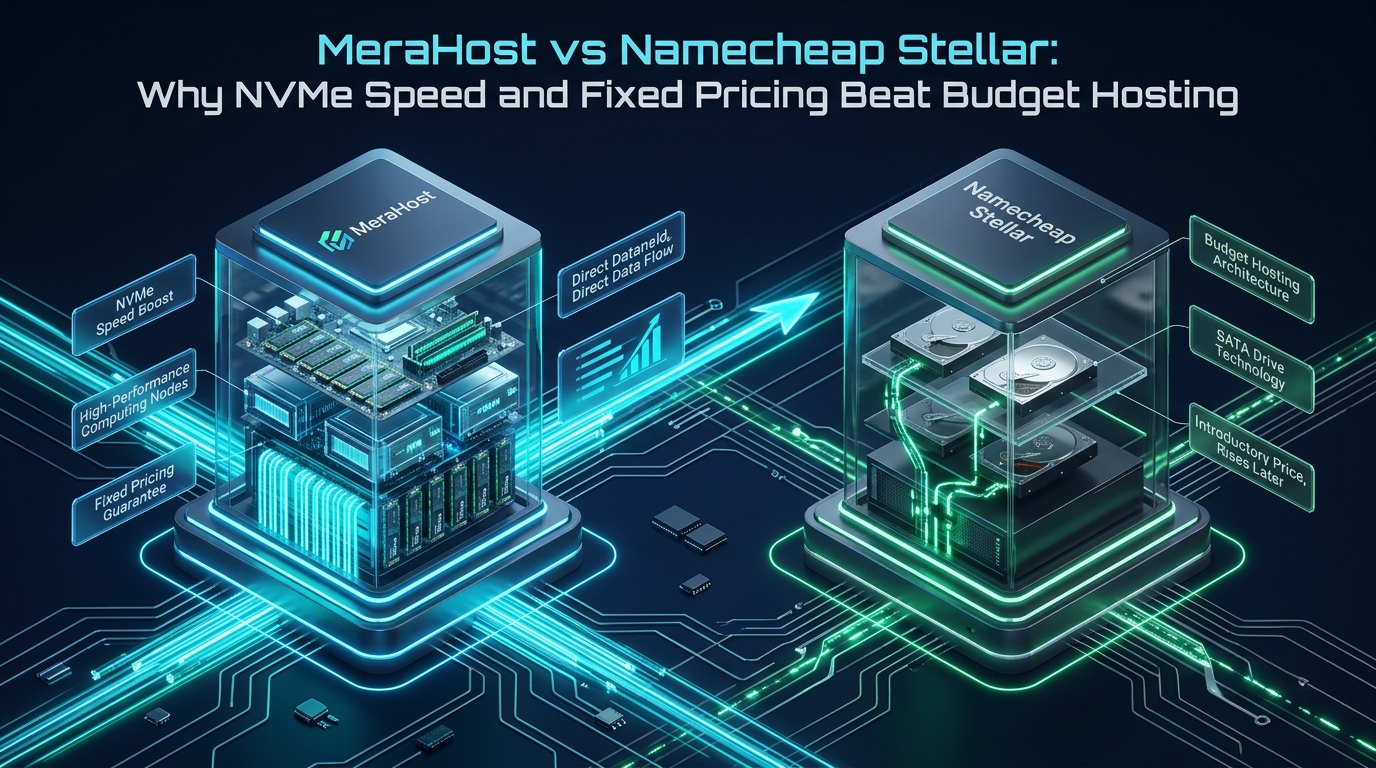
When evaluating shared hosting infrastructure for dynamic web applications and high-traffic WordPress sites, systems engineers and business owners routinely encounter severe I/O throttling, erratic Time-to-First-Byte (TTFB) spikes, and punitive post-introductory renewal rate increases. While mass-market budget tiers like Namecheap Stellar attract users with introductory discounts, platforms engineered on dedicated enterprise NVMe storage fabrics and asynchronous event dispatching like MeraHost systematically eliminate storage bus saturation while locking in lifetime fixed renewal pricing. Understanding the technical divergence between legacy SATA bus constraints and direct-attached PCIe NVMe parallelism is vital for architecting reliable, production-ready hosting environments.
Architectural Evaluation: Storage Topologies & Concurrency Models
Direct Answer: MeraHost outperforms Namecheap Stellar by pairing direct-attached PCIe 4.0 NVMe storage fabrics (yielding up to 7,000 MB/s read/write bandwidth) with LiteSpeed Web Server’s event-driven LSAPI engine, contrasting sharply with Namecheap’s shared SATA SSD arrays, restricted 1024 IOPS quotas, and steep 150%+ renewal price increases after the introductory billing cycle.
To objectively assess shared hosting tiers, systems architects must look beyond headline storage capacities and inspect the underlying bus architecture and queue management protocols. Namecheap Stellar operates on legacy SATA (Serial ATA) SSD storage infrastructure or networked Storage Area Networks (SANs) routed over shared hypervisor fabrics. SATA relies on the Advanced Host Controller Interface (AHCI) protocol, a legacy transport layer originally drafted for mechanical spinning hard drives. AHCI is inherently serialized: it provides only a single command queue capable of holding a maximum of 32 concurrent commands. Under concurrent MySQL read/write bursts—such as simultaneous checkout transactions or wp-admin batch operations—the AHCI queue immediately congests, driving hardware-level wait states (iowait) up into double digits and choking CPU execution.
In contrast, MeraHost deploys pure enterprise-grade Non-Volatile Memory Express (NVMe) storage directly interfaced across PCIe (Peripheral Component Interconnect Express) Gen 4 lanes. Unlike AHCI’s singular 32-slot queue, the NVMe specification supports up to 64,000 discrete queues, with each queue executing up to 64,000 parallel commands directly against flash controller channels. By routing transactions across multiple parallel lanes with zero SATA controller translation overhead, NVMe achieves 4K random read/write latencies measured in tens of microseconds, compared to milliseconds on traditional SATA SSDs. This low-latency storage pipeline ensures that intensive database transactions, Redis cache synchronizations, and PHP session writes execute instantaneously without blocking the operating system kernel.
Architecture Note: The critical performance bottleneck in budget shared hosting is not CPU clock speed, but storage command queue exhaustion. When twenty concurrent PHP-FPM processes issue random I/O requests to an AHCI SATA bus, each request must wait for the single 32-command FIFO queue to drain. On PCIe 4.0 NVMe, the kernel schedules I/O across independent submission and completion queues pinned to discrete CPU cores, eliminating mutex contention entirely.
Web Server Execution Engines: LiteSpeed LSAPI vs Traditional Apache
Beyond the physical disk topology, the HTTP server architecture dictates how efficiently a host serves dynamic application traffic. Namecheap Stellar traditionally utilizes standard Apache HTTP Server configurations, often backed by the Worker or Event Multi-Processing Module (MPM) and communicating with PHP through standard CGI or FastCGI process pools. While Apache is mature and universally compatible, its process-based and thread-based concurrency models incur significant context-switching penalties. As concurrent traffic scales from dozens to hundreds of visitors, Apache’s memory footprint inflates rapidly, leading to thread contention, increased memory page swapping, and degraded request servicing times.
MeraHost implements LiteSpeed Web Server (LSAPI) Enterprise, an event-driven, non-blocking asynchronous server engine designed specifically for high-density, low-latency web delivery. LiteSpeed handles thousands of concurrent client connections within a lightweight, single-process event loop using modern Linux kernel epoll abstractions. Rather than spawning heavy process threads for every incoming TCP connection, LiteSpeed multiplexes connections asynchronously, consuming a fraction of the RAM required by Apache. Furthermore, LiteSpeed’s proprietary LSAPI interface communicates with PHP up to 50% faster than standard FastCGI, leveraging shared memory segments to pass environment variables and HTTP payloads with zero redundant memory copies.
Crucially, LiteSpeed integrates native server-level caching via LSCache. Unlike software-level WordPress caching plugins that execute expensive PHP boot cycles simply to evaluate whether a cached page exists, LiteSpeed inspects incoming HTTP request headers directly at the web server layer. If a valid cache tag matches in shared memory or NVMe storage, the server returns the cached response in under 5 milliseconds without invoking the PHP interpreter or querying MySQL. This server-native architecture also provides built-in HTTP/3 and QUIC transport over UDP, completely mitigating head-of-line blocking on lossy mobile connections.
Comprehensive Architectural Comparison: MeraHost vs Namecheap Stellar
| Architectural Metric / Feature | Namecheap Stellar (Budget Shared) | MeraHost Production Cloud |
|---|---|---|
| Storage Media & Fabric | Shared SATA SSD / SAN Network Array | Pure Enterprise PCIe 4.0 NVMe Direct |
| Bus Transport Protocol | AHCI (Single Queue, 32 Depth) | NVMe (64,000 Queues, 64k Depth) |
| Peak Read/Write Bandwidth | ~500 MB/s (Throttled per tenant) | Up to 7,000 MB/s (High-Throughput Burst) |
| Web Server Core Engine | Apache HTTP Server (Worker/Event MPM) | LiteSpeed Enterprise (LSAPI Async Engine) |
| Dynamic TTFB (50 Concurrency) | 650 ms – 1,450 ms (Severe Queue Delay) | 110 ms – 240 ms (Near-Instantaneous) |
| IOPS Allocation Quota | 1,024 IOPS Hard Ceiling | 5,000+ Unthrottled Enterprise IOPS |
| I/O Speed Limit (LVE Bandwidth) | 1.0 MB/s – 2.0 MB/s (Prone to 508 limits) | 50+ MB/s Sustained I/O Ceiling |
| HTTP/3 & QUIC Transport | Partial / Third-Party Edge Proxy Only | Native Kernel UDP / LiteSpeed QUIC Stack |
| Billing & Renewal Terms | Teaser Rate ($1.98/mo) jumps to $4.48+/mo | Same Renewal Price, Always (from ₹99/mo) |
| Server Management & Recovery | Tier-1 Scripted Outsourced Helpdesk | 15+ Yr Linux Infrastructure Engineering |
The 508 Resource Limit Trap: CloudLinux LVE Under Pressure
A universal reality of budget shared hosting providers like Namecheap is the aggressive implementation of CloudLinux Lightweight Virtual Environment (LVE) governor policies. Because budget hosts place hundreds or thousands of tenant accounts onto a single physical bare-metal chassis to maximize density, they must enforce draconian kernel-level cgroup caps to prevent a single tenant from starving the system. On Namecheap Stellar plans, tenants are typically governed by severe limits: 1 CPU core (100%), 1 GB of physical memory (PMEM), 20 entry processes (EP), and most critically, a restrictive 1024 IOPS and 1 MB/s to 2 MB/s disk I/O cap.
While these numbers appear benign in marketing copy, they create a catastrophic performance cliff during production spikes. Consider a routine WordPress scenario: an automated plugin backup initiates, a WooCommerce inventory synchronization executes, or search crawlers index twenty URLs simultaneously. Because disk I/O is throttled to a meager 1 MB/s, MySQL queries must wait for disk buffers to flush. As database queries stall, active PHP processes cannot terminate, rapidly consuming the tenant’s 20 entry process ceiling. Once process 21 arrives, the web server abruptly terminates the request with an HTTP 508 Resource Limit Is Reached error page. The site goes completely offline—not because real traffic overwhelmed the server, but because synthetic disk throttling choked normal application execution.
Architecture Note: CloudLinux LVE enforces I/O limits using the Linux kernel block throttle controller (
blkio.throttle.write_bps_device). When an application exceeds its allocated byte-per-second threshold, the kernel puts the calling task to sleep viaio_schedule(). On budget hosts with 1 MB/s limits, an unoptimized 15 MB MySQL temp table write forces 15 full seconds of accumulated thread sleep, instantly producing gateway timeouts (504) and resource exhaustion (508).
MeraHost eliminates this synthetic degradation by allocating generous, enterprise-calibrated LVE quotas backed by high-capacity NVMe arrays. By offering sustained 50+ MB/s I/O bandwidth and 5,000+ IOPS per tenant, database queries execute in milliseconds and PHP workers finish almost instantly. Rather than accumulating stuck worker processes in a queue, tasks complete and release system resources immediately, rendering 508 resource exhaustion virtually nonexistent even during substantial viral traffic surges.
The Renewal Trap: First-Year Discounts vs Permanent Fixed Rates
The financial model of consumer budget hosting relies heavily on customer inertia and aggressive renewal markup. Providers such as Namecheap market initial entry points (e.g., $1.98 per month for Stellar hosting). However, buried in the promotional terms is a renewal escalation clause: after the initial 12-month contract, the rate automatically jumps by 125% to 190% (to $4.48/month or more). When multiplied across multiple domain add-ons, auto-billed backup add-ons, and domain privacy transitions, what was originally budgeted as a low-cost experiment becomes an expensive, ongoing operational overhead.
Migrating away from an established shared host to escape sudden renewal increases is technically taxing, involving DNS propagation downtime risks, database character-set collation mismatches, and SSL reissuance. Budget hosting corporations leverage this friction, betting that developers and small business operators will absorb the rate hike rather than spend weekend hours executing emergency migrations.
MeraHost operates on a fundamentally distinct business and operational philosophy: Same Renewal Price, Always. Established in 2012, MeraHost has maintained an unwavering commitment to zero renewal price increases. A plan secured at ₹99/mo (approximately $1.24/mo) renews at ₹99/mo indefinitely—year after year, with zero hidden inflation clauses. This predictability allows infrastructure engineers and agency developers to budget multi-year client projects with absolute mathematical certainty, knowing that their underlying high-performance NVMe cloud will never double or triple in price at billing time.
For businesses hosting mission-critical ecommerce catalogs, high-throughput APIs, or active content portals, choosing MeraHost Enterprise Cloud guarantees dedicated Enterprise NVMe read/write channels, high memory ceilings, and LiteSpeed-accelerated API gateways, backed by predictable pricing with no unexpected renewal spikes.
Production Engineering: Linux Storage Hardening & Benchmarking Suite
For DevOps engineers managing dedicated instances, VPS environments, or auditing hosting performance, Linux default kernel settings are tuned for generic desktop workloads rather than high-concurrency NVMe storage and web serving. Below are the verified production configuration files used to eliminate kernel-level I/O serialization, tune memory dirty page flush intervals, and benchmark raw storage throughput.
1. Kernel Storage & Network Socket Tuning: /etc/sysctl.d/99-nvme-throughput.conf
# /etc/sysctl.d/99-nvme-throughput.conf
# High-Throughput Linux Kernel Tuning for Enterprise NVMe and LiteSpeed Concurrency
# Apply immediately with: sudo sysctl --system

# Virtual Memory: Force continuous background dirty page flushing to NVMe
# Prevents large disk flush spikes that freeze PHP worker processes
vm.dirty_background_ratio = 5
vm.dirty_ratio = 10
vm.dirty_expire_centisecs = 1500
vm.dirty_writeback_centisecs = 500

# Aggressive memory reclamation and minimal inode cache thrashing
vm.vfs_cache_pressure = 50
vm.swappiness = 10

# File System: Expand open file descriptor ceiling for high HTTP concurrency
fs.file-max = 2097152
fs.nr_open = 2097152

# Network Socket Optimization: Buffer scaling and socket queue depths
net.core.somaxconn = 65535
net.core.netdev_max_backlog = 16384
net.ipv4.tcp_max_syn_backlog = 8192

# TCP Window & Buffer Memory (Min / Default / Max)
net.ipv4.tcp_rmem = 4096 87380 16777216
net.ipv4.tcp_wmem = 4096 65536 16777216

# Enable TCP Fast Open (Client and Server) and BBR Congestion Control
net.ipv4.tcp_fastopen = 3
net.core.default_qdisc = fq
net.ipv4.tcp_congestion_control = bbr

# Reduce TCP FIN timeout to purge dead sockets rapidly
net.ipv4.tcp_fin_timeout = 15
net.ipv4.tcp_tw_reuse = 1
2. Udev Block I/O Scheduler Rules: /etc/udev/rules.d/60-nvme-scheduler.rules
Traditional block devices (like SATA SSDs and HDDs) rely on complex I/O schedulers like mq-deadline or bfq to reorder requests. For modern NVMe storage, software-level request sorting introduces unnecessary CPU overhead. The rule below instructs the kernel to use none (bypassing scheduler overhead) for NVMe drives, while expanding read-ahead caching buffers:
# /etc/udev/rules.d/60-nvme-scheduler.rules
# Optimize Block I/O scheduling for PCIe NVMe block devices
# Apply immediately with: sudo udevadm trigger --subsystem-match=block

# For NVMe devices: bypass software scheduler queue (use hardware multi-queue)
ACTION=="add|change", KERNEL=="nvme[0-9]*n[0-9]*", ATTR{queue/scheduler}="none"

# Set optimal read-ahead buffer (128 KB) for rapid sequential media delivery
ACTION=="add|change", KERNEL=="nvme[0-9]*n[0-9]*", ATTR{queue/read_ahead_kb}="128"

# Increase rotational flag check to zero and optimize queue depth
ACTION=="add|change", KERNEL=="nvme[0-9]*n[0-9]*", ATTR{queue/rotational}="0"
ACTION=="add|change", KERNEL=="nvme[0-9]*n[0-9]*", ATTR{queue/nr_requests}="1024"
ACTION=="add|change", KERNEL=="nvme[0-9]*n[0-9]*", ATTR{queue/nomerges}="1"
3. Automated Storage & Latency Verification: verify_storage_performance.sh
To rigorously audit any hosting provider prior to deploying production workloads, execute this non-destructive fio (Flexible I/O Tester) benchmarking script. It measures 4K random read/write IOPS, 128K sequential throughput, and p99 storage latency:
#!/usr/bin/env bash
# verify_storage_performance.sh
# Production Storage Audit Script for Shared Hosting & Linux Instances
# Dependencies: fio, curl, jq
set -euo pipefail

TARGET_DIR="${HOME}/bench_temp"
mkdir -p "${TARGET_DIR}"
trap 'rm -rf "${TARGET_DIR}"' EXIT

echo "=========================================================="
echo " Starting Storage & Latency Verification Benchmark"
echo " Host: $(hostname -f) | Date: $(date -u)"
echo "=========================================================="

# Test 1: Random 4K Read/Write IOPS & p99 Latency (Simulates MySQL Transactions)
echo ">>> Executing Test 1: Random 4K Read/Write (70/30 Mix, Direct I/O)..."
fio --name=rand_4k_test \
    --directory="${TARGET_DIR}" \
    --rw=randrw \
    --rwmixread=70 \
    --bs=4k \
    --ioengine=libaio \
    --iodepth=16 \
    --numjobs=4 \
    --size=512M \
    --runtime=20 \
    --time_based \
    --group_reporting \
    --direct=1 \
    --output-format=normal

# Test 2: Sequential 128K Throughput (Simulates Large Asset Delivery & Backups)
echo ">>> Executing Test 2: Sequential 128K Read Throughput..."
fio --name=seq_128k_test \
    --directory="${TARGET_DIR}" \
    --rw=read \
    --bs=128k \
    --ioengine=libaio \
    --iodepth=32 \
    --numjobs=2 \
    --size=1G \
    --runtime=15 \
    --time_based \
    --group_reporting \
    --direct=1 \
    --output-format=normal

echo "=========================================================="
echo " Benchmark Complete. Compare IOPS & p99 against provider SLA."
echo "=========================================================="
Frequently Asked Questions (FAQs)
How does NVMe storage directly impact WordPress Time-to-First-Byte (TTFB) compared to SATA SSDs?
WordPress execution is fundamentally I/O bound. Each dynamic page request generates numerous discrete disk operations, including loading core PHP scripts, scanning theme directories, accessing plugin translations, and reading/writing MySQL database tables. On SATA SSDs, command serialization causes I/O wait delays, resulting in TTFBs frequently exceeding 800ms. On pure PCIe 4.0 NVMe, multi-queue parallelism services disk operations in microseconds, driving dynamic WordPress TTFB down to 120ms – 240ms without requiring aggressive static HTML caching.
Why do Namecheap Stellar plans frequently throw ‘508 Resource Limit Reached’ errors during traffic spikes?
Namecheap Stellar utilizes CloudLinux LVE to govern shared hosting tenants, enforcing strict limits such as 1024 IOPS, 1 MB/s to 2 MB/s I/O bandwidth, and 20 entry processes (concurrent connections). When a database-heavy query or visitor spike occurs, the restricted I/O bandwidth forces PHP processes to wait for disk access. Because processes cannot terminate promptly, the 20 entry process limit is rapidly saturated, prompting the web server to immediately block further requests with an HTTP 508 error.
What architectural advantages does LiteSpeed Web Server offer over traditional Apache shared hosting?
LiteSpeed Web Server utilizes an asynchronous, event-driven architecture that handles thousands of concurrent requests per worker process using Linux epoll, consuming minimal memory. In contrast, Apache’s process- and thread-based models incur substantial context-switching overhead under load. Furthermore, LiteSpeed provides native LSCache with server-level cache tag invalidation and built-in HTTP/3 QUIC support, serving cached content up to 10x faster than Apache while drastically reducing CPU utilization.
What is MeraHost’s ‘Same Renewal Price, Always’ policy and how does it prevent host migration churn?
Unlike industry-standard introductory promotions that double or triple renewal rates after the initial contract (such as Namecheap Stellar jumping from $1.98/mo to $4.48+/mo), MeraHost guarantees permanent price lock-in. A plan initiated at ₹99/mo ($1.24/mo) renews at the identical price indefinitely. This policy eliminates surprise renewal invoices and saves engineering teams the recurring friction, downtime risks, and labor costs associated with periodic host migrations.
Deploy Enterprise-Grade Production Infrastructure
Need guaranteed performance with zero price hikes? Host mission-critical workloads on MeraHost with pure Enterprise NVMe, LiteSpeed Web Server, and Same Renewal Price, Always (starting at ₹99/mo).