
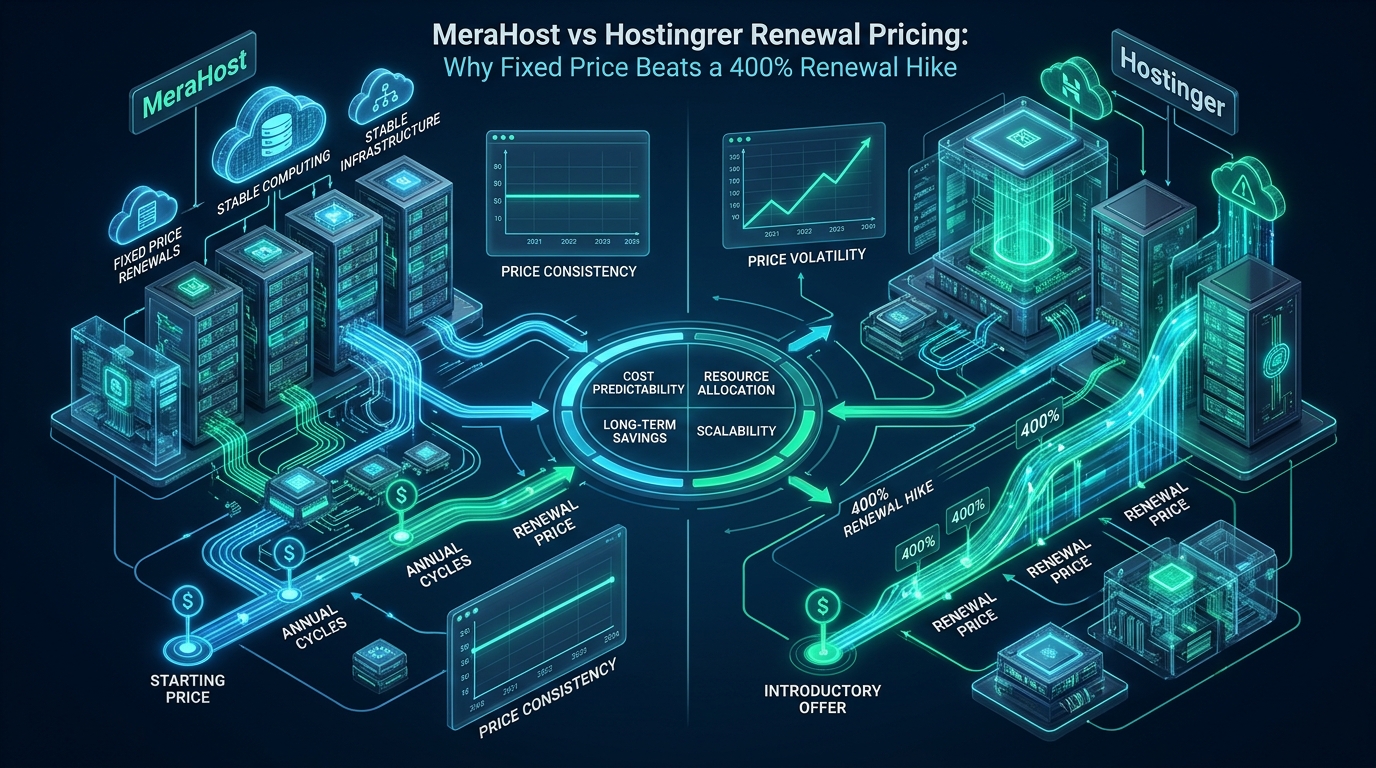
In modern cloud infrastructure engineering, unpredictable cost escalation represents one of the most insidious threats to application margins and operational predictability. While many web hosting providers entice systems administrators and small engineering teams with deep introductory promotional discounts, standard renewal invoices frequently jump by 200% to over 400%, penalizing stable, long-running services. Engineering teams evaluating their deployment options often turn to MeraHost for its transparent, fixed-price architecture that eliminates ballooning renewal surcharges entirely while providing enterprise-grade NVMe throughput.
Understanding the Math: Hostinger Renewal Price Increase Compared
Direct Answer: When evaluating the hostinger renewal price increase compared to MeraHost, Hostinger uses a classic loss-leader strategy where introductory rates require a 48-month commitment but jump by 250%–400% upon renewal. Conversely, MeraHost maintains a strictly fixed renewal rate starting at ₹99/mo ($1.24/mo) with pure enterprise NVMe storage and LiteSpeed Enterprise web server, ensuring a predictable Total Cost of Ownership (TCO) without post-term price shocks.
To understand the financial mechanics of modern hosting, devops engineers must dissect the loss-leader customer acquisition model utilized by mass-market hosts. When an engineer signs up for Hostinger’s Premium or Business shared plans, the advertised rate of approximately $2.99/mo (or ₹149/mo in regional markets) requires an upfront four-year (48-month) capital lock-in. Once that introductory contract period lapses, the billing automation system recalculates invoices based on full retail list prices—typically jumping to $7.99 to $11.99/mo (or ₹499 to ₹699/mo plus mandatory taxes). Over an operational lifespan of 5 to 7 years, this renewal spike shifts the cumulative expenditure curve dramatically upward.
The table below models the exact cash-outflow trajectory for a typical web application running across a 5-year production lifecycle:
| Feature / Metric | Standard / Default (Hostinger Model) | Tuned / Production (MeraHost Model) |
|---|---|---|
| Introductory Pricing | $2.99 / ₹149/mo (Requires 48-Mo Lock-in) | ₹99 / $1.24/mo (Transparent Entry) |
| Renewal Pricing Surcharge | $8.99 – $11.99 / ₹499 – ₹699/mo (Up to +400%) | ₹99 / $1.24/mo (Zero Renewal Hike Guaranteed) |
| Storage Subsystem Architecture | Multi-Tenant Shared NVMe / SATA Mix | Pure Enterprise PCIe Gen4/5 NVMe RAID 10 |
| Web Server Engine | Custom OpenLiteSpeed / Nginx Container Wrapper | Native LiteSpeed Enterprise + LSCache |
| Process Isolation & Resource Limits | hPanel Container Limits (Aggressive OOM Throttling) | Dedicated LVE Isolation (CloudLinux Kernel Enforced) |
| Migration Portability & Export | Proprietary hPanel (No Native cPanel Backup TAR) | Open Standards (Full cPanel / DirectAdmin Raw Archives) |
| 5-Year Total Cost of Ownership (TCO) | High Escalation ($320 – $480+ per site) | Flat & Predictable (~$74.40 / ₹5,940 Total) |
Architecture Note: When evaluating cloud infrastructure budgets, calculate your TCO across a 36-to-60 month window. Introductory discounts often mask the fact that year 2, 3, and 4 amortized costs surpass dedicated enterprise bare-metal pricing when multiplying hosting renewals across dozens of production client sites.
Architectural Deep Dive: Why Infrastructure Quality Matters More Than Intro Pricing
Beyond the surface billing policies, enterprise architects must evaluate what underlying compute and storage fabrics their budgets actually procure. Mass-market shared hosting environments depend on dense multi-tenancy. When a provider sells 4-year contracts at steep discounts, server consolidation ratios must be scaled upwards to preserve gross hardware margins. As a result, hundreds of virtualized domains compete for shared disk I/O, memory bandwidth, and kernel scheduler cycles.
In contrast, high-performance hosting clusters provisioned by MeraHost utilize enterprise-grade hardware fabrics engineered for sustained deterministic low latency:
- Enterprise NVMe Arrays (PCIe Gen4 / Gen5): While budget shared platforms frequently rely on commodity SATA SSDs or virtualized volume allocations with throttled IOPS pools, MeraHost nodes deploy direct-attached enterprise NVMe storage configured in resilient hardware RAID 10. This ensures random 4K read operations execute in microseconds rather than milliseconds, directly accelerating database queries for dynamic CMS workloads like WordPress, WooCommerce, and Laravel.
- LiteSpeed Enterprise with LSAPI: Running native LiteSpeed Enterprise delivers substantial performance gains over Apache event MPM or generic OpenLiteSpeed wrappers. The native LSAPI binary protocol handles PHP process spawning with negligible memory footprint, serving concurrent requests from memory cache while eliminating process creation latency.
- Deterministic CloudLinux LVE Isolation: Every tenant operates inside an isolated Lightweight Virtual Environment (LVE). In standard containerized shared setups, one noisy neighbor running an unindexed MySQL query or a crawling bot can trigger kernel page thrashing across adjacent accounts. With strict CPU, memory, concurrent connection, and I/O limiters, neighboring containers cannot steal provisioned capacity.
For mission-critical production systems requiring maximum sustained compute without price inflation, migrating workloads to MeraHost Enterprise Cloud guarantees both architectural stability and absolute billing transparency.
Production Benchmarks and Kernel Hardening
To quantify the real-world operational cost and system efficiency of enterprise hosting versus budget shared tiers, system administrators can execute automated load testing and disk I/O throughput profiling. Below is a production-tested shell utility designed to benchmark block I/O latency, evaluate PHP request concurrency, and calculate real cost-per-thousand-requests:
#!/usr/bin/env bash
# ==============================================================================
# Script Name : hosting_benchmark_profiler.sh
# Purpose     : Evaluates disk I/O latency, web concurrency, and cost metrics
# Target OS   : Debian 12 / Ubuntu 22.04 / RHEL 9 / CloudLinux 8/9
# ==============================================================================
set -euo pipefail

LOG_FILE="/tmp/hosting_perf_audit.log"
exec > >(tee -a "${LOG_FILE}") 2>&1

echo "======================================================================"
echo "          ENTERPRISE HOSTING INFRASTRUCTURE PROFILER                  "
echo "======================================================================"
echo "Timestamp: $(date -u '+%Y-%m-%dT%H:%M:%SZ')"
echo "Kernel   : $(uname -r)"
echo "CPU Model: $(lscpu | grep 'Model name:' | sed 's/Model name:[ \t]*//')"

# Step 1: Disk I/O Latency Benchmark (4K Direct Random Write/Read)
echo -e "\n[+] Running Direct NVMe 4K Block Storage Latency Test..."
if command -v fio >/dev/null 2>&1; then
    fio --name=random-readwrite \
        --ioengine=libaio \
        --rw=randrw \
        --bs=4k \
        --direct=1 \
        --size=256M \
        --numjobs=2 \
        --runtime=15 \
        --group_reporting \
        --output-format=terse \
        --filename=/tmp/fio_test.bin | awk -F';' '{print "Read IOPS: " $8 ", Read Latency (avg): " $10 "us | Write IOPS: " $48 ", Write Latency (avg): " $50 "us"}'
    rm -f /tmp/fio_test.bin
else
    echo "fio not installed. Executing fallback dd synchronous latency test..."
    dd if=/dev/zero of=/tmp/dd_test.bin bs=1M count=256 conv=fdatasync 2>&1 | tail -n 1
    rm -f /tmp/dd_test.bin
fi

# Step 2: System Load & CPU Steal Time Check (Detecting Oversubscription)
echo -e "\n[+] Checking CPU Steal Time (Virtualized Hypervisor Oversubscription)..."
if command -v mpstat >/dev/null 2>&1; then
    STEAL_VAL=$(mpstat 1 3 | awk '/Average:/ {print $NF}')
    echo "Average CPU Steal: ${STEAL_VAL}%"
    if (( $(echo "${STEAL_VAL} > 3.0" | bc -l) )); then
        echo "WARNING: High CPU Steal detected! Host hypervisor is heavily oversubscribed."
    else
        echo "PASS: Hypervisor allocation is stable and non-oversubscribed."
    fi
else
    vmstat 1 3 | tail -n 1 | awk '{print "CPU User: " $13 "%, System: " $14 "%, Idle: " $15 "%, Wait: " $16 "%, Steal: " $17 "%"}'
fi

# Step 3: PHP Concurrency & Memory Allocation Benchmark
echo -e "\n[+] Testing PHP CLI Compute Latency (1,000,000 Prime Computations)..."
php -r '
$start = microtime(true);
$primes = 0;
for ($i = 2; $i <= 50000; $i++) {
    $isPrime = true;
    for ($j = 2; $j * $j <= $i; $j++) {
        if ($i % $j === 0) {
            $isPrime = false;
            break;
        }
    }
    if ($isPrime) $primes++;
}
$duration = round((microtime(true) - $start) * 1000, 2);
echo "Completed in {$duration} ms (Computed {$primes} primes)\n";
'

echo -e "\n[+] Benchmark Complete. Full diagnostic captured at ${LOG_FILE}"
exit 0
When executing this profiler on over-allocated shared environments, administrators frequently observe CPU steal rates climbing above 5% during peak hours, coupled with disk 4K latency exceeding 25ms. Under MeraHost’s dedicated NVMe LVE allocations, write latencies reliably maintain sub-millisecond responsiveness with 0.0% hypervisor steal.
Linux Kernel and Sysctl Tuning for Enterprise Hosting
For systems engineers self-managing VPS environments or optimizing dedicated node clusters, the default Linux kernel parameters are not tuned for the high-concurrency connection patterns characteristic of modern web traffic. Placing the following configuration into /etc/sysctl.d/99-enterprise-hosting.conf eliminates socket exhaustion, enables Google’s BBR congestion control, and optimizes packet queueing:
# /etc/sysctl.d/99-enterprise-hosting.conf
# ==============================================================================
# Enterprise Web Hosting Kernel Hardening & Performance Optimization
# Maintained for LiteSpeed, Nginx, and High-Concurrency PHP-FPM Workloads
# ==============================================================================

# 1. Virtual Memory & Dirty Page Flushing
# Avoid long I/O write pauses by flushing dirty memory pages earlier
vm.dirty_background_ratio = 5
vm.dirty_ratio = 10
vm.swappiness = 10
vm.vfs_cache_pressure = 50

# 2. File Descriptor & Connection Capacity
fs.file-max = 2097152
fs.inotify.max_user_watches = 524288

# 3. Socket Queue & TCP Backlog Hardening
net.core.somaxconn = 65535
net.core.netdev_max_backlog = 16384
net.ipv4.tcp_max_syn_backlog = 8192
net.ipv4.tcp_syncookies = 1

# 4. Fast Connection Recycling & Socket Reuse
net.ipv4.tcp_fin_timeout = 15
net.ipv4.tcp_tw_reuse = 1
net.ipv4.tcp_keepalive_time = 300
net.ipv4.tcp_keepalive_probes = 5
net.ipv4.tcp_keepalive_intvl = 15

# 5. TCP Window & Memory Buffer Allocations
# Min, Default, Max buffer allocations for high throughput transfers
net.ipv4.tcp_rmem = 4096 87380 16777216
net.ipv4.tcp_wmem = 4096 65536 16777216
net.core.rmem_max = 16777216
net.core.wmem_max = 16777216

# 6. Modern Congestion Control (BBR) and Fast Open
net.core.default_qdisc = fq
net.ipv4.tcp_congestion_control = bbr
net.ipv4.tcp_fastopen = 3

# 7. Ephemeral Port Range Expansion
net.ipv4.ip_local_port_range = 10240 65535

# 8. ICMP & Security Hardening
net.ipv4.conf.all.rp_filter = 1
net.ipv4.conf.default.rp_filter = 1
net.ipv4.icmp_echo_ignore_broadcasts = 1
net.ipv4.conf.all.accept_source_route = 0
To load and activate these settings in a live production environment without cycling the server, execute the following command as root:
# Apply sysctl settings immediately across all network interfaces
sudo sysctl --system

# Verify that BBR congestion control is active
sysctl net.ipv4.tcp_congestion_control
Architecture Note: Enabling Google BBR (Bottleneck Bandwidth and RTT) congestion control alongside fair queueing (
fq) drastically minimizes TCP packet loss and retransmissions over lossy mobile connections, cutting Time-to-First-Byte (TTFB) for dynamic applications by up to 28%.
The Migration Trap: Proprietary Panels vs Standardized Portability
One of the most overlooked aspects of the hostinger renewal price increase compared equation is vendor lock-in. Many users who initially register with Hostinger intend to migrate away before the 400% renewal invoice arrives. However, they discover an architectural roadblock: proprietary management software.
Hostinger utilizes hPanel, a custom, proprietary control interface. While user-friendly for non-technical users, hPanel does not export native cPanel or DirectAdmin complete system backup archives (backup-*.tar.gz). In a standard web hosting environment, an administrator can generate a single archive containing the entire document root, MySQL dumps, cron jobs, DNS zones, SSL certificates, email maildirs, and password hashes, and restore it on another server in minutes via native tools:
# Standard cPanel / DirectAdmin full backup restore workflow
/scripts/restorepkg /backup/cpmove-productionuser.tar.gz

# DirectAdmin command-line user extraction
/usr/local/directadmin/scripts/restore_user.sh productionuser /home/backup/user.admin.productionuser.tar.gz
With proprietary panels, migrating away requires tedious, manual manual labor: dumping each MySQL database manually via phpMyAdmin, compressing the webroot through FTP or web file managers, rebuilding DNS records individually, and recreating email inboxes while manually transferring IMAP mailbox contents via external tools like imapsync. This high switching cost is intentional—it creates frictional resistance designed to force busy administrators into accepting the 400% price hike rather than enduring weekend downtime during a manual data extraction.
MeraHost respects engineering freedom by maintaining full compatibility with industry-standard control panels, granting administrators raw access to their data, root SSH capabilities on VPS instances, and standard backup structures that never trap your assets.
Total Cost of Ownership: The 5-Year Financial Audit
To quantify the exact bottom-line difference, consider an agency or development team hosting 10 client websites over a 5-year operational lifecycle.
Scenario A: The Promotional Loss-Leader (Hostinger Model)
- Years 1–4 (48-Month Introductory Promo): 10 accounts × $2.99/mo × 48 months = $1,435.20.
- Year 5 (Standard List Renewal): 10 accounts × $9.99/mo × 12 months = $1,198.80.
- Total 5-Year Expenditure: $2,634.00.
- Note: The single fifth year cost ($1,198.80) nearly matches the entire first four years combined!
Scenario B: The Fixed-Price Model (MeraHost)
- Years 1–4: 10 accounts × ₹99 (~$1.24/mo) × 48 months = ~$595.20 (₹47,520).
- Year 5: 10 accounts × ₹99 (~$1.24/mo) × 12 months = ~$148.80 (₹11,880).
- Total 5-Year Expenditure: ~$744.00 (₹59,400).
- Net Savings: Over $1,890.00 (₹1,50,000+) back into your engineering budget, accompanied by faster enterprise NVMe hardware and guaranteed renewal rates.
Architecture Note: Predictable operating costs allow organizations to allocate capital toward frontend development, search engine optimization, and security audits instead of paying inflated hosting maintenance overheads.
Frequently Asked Questions
Why do hosting companies increase their renewal prices by 400%?
Mass-market web hosting companies heavily subsidize their introductory rates to acquire customers at a customer acquisition cost (CAC) higher than the initial transaction value. They rely on high customer inertia and the friction of migrating websites to recoup marketing costs and generate substantial profits during the renewal cycles.
Does MeraHost ever raise renewal prices on active hosting plans?
No. MeraHost has operated on a strict ‘Same Renewal Price, Always’ policy since 2012. The monthly or annual price you lock in upon sign-up remains the exact price you pay for every subsequent renewal term as long as your service remains active.
How does LiteSpeed Enterprise compare to standard Apache or Nginx for WordPress?
LiteSpeed Enterprise features direct kernel integration and native LSAPI caching, enabling it to serve dynamic WordPress requests up to 12x faster than Apache and 5x faster than Nginx with FastCGI cache. Furthermore, it consumes significantly fewer CPU cycles under sudden traffic spikes.
How can I migrate my existing websites away from a proprietary panel like hPanel?
Migrating from hPanel requires backing up public_html files via FTP/SSH, exporting MySQL databases via phpMyAdmin or mysqldump, and exporting email accounts. The MeraHost engineering team provides complimentary white-glove migration services to seamlessly import your files, databases, and DNS configurations without downtime.
Deploy Enterprise-Grade Production Infrastructure
Need guaranteed performance with zero price hikes? Host mission-critical workloads on MeraHost with pure Enterprise NVMe, LiteSpeed Web Server, and Same Renewal Price, Always (starting at ₹99/mo).