
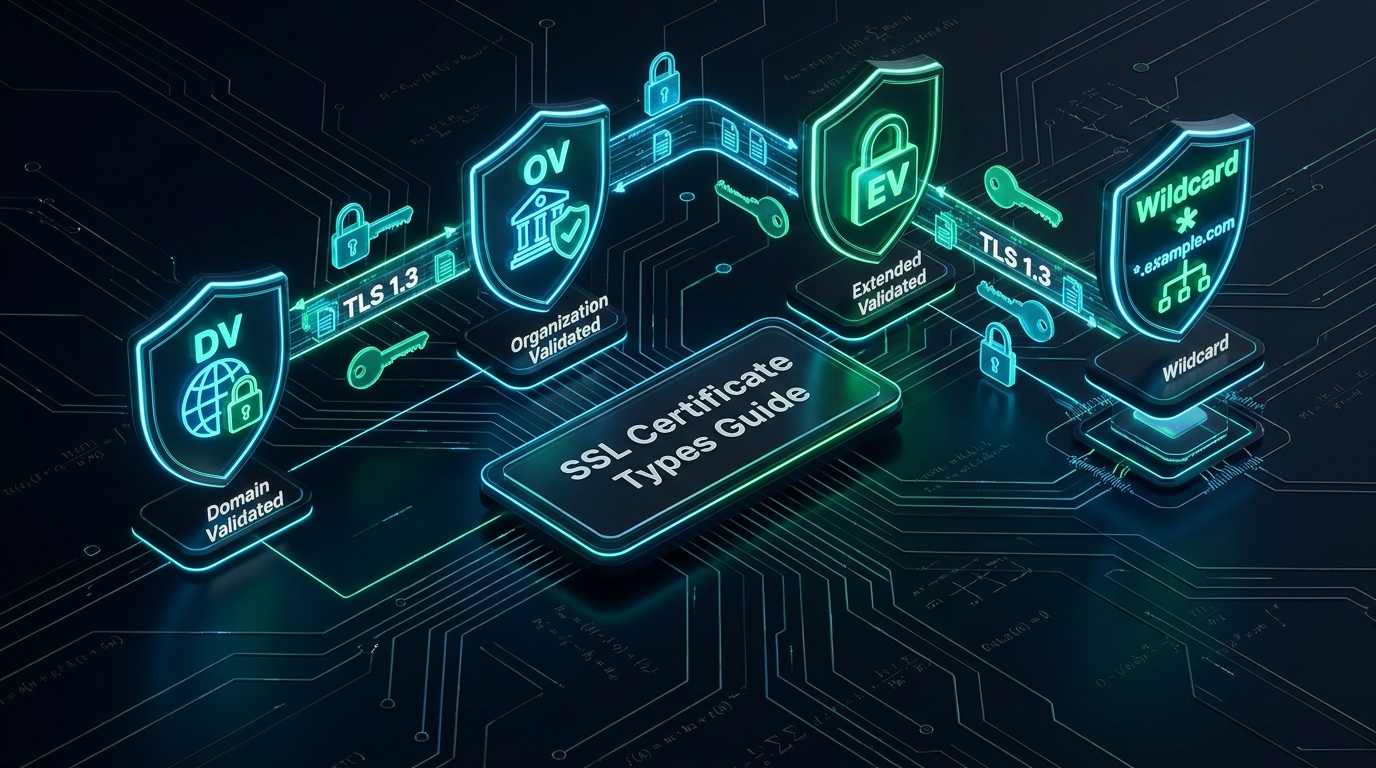
Quick Answer: The 4 Types of SSL/TLS Certificates
SSL/TLS certificates differ by validation level and domain coverage: 1) Domain Validation (DV) verifies domain control and issues instantly (ideal for blogs, portfolios, and SMBs; provided 100% free at MeraHost via Let’s Encrypt), 2) Organization Validation (OV) verifies legal business registration, 3) Extended Validation (EV) requires rigorous corporate audits, and 4) Wildcard SSL protects a root domain and unlimited subdomains (*.yourdomain.com). Crucially, all four types provide identical 256-bit cryptographic encryption; the difference lies solely in identity vetting and financial warranties.
Every secure digital transaction, login form, and e-commerce checkout on the web depends on Transport Layer Security (TLS)—the modern cryptographic successor to Secure Sockets Layer (SSL). While the security padlock icon in web browsers has become ubiquitous, choosing the correct certificate type for your enterprise infrastructure requires understanding validation tiers, cryptographic cipher suites, and operational renewal overhead.
Historical commercial brands like Comodo (rebranded as Sectigo), DigiCert, and GeoTrust once dominated the landscape with expensive annual licensing models. Today, automated open-standard certificate authorities like Let’s Encrypt have transformed standard Domain Validation into an automated utility. In this comprehensive 2026 guide, we compare DV, OV, EV, Multi-Domain SAN, and Wildcard SSL certificates, explain their technical mechanisms, and help you select the exact security configuration your enterprise needs.
The 4 Primary SSL/TLS Certificate Types Compared
1. Cryptographic Truth: All Certificates Provide 256-Bit Encryption
A prevalent industry myth manufactured by traditional certificate vendors is that paid commercial SSL certificates provide “stronger encryption” than free Let’s Encrypt certificates. This is mathematically false.
Regardless of whether you pay ₹0 for Let’s Encrypt AutoSSL or ₹30,000 for an EV certificate from a legacy commercial CA, the actual cryptographic session established between your visitor’s browser and the web server is negotiated using identical protocols: TLS 1.3 with AES-256-GCM or ChaCha20-Poly1305 ciphers and 2048/4096-bit RSA or 256-bit ECDSA elliptic curve keys.
What you pay for with OV and EV certificates is not encryption; you are paying for manual administrative human vetting of your corporate paperwork and an insurance warranty policy.
Automated 256-Bit SSL on Every MeraHost Plan for Life
Stop wasting annual budget on basic SSL certificates. MeraHost includes automated Let’s Encrypt SSL, HTTP/3 QUIC support, and pure NVMe RAID-10 performance from just ₹99/month.
2. The Evolution of EV SSL: Why Green Address Bars Disappeared
Historically, Extended Validation (EV) certificates were popular because modern browsers rendered the full company legal name in a bright green address bar next to the URL. However, in 2019, Google Chrome, Mozilla Firefox, and Apple Safari removed the visual green address bar after extensive UX security research proved that consumers rarely noticed it and that it provided no measurable defense against modern phishing attacks.
Today, all SSL certificates (DV, OV, and EV) display an identical, clean padlock or tune icon in browser URL bars. Paying thousands of dollars extra for an EV certificate no longer provides visible differentiation to website visitors.
Frequently Asked Questions
Is a free DV SSL certificate legal for payment gateways like Razorpay or Stripe?
Yes, 100%. Major payment gateways and card networks (Visa, Mastercard, PCI-DSS Level 1) mandate standard 256-bit TLS encryption, which Let’s Encrypt and AutoSSL provide natively. Thousands of large e-commerce platforms process millions of dollars daily using free Let’s Encrypt certificates.
How does a Wildcard SSL certificate work?
A Wildcard certificate uses an asterisk notation (*.yourdomain.com) to secure your primary domain and an unlimited number of first-level subdomains (such as blog.yourdomain.com, shop.yourdomain.com, and api.yourdomain.com) under a single cryptographic certificate.
Can I install my own custom commercial SSL certificate on MeraHost?
Yes. While free AutoSSL is active by default, you can easily paste custom commercial certificates, private keys, and CA bundles into your DirectAdmin or cPanel control panel at any time.
What is the difference between SSL and TLS?
SSL (Secure Sockets Layer) was the original encryption protocol developed in the 1990s. TLS (Transport Layer Security) is its modernized, secure successor. While the tech industry colloquially still says “SSL certificate,” all modern certificates operate exclusively on TLS 1.2 and TLS 1.3 protocols.