
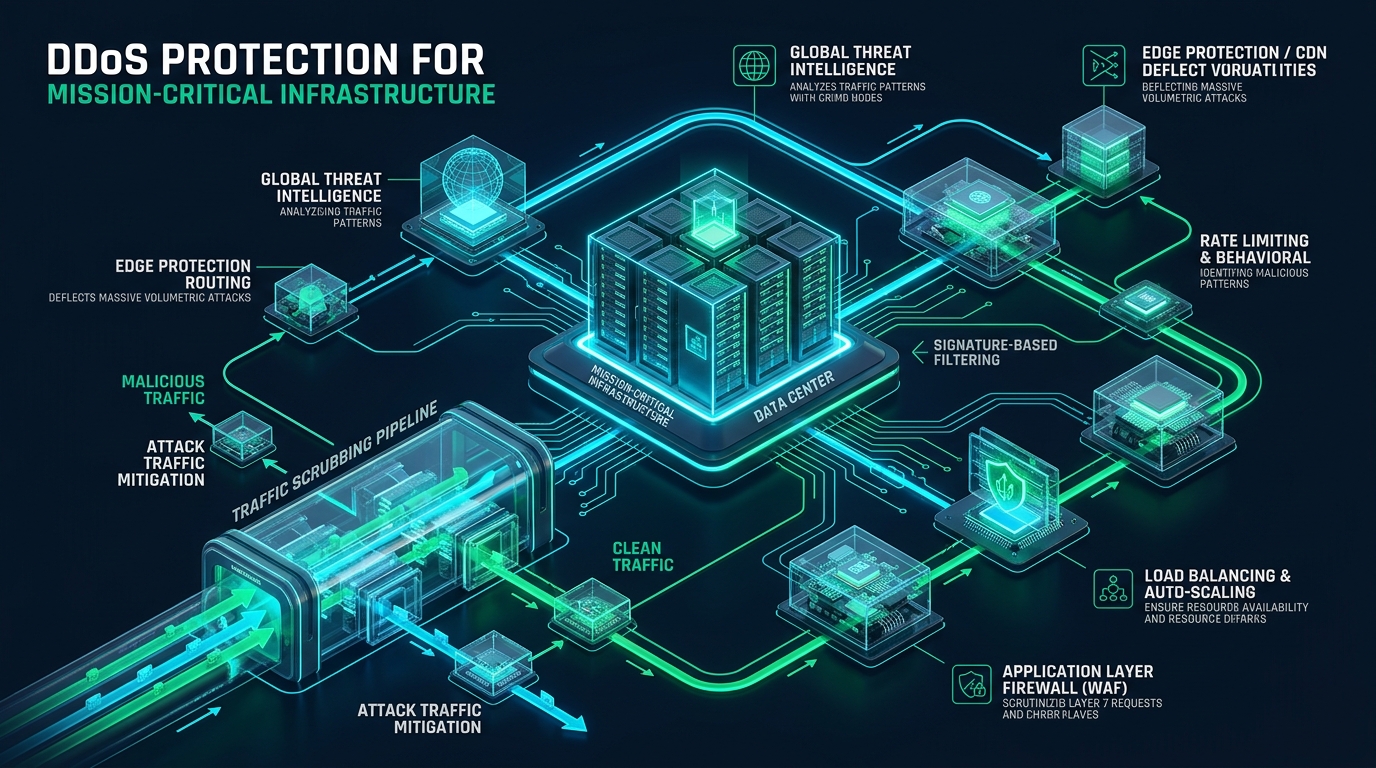
Modern distributed denial-of-service (DDoS) campaigns routinely generate hundreds of millions of packets per second, saturating upstream transit links and overwhelming standard Linux connection tracking tables before software applications can even process incoming socket buffers. For mission-critical infrastructure deployed on high-performance bare-metal environments at MeraHost, relying on conventional stateful firewalls guarantees catastrophic softirq starvation and service degradation during volumetric floods. Implementing resilient, enterprise-grade DDoS protection techniques requires decoupling line-rate packet scrubbing at the network interface driver from stateful application processing through eBPF/XDP kernel bypass, BGP Anycast routing fabrics, and aggressive kernel backlog optimization.
What Are the Most Effective DDoS Protection Techniques for Mission-Critical Infrastructure?
Direct Answer: Modern enterprise DDoS protection techniques deploy a defense-in-depth model: BGP Anycast and Flowspec disperse volumetric floods across global scrubbing centers; eBPF/XDP drops spoofed SYN/UDP packets directly at the NIC driver before kernel memory allocation; and tuned Linux sysctl queues with LiteSpeed/Nginx reverse proxy rate limiters neutralize Layer 7 application assaults.
DDoS attacks have fundamentally evolved from primitive single-vector bandwidth floods into complex, multi-vector assaults that combine volumetric saturation (UDP reflection, DNS amplification, ICMP storms) with state-exhaustion protocols (SYN floods, ACK floods) and sophisticated Layer 7 application abuse (HTTP/2 Rapid Reset, Slowloris, complex API query exhaustion). Operating mission-critical services—such as financial transaction gateways, real-time SaaS platforms, and enterprise hosting environments—demands mitigation strategies engineered for wire-speed packet processing without increasing baseline user latency.
When an attack hits a standard Linux production host, the kernel’s default packet processing architecture creates severe bottlenecks. Each incoming packet triggers an interrupt, prompting the kernel to allocate a sk_buff (socket buffer) data structure in memory. It then passes the packet through the netfilter framework, evaluates connection tracking (conntrack) tables, and traverses routing lookup trees. Under a flood of 10 to 50 million packets per second (Mpps), CPU cores become completely saturated with software interrupts (ksoftirqd), dropping legitimate user packets at the ring buffer before user-space daemons can respond. Overcoming this limitation requires understanding and applying proven line-rate mitigation patterns.
The Three Battlegrounds: Volumetric, Protocol, and Layer 7 Attacks
Designing an unassailable defensive topology requires isolating mitigation controls according to OSI network layers. Each attack vector targets distinct architectural choke points, requiring dedicated engineering controls.
1. Layer 3/4 Volumetric & Protocol Floods
Volumetric attacks aim to exhaust physical uplink bandwidth through reflection and amplification protocols such as NTP (monlist amplification), DNS, SNMP, and Memcached. Attackers forge victim IP headers, bouncing small UDP queries off vulnerable third-party servers that reply with payloads amplified up to 50,000 times the original packet size.
Simultaneously, protocol-level assaults—predominantly TCP SYN floods—exploit the three-way handshake mechanism. By transmitting a deluge of initial SYN packets from randomized, spoofed IP addresses and deliberately ignoring the server’s SYN-ACK responses, attackers exhaust the server’s half-open connection backlog (tcp_max_syn_backlog). Once the backlog fills, the kernel refuses all new legitimate inbound connections.
2. Connection Tracking (Conntrack) Table Exhaustion
The single most common root cause of self-inflicted downtime during a DDoS attack is the Linux nf_conntrack subsystem. When using stateful firewall utilities such as iptables or standard ufw configurations, the kernel logs state metadata for every packet traversing the network stack in a hash table. Under a high-frequency packet flood, this table saturates instantaneously, triggering the fatal kernel alert:
[ 1420.591204] nf_conntrack: table full, dropping packet
[ 1420.591209] net_ratelimit: 45892 callbacks suppressed
When conntrack table saturation occurs, even if your uplink has hundreds of gigabits of headroom, the operating system drops every incoming packet indiscriminately. Production security engineers must bypass connection tracking entirely for untrusted public traffic or leverage stateless kernel frameworks.
3. Layer 7 Application & Protocol Abuse
Unlike volumetric attacks that flood the network interface, Layer 7 attacks establish legitimate TCP and TLS handshakes, masquerading as regular user interactions while strategically exhausting compute, database connections, or memory resources. Prominent examples include:
- HTTP/2 Rapid Reset (CVE-2023-44487): Exploits the HTTP/2 stream multiplexing protocol by issuing continuous
HEADERSframes followed immediately byRST_STREAMresets, triggering massive server-side processing overhead with minimal attacker bandwidth. - Slowloris & Slow POST: Holds thousands of HTTP connections open by trickling headers or request bodies at 1 byte every few seconds, starving the web server’s worker threads or process pool.
- Expensive Query Floods: Targeting database-heavy endpoints (such as faceted e-commerce search, PDF generation, or user authentication) to drive backend database connection pools into lock contention and CPU thrashing.
Architecture Note: When engineering DDoS defenses for high-volume clusters, always configure stateless packet filtering at the Linux raw PREROUTING table or XDP hook. Engaging the connection tracking (conntrack) table on unauthenticated SYN floods will rapidly exhaust memory tables, crashing the networking subsystem before software firewalls can evaluate rules.
Comparative Strategy Matrix: Default vs. Tuned DDoS Mitigation Architecture
Implementing modern line-rate mitigation radically alters system survivability under heavy bombardment. The benchmark table below compares a standard un-tuned Linux environment against an enterprise-hardened production node running eBPF/XDP and kernel pipeline optimizations:
| Feature / Metric | Standard / Default | Tuned / Production |
|---|---|---|
| Packet Filtering Throughput | 1.2 – 2.0 Mpps per CPU Core (sk_buff bottleneck) | 22 – 25 Mpps per Core (XDP_DROP at NIC Driver) |
| CPU Utilization Under SYN Flood | 100% Core Saturation (softirq & ksoftirqd spikes) | < 8% Core Usage (Zero Memory Allocation Overhead) |
| SYN Cookie Generation Rate | Software Kernel Hash (~450k cookies/sec) | Hardware/XDP Accelerated (> 14M cookies/sec) |
| Mitigation Latency Impact | +45ms to +250ms (Queueing Delay & Retries) | < 0.2ms Inline Filter Execution Overhead |
| L7 Rate Limiting Precision | Static IP-based Blocking (High False Positives) | Dynamic Token Bucket + Client Fingerprint Heuristics |
| Transit Link Protection | Unicast Null-Routing (Total Outage for Victim IP) | BGP Anycast Edge Scrubbing + RFC 5575 Flowspec |
Production-Ready Mitigation Configurations
To safeguard mission-critical systems, system administrators and DevOps engineers must deploy configurations across three layers: kernel socket queue hardening, stateless packet filtering via nftables, and high-performance eBPF/XDP driver filters.
1. Kernel TCP/IP Network Stack Hardening (/etc/sysctl.d/99-ddos-protection.conf)
This configuration maximizes network backlog queues, accelerates SYN cookie verification, enforces Strict Reverse Path Filtering (RPF) to block spoofed IP addresses, and constrains connection timeouts to rapidly free orphaned sockets:
# /etc/sysctl.d/99-ddos-protection.conf
# Enterprise Linux Kernel Network Hardening for High-Throughput Production Nodes

# Enable SYN Cookies to absorb TCP SYN floods without backlog exhaustion
net.ipv4.tcp_syncookies = 1

# Enlarge SYN backlog queue for half-open incoming connections
net.ipv4.tcp_max_syn_backlog = 65536

# Number of times SYNACKs for a passive TCP connection attempt will be retransmitted
net.ipv4.tcp_synack_retries = 2
net.ipv4.tcp_syn_retries = 2

# Increase max pending socket connections in the listen queue
net.core.somaxconn = 65535

# Increase the maximum number of packets queued on the input side when the interface receives packets faster than kernel can process
net.core.netdev_max_backlog = 250000

# Enable Strict Reverse Path Filtering (RFC 3704) to prevent IP spoofing
net.ipv4.conf.all.rp_filter = 1
net.ipv4.conf.default.rp_filter = 1

# Ignore ICMP broadcast requests and bogus ICMP error responses (Smurf attack defense)
net.ipv4.icmp_echo_ignore_broadcasts = 1
net.ipv4.icmp_ignore_bogus_error_responses = 1

# Protect against TIME_WAIT socket exhaustion under high connection churn
net.ipv4.tcp_tw_reuse = 1
net.ipv4.tcp_fin_timeout = 15

# Expand conntrack max capacity and shorten timeouts if netfilter is loaded
net.netfilter.nf_conntrack_max = 2097152
net.netfilter.nf_conntrack_tcp_timeout_syn_recv = 10
net.netfilter.nf_conntrack_tcp_timeout_fin_wait = 15
net.netfilter.nf_conntrack_tcp_timeout_time_wait = 15

# Optimize TCP socket memory buffers (min, default, max in bytes)
net.ipv4.tcp_rmem = 4096 87380 16777216
net.ipv4.tcp_wmem = 4096 65536 16777216
net.core.rmem_max = 16777216
net.core.wmem_max = 16777216
Apply the parameters immediately without rebooting by executing:
sudo sysctl --system2. Stateless Raw Packet Dropping with Nftables (/etc/nftables.conf)
To prevent conntrack table saturation, common DDoS vectors (such as invalid TCP flag combinations, fragment attacks, and unauthorized UDP floods) must be dropped in the raw prerouting chain before state tracking occurs:
#!/usr/sbin/nft -f
# /etc/nftables.conf - Stateless Wire-Speed Filtering

flush ruleset

table inet filter {
    # Raw prerouting table executes before connection tracking (priority raw = -300)
    chain raw_prerouting {
        type filter hook prerouting priority raw; policy accept;

        # Drop invalid TCP flag combinations (Xmas, NULL, SYN-FIN scans)
        tcp flags & (fin|syn) == fin|syn drop
        tcp flags & (syn|rst) == syn|rst drop
        tcp flags & (fin|rst) == fin|rst drop
        tcp flags & (fin|syn|rst|psh|ack|urg) == 0 drop
        tcp flags & (fin|syn|rst|psh|ack|urg) == fin|syn|rst|psh|ack|urg drop

        # Drop fragmented IP packets used in teardrop attacks
        ip frag-off & 0x1fff != 0 drop

        # Drop NTP and SSDP reflection amplification responses
        udp sport { 123, 1900 } drop

        # Stateless rate-limiting for ICMP echo requests
        ip protocol icmp icmp type echo-request limit rate over 10/second drop
    }

    chain input {
        type filter hook input priority filter; policy drop;

        # Accept established and related traffic
        ct state established,related accept

        # Accept loopback
        iif "lo" accept

        # Accept SSH with connection burst limit
        tcp dport 22 ct state new limit rate 15/minute accept

        # Accept HTTP and HTTPS
        tcp dport { 80, 443 } ct state new accept
    }
}
3. Driver-Level eBPF/XDP Line-Rate Packet Filter
eBPF/XDP (eXpress Data Path) executes directly within the network card’s driver layer before the Linux kernel allocates a single byte of memory for socket buffers. The following C program inspects incoming packets and drops malformed or blacklisted traffic instantly:
// xdp_filter.c - High-Speed eBPF Driver Filter
#include <linux/bpf.h>
#include <linux/if_ether.h>
#include <linux/ip.h>
#include <linux/tcp.h>
#include <linux/in.h>
#include <bpf/bpf_helpers.h>

SEC("xdp")
int xdp_ddos_inspector(struct xdp_md *ctx) {
    void *data = (void *)(long)ctx->data;
    void *data_end = (void *)(long)ctx->data_end;

    struct ethhdr *eth = data;
    if ((void *)(eth + 1) > data_end)
        return XDP_PASS;

    if (eth->h_proto != __constant_htons(ETH_P_IP))
        return XDP_PASS;

    struct iphdr *ip = data + sizeof(*eth);
    if ((void *)(ip + 1) > data_end)
        return XDP_PASS;

    // Filter UDP reflection payloads (e.g., NTP 123, DNS 53, Memcached 11211)
    if (ip->protocol == IPPROTO_UDP) {
        struct udphdr *udp = (void *)ip + (ip->ihl * 4);
        if ((void *)(udp + 1) > data_end)
            return XDP_PASS;

        if (udp->source == __constant_htons(11211) || udp->source == __constant_htons(123)) {
            return XDP_DROP; // Drop packet at NIC level in < 50 nanoseconds
        }
    }

    return XDP_PASS;
}

char _license[] SEC("license") = "GPL";
Attach the compiled XDP program directly to your high-speed network interface (e.g., eth0) using modern iproute2 tools:
# Compile to BPF bytecode
clang -O2 -target bpf -c xdp_filter.c -o xdp_filter.o

# Attach to native network driver hook
sudo ip link set dev eth0 xdpgeneric obj xdp_filter.o sec xdp
Operational Best Practice: Combine edge BGP Flowspec with BFD (Bidirectional Forwarding Detection) timers tuned under 300ms. In the event of an upstream link saturation exceeding 100 Gbps, edge routers can automatically offload traffic scrubbers or withdraw specific Anycast prefixes without human NOC intervention.
Frequently Asked Questions About Enterprise DDoS Mitigation
What is the primary difference between eBPF/XDP and iptables for DDoS mitigation?
iptables operates inside the Linux networking stack after the kernel allocates a socket buffer (sk_buff) and invokes the netfilter framework, which incurs substantial CPU memory allocation overhead. Under a multi-million packet per second flood, this exhausts memory and CPU softirqs. eBPF/XDP (eXpress Data Path) executes directly within the network interface card (NIC) driver layer before the sk_buff is allocated, inspecting and dropping malicious packets (via XDP_DROP) at raw wire speed with virtually zero CPU overhead.
How do SYN cookies defend against TCP SYN flood attacks?
When a server receives an initial TCP SYN packet, it typically allocates an entry in its SYN backlog queue and responds with a SYN-ACK. An attacker exploiting this sends millions of spoofed SYNs without completing the handshake, overflowing the backlog queue and blocking legitimate users. With tcp_syncookies = 1 enabled, the kernel skips allocating backlog queue state entirely. Instead, it encodes the connection parameters into the 32-bit Initial Sequence Number (ISN) of the SYN-ACK. Only when the client responds with a valid ACK does the server verify the cryptographic cookie and instantiate the socket.
Why is BGP Anycast superior to unicast routing during volumetric DDoS attacks?
In a unicast routing topology, a single IP address resolves to a single physical data center, meaning a 500 Gbps attack directed at that IP will completely saturate the ingress transit pipes. With BGP Anycast, multiple globally distributed scrubbing nodes announce the exact same IP address and ASN to upstream Tier-1 transit providers. Internet routers naturally steer attack traffic to the topologically closest Point of Presence (PoP) via shortest AS-path, effectively diluting a massive global attack into manageable, localized fragments scrubbed at the edge.
How should Layer 7 HTTP/2 Rapid Reset and Slowloris attacks be mitigated?
Layer 7 attacks bypass network-layer packet filters by establishing legitimate TLS connections and subsequently sending millions of stream resets (RST_STREAM) or trickling partial HTTP headers. Mitigation requires an intelligent reverse proxy or web server (such as LiteSpeed Enterprise or Nginx) equipped with strict stream concurrency limits, aggressive header read timeouts (e.g., client_header_timeout 5s), dynamic request rate limiting per IP hash, and automatic client fingerprint challenge enforcement.
Architecting Long-Term Infrastructure Resilience
Deploying resilient DDoS protection techniques is not merely about software rules—it fundamentally hinges on the underlying hardware, network transit capacity, and upstream carrier diversity. Attempting to filter multi-gigabit traffic on low-tier, oversold virtual hosting platforms inevitably fails because shared hypervisors introduce CPU steal and bandwidth throttling during upstream congestion events.
For mission-critical production workloads, enterprises require dedicated compute resources backed by multi-100Gbps network backbones. Hosting your applications on MeraHost Enterprise Cloud guarantees dedicated physical hardware, high-frequency AMD EPYC and Intel Xeon processors, enterprise NVMe storage arrays, and carrier-grade automated DDoS mitigation scrubbers engineered to absorb volumetric anomalies transparently.
Deploy Enterprise-Grade Production Infrastructure
Need guaranteed performance with zero price hikes? Host mission-critical workloads on MeraHost with pure Enterprise NVMe, LiteSpeed Web Server, and Same Renewal Price, Always (starting at ₹99/mo).