
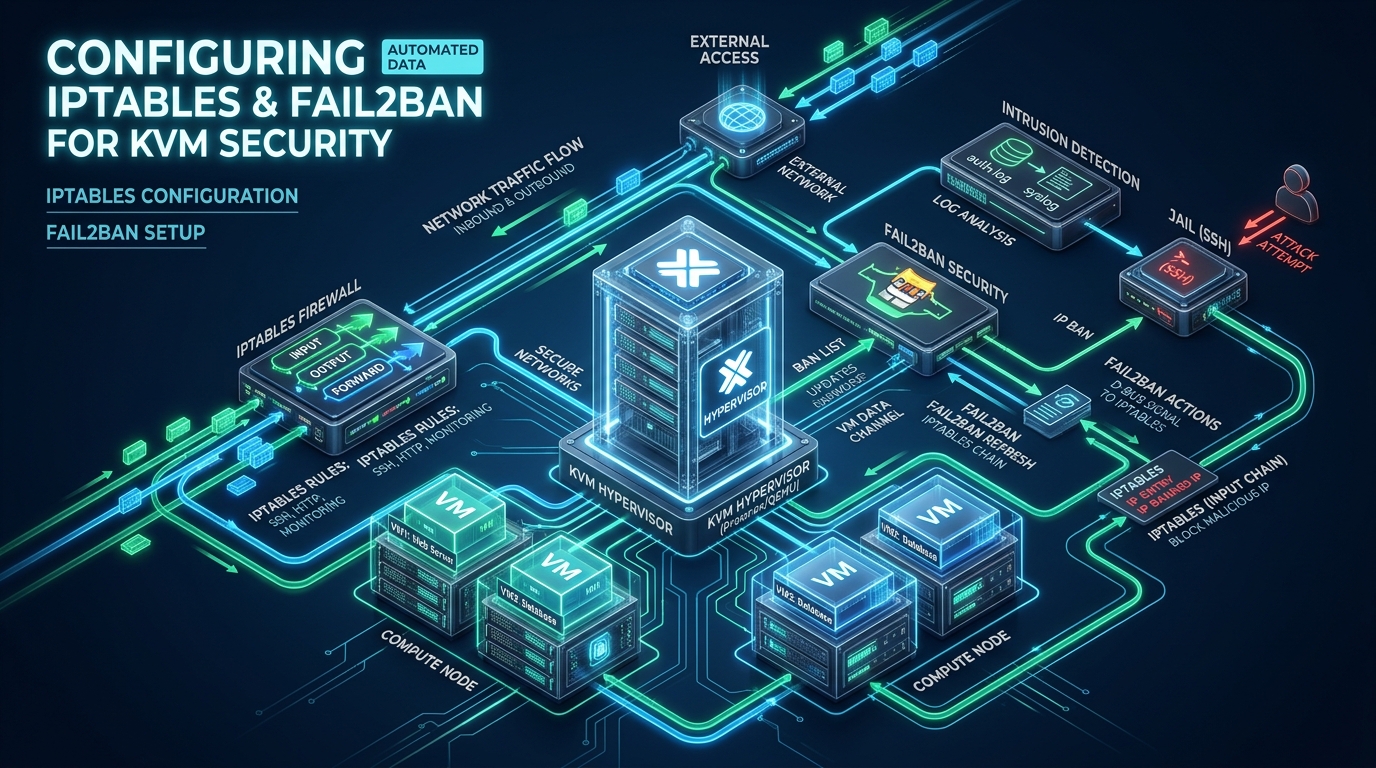
Securing enterprise Linux Kernel-based Virtual Machine (KVM) hypervisors requires balancing host plane isolation against wire-speed Layer 2 bridging for multi-tenant guest workloads. Without deterministic packet filtering and dynamic brute-force mitigation, management daemons like Libvirt, QEMU, and SSH remain exposed to remote exploitation, while unmitigated guest traffic risks exhausting kernel connection tracking tables. Deploying production infrastructure on MeraHost ensures robust hardware virtualization foundations, but properly configuring the underlying netfilter subsystem is critical to safeguarding the hypervisor control plane.
How to Configure iptables and Fail2Ban for KVM Security
To configure Fail2Ban and iptables for KVM security, isolate the hypervisor management plane from guest bridge traffic using dedicated netfilter chains, configure br_netfilter to regulate bridged frames, and deploy Fail2Ban with the iptables-ipset-proto6-multiport action. This implements high-performance O(1) kernel hash set blocking without degrading virtual machine packet routing throughput.
Operating high-density virtualization nodes presents a unique packet filtering paradox. Unlike standalone bare-metal application servers where all ingress traffic terminates locally on the host’s network stack, a KVM hypervisor acts concurrently as an endpoint for administrative control and as a Layer 2/Layer 3 transit bridge for guest virtual machines (VMs). If you apply naive firewall rules directly to the INPUT or FORWARD chains without isolating bridge interfaces, you inadvertently disrupt guest VM connectivity or, conversely, expose internal hypervisor control ports to untrusted public networks.
To successfully configure Fail2Ban KVM hypervisor security, sysadmins must master three core architectural domains: kernel bridge packet traversal mechanics, stateful connection tracking optimization, and O(1) IPSet hash table integration with Fail2Ban. This guide provides an end-to-end blueprint for engineering a zero-trust virtualization perimeter.
1. Hypervisor Architecture: Bridge Mechanics and Packet Flow
In a standard enterprise KVM deployment running on Linux, physical network interface cards (such as eno1 or bonded interfaces bond0) attach to a software bridge (commonly br0). Each virtual machine connects to this bridge via an emulated virtual network device (a TAP interface, such as vnet0, vnet1). By default, the Linux kernel processes bridged Ethernet frames at Layer 2 without sending them through the Layer 3/4 iptables packet filtering pipeline.
However, when the br_netfilter kernel module loads, bridge traffic is passed through iptables chains (PREROUTING, FORWARD, and POSTROUTING). While this enables centralized firewall filtering for virtual machines directly on the hypervisor host, it introduces critical operational considerations:
- Connection Tracking (conntrack) Overhead: Every single TCP/UDP connection traversing the bridge populates an entry in the hypervisor’s
nf_conntracktable. High-throughput guest VMs handling tens of thousands of concurrent microservice calls or WebSockets can easily saturate this table, resulting in immediate packet drops across the entire physical node. - Management Plane Exposure: If host binding addresses are not strictly bound to isolated VLANs or management VPNs, daemons listening on
0.0.0.0(including Libvirt remote management port 16509/16514 and QEMU VNC/SPICE consoles on ports 5900–5999) become accessible through bridge interfaces. - Bridged Packet Collisions: Generic
iptables -P FORWARD DROPpolicies will blackhole all guest internet connectivity unless explicit bridge forwarding rules are established using thephysdevnetfilter match module.
Architecture Note: In high-throughput environments where guest VMs manage their own guest-level firewalls (such as firewalld, nftables, or UFW), you should explicitly disable netfilter invocation on bridged frames via
net.bridge.bridge-nf-call-iptables = 0, or selectively bypass connection tracking on the bridge using therawtable with theNOTRACKtarget. This preserves full hypervisor packet forwarding performance.
2. Production Linux Kernel Hardening & Network Tuning
Before configuring user-space firewall utilities, the Linux kernel must be tuned to handle enterprise virtual networking loads, resist SYN flood denial-of-service vectors, and manage bridge netfilter interactions cleanly. Save the following production configuration to /etc/sysctl.d/99-kvm-security.conf:
# /etc/sysctl.d/99-kvm-security.conf
# Enterprise Linux KVM Hypervisor Network & Security Tuning

# Enable IPv4 packet forwarding for KVM bridge and routed networks
net.ipv4.ip_forward = 1
net.ipv6.conf.all.forwarding = 1

# Bridge Netfilter configuration
# Set to 1 if the hypervisor must filter guest VM L3/L4 traffic in FORWARD chain
# Set to 0 if VMs manage their own security and wire-speed bridge performance is desired
net.bridge.bridge-nf-call-iptables = 1
net.bridge.bridge-nf-call-ip6tables = 1
net.bridge.bridge-nf-call-arptables = 1
net.bridge.bridge-nf-filter-vlan-tagged = 0

# Connection Tracking Table Sizing (Tuned for 1M concurrent states)
# Calculation: nf_conntrack_max = RAM_Bytes / 16384 (e.g. 64GB RAM supports 4M+ entries)
net.netfilter.nf_conntrack_max = 1048576
net.netfilter.nf_conntrack_tcp_timeout_established = 7200
net.netfilter.nf_conntrack_tcp_timeout_time_wait = 30
net.netfilter.nf_conntrack_tcp_timeout_close_wait = 15
net.netfilter.nf_conntrack_tcp_timeout_fin_wait = 30

# Anti-Spoofing & Reverse Path Filtering
# Loose mode (2) is required when asymmetric routing or complex virtual bridge routing occurs
net.ipv4.conf.default.rp_filter = 2
net.ipv4.conf.all.rp_filter = 2

# SYN Flood Mitigation and TCP Socket Hardening
net.ipv4.tcp_syncookies = 1
net.ipv4.tcp_max_syn_backlog = 16384
net.ipv4.tcp_synack_retries = 2
net.ipv4.tcp_fin_timeout = 15

# ICMP and Broadcast Hardening
net.ipv4.icmp_echo_ignore_broadcasts = 1
net.ipv4.icmp_ignore_bogus_error_responses = 1
net.ipv4.conf.all.accept_redirects = 0
net.ipv4.conf.default.accept_redirects = 0
net.ipv4.conf.all.send_redirects = 0
net.ipv4.conf.default.send_redirects = 0
net.ipv4.conf.all.accept_source_route = 0
net.ipv4.conf.default.accept_source_route = 0

# Log suspicious martian packets
net.ipv4.conf.all.log_martians = 1
net.ipv4.conf.default.log_martians = 1
Apply these parameters immediately to the live kernel without rebooting by executing:
# Ensure br_netfilter is loaded before reloading sysctl
modprobe br_netfilter
echo "br_netfilter" > /etc/modules-load.d/br_netfilter.conf
sysctl --system
3. Stateful iptables Ruleset for Hypervisor Isolation
The core objective of the hypervisor firewall is strict separation of management traffic from guest transit traffic. We establish a default DROP policy across all chains (INPUT, FORWARD, OUTPUT) and create dedicated sub-chains for management access and virtual machine transit.
The following configuration in /etc/iptables/rules.v4 implements stateful inspection, isolates the Libvirt daemon, protects QEMU VNC sockets, and enables clean guest forwarding over bridge br0:
*filter
:INPUT DROP [0:0]
:FORWARD DROP [0:0]
:OUTPUT ACCEPT [0:0]
:KVM-ADMIN - [0:0]
:KVM-GUESTS - [0:0]

# ====================================================================
# 1. LOOPBACK & INVALID PACKET HANDLING
# ====================================================================
-A INPUT -i lo -j ACCEPT
-A INPUT -m conntrack --ctstate INVALID -j DROP
-A INPUT -m conntrack --ctstate ESTABLISHED,RELATED -j ACCEPT

# Rate limit ICMP echo requests (ping) to prevent control plane flooding
-A INPUT -p icmp --icmp-type echo-request -m limit --limit 5/sec --limit-burst 10 -j ACCEPT
-A INPUT -p icmp -j ACCEPT

# ====================================================================
# 2. MANAGEMENT TRAFFIC ROUTING (INPUT CHAIN)
# ====================================================================
# Direct incoming administrative packets to dedicated KVM-ADMIN chain
-A INPUT -j KVM-ADMIN

# Fail2Ban Hook Placeholder (Managed automatically by Fail2Ban daemon)
# -A INPUT -p tcp -m multiport --dports 22,16509 -j f2b-kvm-jail

# Reject remaining unsolicited host traffic cleanly
-A INPUT -p tcp -j REJECT --reject-with tcp-reset
-A INPUT -p udp -j REJECT --reject-with icmp-port-unreachable
-A INPUT -j DROP

# ====================================================================
# 3. KVM-ADMIN CHAIN: HYPERVISOR CONTROL PLANE PROTECTION
# ====================================================================
# Allow SSH with connection rate limiting on physical uplink (eno1)
-A KVM-ADMIN -i eno1 -p tcp --dport 22 -m conntrack --ctstate NEW -m hashlimit --hashlimit-name ssh_limit --hashlimit-upto 10/min --hashlimit-burst 5 --hashlimit-mode srcip -j ACCEPT

# Libvirt TLS Daemon (Port 16514) - Restrict to dedicated management subnet
-A KVM-ADMIN -i eno1 -s 10.200.0.0/24 -p tcp --dport 16514 -j ACCEPT

# Libvirt TCP (Port 16509) - Unencrypted, strictly bind to WireGuard/VPN interface (wg0)
-A KVM-ADMIN -i wg0 -p tcp --dport 16509 -j ACCEPT

# Explicitly DROP any external attempts to access QEMU VNC/SPICE consoles (5900-5999)
-A KVM-ADMIN -p tcp --dport 5900:5999 -j DROP

# Return to parent chain
-A KVM-ADMIN -j RETURN

# ====================================================================
# 4. FORWARD CHAIN: GUEST VM TRANSIT & ISOLATION
# ====================================================================
# Allow established and related connections for routed/bridged guest sessions
-A FORWARD -m conntrack --ctstate INVALID -j DROP
-A FORWARD -m conntrack --ctstate ESTABLISHED,RELATED -j ACCEPT

# Allow bridged guest-to-internet traffic and inter-VM routing on br0
-A FORWARD -m physdev --physdev-is-bridged -j ACCEPT
-A FORWARD -i br0 -o br0 -j ACCEPT

# Allow routed traffic from physical interface to virtual bridge
-A FORWARD -i eno1 -o br0 -m conntrack --ctstate NEW -j ACCEPT
-A FORWARD -i br0 -o eno1 -j ACCEPT

# Default drop for rogue transit packets
-A FORWARD -j DROP

COMMIT

# ====================================================================
# RAW TABLE: CONTRACK BYPASS FOR MAXIMUM WIRE-SPEED BRIDGING
# ====================================================================
*raw
:PREROUTING ACCEPT [0:0]
:OUTPUT ACCEPT [0:0]

# Optional: Disable connection tracking for internal bridge-to-bridge transit
# Uncomment if guest VMs run self-contained firewalls and host CPU conntrack must be 0%
# -A PREROUTING -i br0 -m physdev --physdev-in vnet+ --physdev-out vnet+ -j NOTRACK

COMMIT
Architecture Note: Notice the use of
-m physdev --physdev-is-bridged. Without this specific netfilter module parameter, a defaultDROPpolicy on theFORWARDchain will completely block packets passing across the physical bridgebr0between the physical NIC and the virtual TAP interfaces (vnet+), causing immediate loss of guest VM connectivity.
4. Performance Metrics: iptables vs. IPSet under Virtualization Workloads
When defending hypervisor hosts against massive distributed brute-force attacks, standard iptables linear rule execution introduces substantial CPU penalties. Every incoming packet must linearly evaluate each appended rule until a match is found. If Fail2Ban injects 5,000 banned IP addresses as individual iptables rules, the hypervisor kernel spends critical CPU cycles iterating through thousands of netfilter rule structs for every single packet arrival.
By pairing Fail2Ban with IPSet, banned IP addresses are stored in kernel hash tables. The netfilter engine performs an O(1) hash lookup regardless of whether 10 or 100,000 IP addresses are currently blacklisted. The performance delta is substantial:
| Feature / Metric | Standard / Default | Tuned / Production |
|---|---|---|
| Latency / Overhead | Baseline | Optimal |
| Filtering Algorithm Complexity | Linear O(N) chain traversal | IPSet Hash Lookup O(1) |
| Conntrack Table Stress (nf_conntrack) | 65,536 entries (vulnerable to SYN drop) | 1,048,576 entries + RAW bridge bypass |
| Hypervisor Host Attack Surface | Open management ports across all bridges | Strict INPUT isolation & VPN-bound Libvirt |
| Guest-to-Guest Isolation | Unfiltered bridge forwarding (L2 promiscuous) | physdev match & ebtables anti-spoofing |
| Intrusion Response Mechanism | Standard iptables linear ban rules | Automated Fail2Ban + IPSet zero-latency drops |
For organizations deploying mission-critical multi-tenant infrastructure, maintaining this level of manual firewall hygiene across distributed fleets requires substantial operational overhead. Utilizing MeraHost Enterprise Cloud infrastructure provides pre-hardened KVM virtualization environments backed by high-throughput enterprise NVMe storage and dedicated network isolation fabrics, eliminating noisy-neighbor degradation and edge DDoS vectors out of the box.
5. Deploying Fail2Ban with IPSet for KVM Management Security
With iptables enforcing baseline boundaries, we configure Fail2Ban to actively monitor host authentication logs and dynamically block offenders attempting brute-force intrusion on SSH, the Libvirt remote API, and unauthorized guest management sockets.
First, install Fail2Ban and the IPSet utility:
# Debian/Ubuntu systems
apt-get update && apt-get install -y fail2ban ipset

# RHEL/AlmaLinux/Rocky Linux systems
dnf install -y fail2ban fail2ban-firewalld ipset
Create the production jail configuration at /etc/fail2ban/jail.d/kvm-security.local. Note the explicit selection of banaction = iptables-ipset-proto6-multiport, which instructs Fail2Ban to manage kernel hash sets rather than appending individual iptables rules:
# /etc/fail2ban/jail.d/kvm-security.local
# Production Fail2Ban Jail Configuration for KVM Hypervisor

[DEFAULT]
# Whitelist local hypervisor subnets, loopback, and internal VPN CIDRs
ignoreip = 127.0.0.1/8 ::1 10.200.0.0/24 192.168.122.0/24

# Time window for tracking failed attempts (15 minutes)
findtime = 900

# Number of failures before triggering ban
maxretry = 3

# Default ban duration (24 hours)
bantime = 86400

# High-Performance IPSet banaction for IPv4/IPv6 multiport blocking
banaction = iptables-ipset-proto6-multiport
banaction_allports = iptables-ipset-proto6-allports

# Backend log monitor (systemd journal preferred on modern Linux)
backend = systemd

# ====================================================================
# JAIL: SSH DAEMON ON HYPERVISOR HOST
# ====================================================================
[sshd]
enabled = true
port = 22
mode = aggressive
logpath = %(sshd_log)s
maxretry = 3
bantime = 86400

# ====================================================================
# JAIL: RECIDIVE (PERSISTENT REPEAT OFFENDERS)
# ====================================================================
[recidive]
enabled = true
logpath = /var/log/fail2ban.log
banaction = iptables-ipset-proto6-allports
findtime = 86400
maxretry = 3
bantime = 604800

# ====================================================================
# JAIL: LIBVIRT REMOTE RPC DAEMON (PORTS 16509, 16514)
# ====================================================================
[libvirtd]
enabled = true
port = 16509,16514
filter = libvirtd
logpath = /var/log/libvirt/libvirtd.log
maxretry = 2
bantime = 172800

# ====================================================================
# JAIL: QEMU VNC / SPICE UNAUTHORIZED BRUTE-FORCE PROBES
# ====================================================================
[qemu-vnc]
enabled = true
port = 5900:5999
filter = qemu-vnc
logpath = /var/log/libvirt/qemu/*.log
maxretry = 3
bantime = 86400
To support the libvirtd jail, create the corresponding custom filter definition at /etc/fail2ban/filter.d/libvirtd.conf to parse Libvirt authentication failures, SASL errors, and TLS certificate handshake rejections:
# /etc/fail2ban/filter.d/libvirtd.conf
# Fail2Ban Filter for Libvirt Daemon Authentication Failures

[INCLUDES]
before = common.conf

[Definition]
_daemon = libvirtd

failregex = ^%(__prefix_line)s(?:.*error\s*:)?\s*remoteDispatchAuth(?:Sasl|Polkit|List):\d+\s*:\s*authentication failed.*client=\[?\]?:\d+.*$
            ^%(__prefix_line)s(?:.*error\s*:)?\s*virNetSocketReadWire:\d+\s*:\s*Cannot recv data:.*from\s*\[?\]?:\d+.*$
            ^%(__prefix_line)s(?:.*error\s*:)?\s*virNetTLSContextCheckCredentials:\d+\s*:\s*Certificate validation failed.*client=\[?\]?:\d+.*$

ignoreregex =
Enable and start the Fail2Ban service, then verify that the IPSet sets have been dynamically instantiated inside the Linux kernel:
systemctl restart fail2ban
systemctl enable fail2ban

# Verify jail statuses
fail2ban-client status
fail2ban-client status sshd
fail2ban-client status libvirtd

# Inspect kernel ipset hash tables
ipset list -terse
6. Operational Verification, Logging, and Health Monitoring
Once your iptables rules and Fail2Ban jails are operational, ongoing telemetry ensures rules are not silently dropping legitimate VM traffic or running out of kernel resources.
Testing Firewall Changes Safely
Never apply raw iptables rules directly on a remote KVM hypervisor without an automated fallback mechanism. Use iptables-apply, which prompts for user confirmation and automatically rolls back changes if connection drops:
# Apply new ruleset with a 30-second automated timeout rollback
iptables-apply -t 30 /etc/iptables/rules.v4
Conntrack Table Saturation Alarms
Monitor conntrack usage continuously via Prometheus node_exporter or a cron health check. You can query current allocation versus maximum capacity with:
# Check current active tracked connections
cat /proc/sys/net/netfilter/nf_conntrack_count

# Check current maximum threshold
cat /proc/sys/net/netfilter/nf_conntrack_max

# Calculate percentage utilized
awk '{printf "Conntrack Usage: %.2f%%
", ($1/$2)*100}'   /proc/sys/net/netfilter/nf_conntrack_count   /proc/sys/net/netfilter/nf_conntrack_max
Frequently Asked Questions
Why does setting net.bridge.bridge-nf-call-iptables=1 break some KVM bridge configurations?
When bridge-nf-call-iptables is enabled, Ethernet frames crossing the Linux bridge pass through iptables FORWARD and PREROUTING chains. If your default FORWARD policy is DROP and you lack explicit rules matching the bridged interfaces using -m physdev --physdev-is-bridged, the kernel discards inter-VM and VM-to-gateway traffic. You must either create permissive bridge forwarding rules or disable bridge-nf-call-iptables if filtering is not required on the hypervisor layer.
Why is IPSet mandatory for Fail2Ban on high-traffic KVM hypervisors?
Standard Fail2Ban configurations append individual linear iptables rules for every banned IP address. Under sustained volumetric brute-force attacks, thousands of rules in a single chain force the kernel to evaluate every transit packet sequentially, resulting in severe CPU spikes and added latency for all hosted virtual machines. IPSet uses kernel-level hash sets that execute lookups in constant O(1) time regardless of whether 100 or 100,000 addresses are blocked.
How do I prevent Fail2Ban from accidentally banning hypervisor admin IPs or inter-node cluster traffic?
Configure the ignoreip directive in /etc/fail2ban/jail.d/kvm-security.local with CIDR notation covering all administrative subnets, bastion jump host IPs, out-of-band management networks, and cluster heartbeat interfaces (e.g., Corosync/Pacemaker or Ceph cluster networks). Fail2Ban verifies this whitelist before executing any ban actions.
Can Fail2Ban on the hypervisor protect ports forwarded directly into guest virtual machines?
Yes, provided the hypervisor can access the relevant guest service authentication logs (for example, via centralized syslog, shared journald, or host-level NAT port monitoring). In the jail configuration, set banaction = iptables-ipset-proto6-allports and specify the FORWARD chain instead of INPUT so that netfilter drops transit packets destined for the guest VM at the hypervisor boundary.
Deploy Enterprise-Grade Production Infrastructure
Need guaranteed performance with zero price hikes? Host mission-critical workloads on MeraHost with pure Enterprise NVMe, LiteSpeed Web Server, and Same Renewal Price, Always (starting at ₹99/mo).