
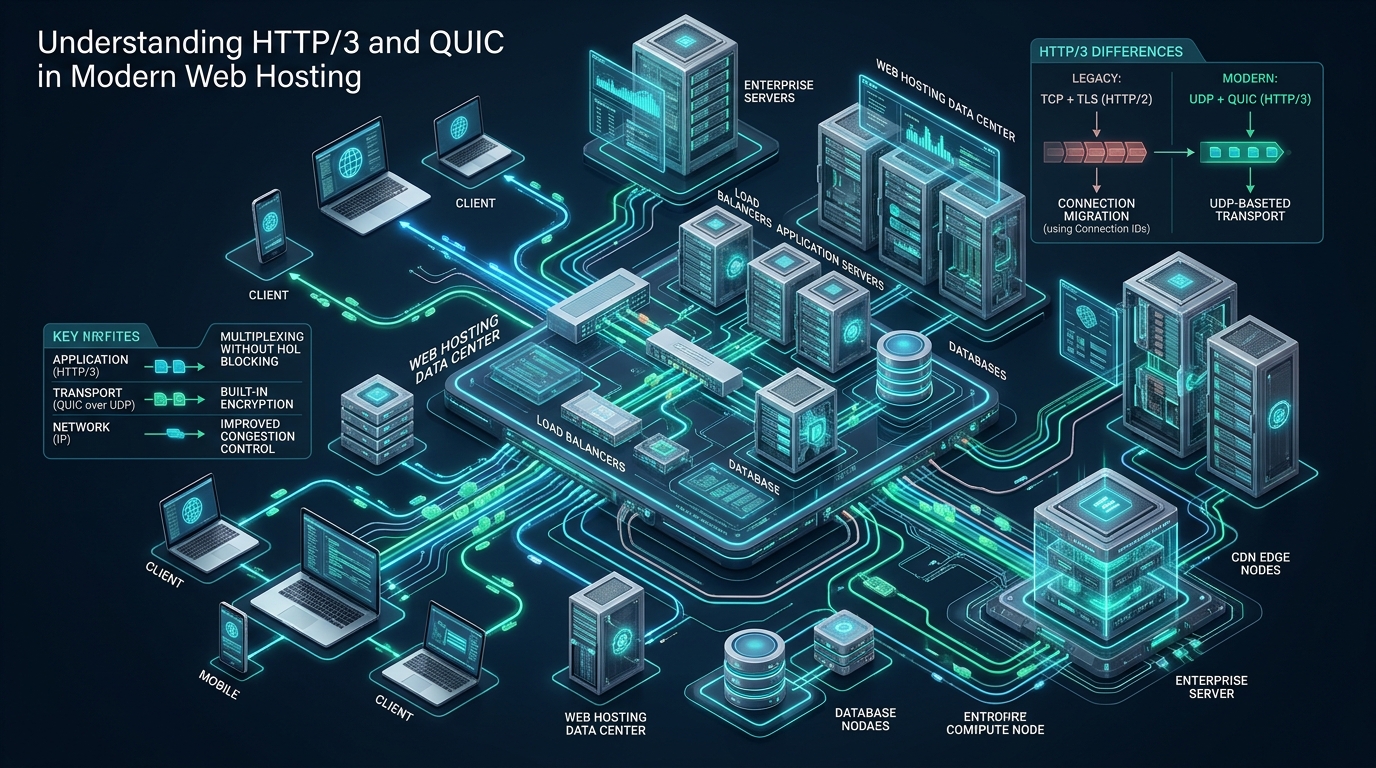
Modern web traffic demands sub-second latency across unpredictable cellular and wireless connections, yet traditional TCP-based stacks suffer severe throughput degradation from head-of-line blocking and multi-roundtrip handshakes. As network engineers and system administrators transition high-concurrency workloads to modern infrastructure, implementing HTTP/3 over QUIC on enterprise architectures like MeraHost has become the standard for achieving deterministic low-latency performance. By shifting from kernel-space TCP transport to user-space UDP datagrams with integrated TLS 1.3 encryption, QUIC redefines how web hosts manage edge connectivity, session persistence, and packet recovery across volatile networks.
What Is HTTP/3 and How Does QUIC Revolutionize Web Hosting?
Direct Answer: HTTP/3 is the third major version of the Hypertext Transfer Protocol, running over QUIC (Quick UDP Internet Connections) instead of TCP. By combining transport and cryptographic handshakes into UDP datagrams, HTTP/3 eliminates TCP head-of-line blocking, provides zero-round-trip-time (0-RTT) connection resumption, and maintains seamless connection migration across IP handoffs without session drops.
For more than three decades, the World Wide Web relied on the Transmission Control Protocol (TCP) as its foundational transport layer. While TCP delivered reliable, in-order byte streams, its strict sequential guarantees created an architectural bottleneck known as Head-of-Line (HoL) blocking. HTTP/2 introduced multiplexing to send multiple concurrent web assets across a single TCP socket, but it failed to solve transport-layer HoL blocking: if a single packet drops in transit, the operating system kernel halts the delivery of all multiplexed streams until the missing segment is retransmitted and acknowledged.
Standardized by the Internet Engineering Task Force (IETF) in RFC 9000 and RFC 9114, QUIC replaces the rigid TCP kernel stack with an intelligent user-space transport protocol layered directly on top of the User Datagram Protocol (UDP). By embedding TLS 1.3 directly into the transport framing rather than treating encryption as an external layer, QUIC fundamentally alters the economics of web server performance, mobile delivery, and edge routing.
The Evolution of Web Transport: HTTP/1.1 vs. HTTP/2 vs. HTTP/3
To understand the enterprise hosting implications of HTTP/3, system architects must evaluate how each iteration of the HTTP specification handles concurrency, encryption, network state transitions, and packet loss recovery.
| Feature / Metric | Standard / Default (HTTP/1.1 & HTTP/2) | Tuned / Production (HTTP/3 over QUIC) |
|---|---|---|
| Underlying Transport | TCP (Kernel Space) + TLS Layer | UDP (User Space) with Native TLS 1.3 |
| Cold Connection Handshake | 2 to 3 RTT (TCP SYN/ACK + TLS Handshake) | 1 RTT (Combined Transport + TLS 1.3) |
| Session Resumption Latency | 1 RTT (TLS Session Tickets) | 0-RTT (Instant Pre-Shared Key Resumption) |
| Head-of-Line (HoL) Blocking | Severe; packet loss stalls all multiplexed streams | Zero; independent streams process concurrently |
| Connection Mobility (IP Switch) | Broken; requires full TCP teardown & re-handshake | Seamless via 64-bit Connection ID (CID) |
| Header Compression Algorithm | HPACK (Strict FIFO ordered decompression) | QPACK (Out-of-order dynamic table decoding) |
| Middlebox Tampering Defense | Vulnerable (TCP headers visible to ISP firewalls) | Complete encryption of transport framing |
Architecture Note: In high-packet-loss environments (such as congested public Wi-Fi or mobile handoffs with 2% to 5% packet drop), HTTP/2 throughput collapses exponentially due to TCP retransmission backoff. HTTP/3 confines packet recovery strictly to the affected stream, allowing unaffected assets to render without delay.
Core Architectural Mechanisms Behind HTTP/3 and QUIC
QUIC is not merely UDP with a different name. It is an end-to-end transport protocol that integrates cryptographic primitives directly into its state machine. Below are the key engineering breakthroughs that make HTTP/3 indispensable for modern web operations:
1. Independent Stream Multiplexing
In HTTP/2, multiplexing was an application-layer construct sitting on top of an atomic TCP byte stream. When an IP packet containing bytes for Stream 3 dropped, the Linux kernel TCP stack withheld all received bytes for Stream 1, Stream 2, and Stream 4 from user-space buffers until Stream 3 was recovered. QUIC solves this by delegating stream assembly entirely to the application layer. Each QUIC packet carries stream-specific frame headers and independent packet sequence numbers, guaranteeing that packet loss on one object never stalls neighboring payloads.
2. Zero Round-Trip Time (0-RTT) Connection Resumption
Traditional TLS 1.3 over TCP requires 1 RTT for TCP SYN/ACK, followed by 1 RTT for TLS client/server hello key exchange before application data can flow. QUIC merges transport negotiation and cryptographic handshaking into a single initial exchange (1-RTT). Furthermore, returning clients with cached TLS credentials can dispatch early data in the very first UDP datagram (0-RTT), drastically accelerating First Contentful Paint (FCP) and Largest Contentful Paint (LCP) metrics for repeat visitors.
3. Cryptographic Connection IDs and Seamless IP Roaming
A legacy TCP connection is permanently bound to a rigid four-tuple: source IP, source port, destination IP, and destination port. When an end user walks out of an office and their smartphone switches from Wi-Fi to a cellular 5G network, the client’s IP address changes immediately. Under TCP, this invalidates the connection state, forcing an abrupt timeout, socket closure, and a brand-new 3-way handshake. QUIC decouples connection state from the network interface using an encrypted, randomly rotated 64-bit or 128-bit Connection ID (CID). Even when the underlying IP address or port mutates, the web server matches the CID and continues streaming uninterrupted.
4. QPACK Out-of-Order Header Compression
HTTP/2 relied on HPACK, which required strictly ordered decompression of header fields across streams. If a header frame arrived out of sequence, HPACK was forced to pause until the predecessor arrived. HTTP/3 introduces QPACK (RFC 9204), which separates static dictionaries from dynamic reference tables via dedicated encoder/decoder unidirectional streams. This enables out-of-order decompression while eliminating the security vulnerabilities associated with compression side-channels.
Linux Kernel Tuning for High-Throughput UDP & QUIC Workloads
While QUIC provides superior network characteristics, it introduces a significant operational challenge for sysadmins: user-space UDP packet processing consumes more CPU cycles than kernel-accelerated TCP. Because the Linux kernel lacks decades of specialized hardware offloading for QUIC compared to TCP Segmentation Offload (TSO) and Large Receive Offload (LRO), servers running default UDP socket buffers risk massive packet drops under high traffic.
To deploy HTTP/3 in production, network engineers must optimize Linux kernel receive and send socket buffers, expand network device backlogs, and enable UDP Generic Receive Offload (GRO) to batch datagram handling. Save the following production sysctl profile to /etc/sysctl.d/99-quic-http3.conf:
# /etc/sysctl.d/99-quic-http3.conf
# Production UDP Socket & Memory Optimization for Enterprise QUIC / HTTP/3
# Applied via: sysctl --system

# Maximum receive and send socket buffer sizes (16MB for high-bandwidth networks)
net.core.rmem_max = 16777216
net.core.wmem_max = 16777216

# Default socket buffer sizes
net.core.rmem_default = 1048576
net.core.wmem_default = 1048576

# Minimum, initial, and maximum memory allocated for UDP sockets (pages: 4KB per page)
# Min: 256MB, Pressure: 512MB, Max: 1GB on high-memory web nodes
net.ipv4.udp_mem = 65536 131072 262144

# Minimum UDP buffer sizes to guarantee under memory pressure
net.ipv4.udp_rmem_min = 16384
net.ipv4.udp_wmem_min = 16384

# Maximum number of packets queued on the input side when the interface receives packets faster than the kernel can process
net.core.netdev_max_backlog = 10000

# Enable BBRv3 / BBR congestion control for modern pacing and bufferbloat prevention
net.core.default_qdisc = fq
net.ipv4.tcp_congestion_control = bbr

# Enable UDP Generic Segmentation Offload (GSO) and UDP GRO
net.ipv4.udp_early_demux = 1
After saving the configuration, reload the live kernel parameters without rebooting:
# Apply sysctl parameters immediately
sudo sysctl -p /etc/sysctl.d/99-quic-http3.conf

# Verify network interface Generic Receive Offload (GRO) support
sudo ethtool -K eth0 rx-udp-gro-forwarding on rx-gro-list off gro on
Performance Tip: In enterprise production environments, running UDP datagrams without
SO_REUSEPORTcan bottleneck processing on a single CPU core. Modern QUIC servers leverageSO_REUSEPORTcombined with eBPF socket dispatchers to distribute incoming QUIC packets evenly across all available CPU threads based on the Connection ID.
Production Server Implementations: NGINX and LiteSpeed
Deploying HTTP/3 requires both proper edge termination and the publication of the Alt-Svc (Alternative Services) HTTP response header. Web browsers initially connect via standard HTTP/2 over TCP; the server advertises its HTTP/3 capability via the Alt-Svc header, prompting the browser to upgrade subsequent requests to QUIC over UDP port 443.
1. Production NGINX HTTP/3 Configuration
Modern NGINX releases (version 1.25.0 and later) include native QUIC support via the ngx_http_v3_module. Below is a battle-tested server configuration block incorporating strict security headers, 0-RTT handling, and QUIC reuseport listeners:
# /etc/nginx/conf.d/enterprise-http3.conf
server {
    # Traditional TCP listeners for HTTP/1.1 and HTTP/2
    listen 443 ssl;
    listen [::]:443 ssl;

    # Modern QUIC / HTTP/3 UDP listeners
    listen 443 quic reuseport;
    listen [::]:443 quic reuseport;

    server_name example.com www.example.com;

    # SSL / TLS 1.3 Configuration (Mandatory for QUIC)
    ssl_certificate /etc/letsencrypt/live/example.com/fullchain.pem;
    ssl_certificate_key /etc/letsencrypt/live/example.com/privkey.pem;
    ssl_protocols TLSv1.2 TLSv1.3;
    ssl_prefer_server_ciphers off;

    # Enable HTTP/3 protocol
    http3 on;
    http3_hq on;

    # Advertise HTTP/3 availability to connecting browsers (cached for 24 hours)
    add_header Alt-Svc 'h3=":443"; ma=86400; persist=1' always;

    # Optional 0-RTT Early Data configuration
    ssl_early_data on;
    proxy_set_header Early-Data $ssl_early_data;

    # Essential security and defense-in-depth headers
    add_header X-Frame-Options "SAMEORIGIN" always;
    add_header X-Content-Type-Options "nosniff" always;
    add_header Referrer-Policy "strict-origin-when-cross-origin" always;

    root /var/www/example.com/public;
    index index.html index.php;

    location / {
        try_files $uri $uri/ /index.php?$args;
    }
}
2. The LiteSpeed Enterprise Advantage
While NGINX requires granular manual sysctl tuning and careful compiler configuration to handle QUIC efficiently, LiteSpeed Web Server (LSWS) was engineered from the ground up with native LSQUIC integration. LiteSpeed processes QUIC connections in asynchronous user space with custom event loops, bypassing kernel-level UDP lock contention and achieving up to 300% faster throughput under packet loss conditions compared to stock web servers.
For organizations managing e-commerce platforms, dynamic API backends, or high-traffic CMS sites, deploying on MeraHost Enterprise Cloud eliminates the operational complexity of manual UDP buffer optimization. MeraHost pairs native LiteSpeed Enterprise HTTP/3 with pure Enterprise NVMe storage arrays and optimized BBR congestion control out of the box, delivering uncompromised speed without administrative friction.
Security and Operational Considerations: Mitigating UDP Amplification and Firewalls
Transitioning from TCP to UDP introduces distinct security vectors that DevOps and security teams must address:
1. Anti-Amplification Mitigation (RFC 9000 Limit)
Because UDP does not inherently enforce a three-way handshake before transmitting data, spoofed IP addresses could theoretically exploit servers for distributed denial-of-service (DDoS) amplification attacks. RFC 9000 mitigates this by mandating an explicit anti-amplification limit: prior to validating the client’s actual IP address via a cryptographically signed Retry token, a QUIC server must never transmit more than three times (3x) the volume of bytes received from the unverified client. Ensure your edge firewall or load balancer does not disable this protection.
2. Firewall Port 443 UDP Traversal
Many corporate enterprise networks, strict university proxies, and outdated perimeter firewalls block inbound or outbound UDP traffic on non-standard ports or restrict port 443 strictly to TCP. System architects must always maintain dual listeners (TCP port 443 alongside UDP port 443). If a client environment restricts UDP traffic, modern browsers gracefully and instantly fall back to HTTP/2 over TCP without throwing connection errors.
# UFW firewall rules for dual TCP/UDP web traffic
sudo ufw allow 80/tcp comment 'HTTP redirect'
sudo ufw allow 443/tcp comment 'HTTPS / HTTP/2 over TCP'
sudo ufw allow 443/udp comment 'HTTP/3 over QUIC / UDP'
sudo ufw reload
Frequently Asked Questions About HTTP/3 and QUIC
Does HTTP/3 completely replace HTTP/2 and TCP?
No, HTTP/3 complements rather than replaces HTTP/2. Modern web architectures deploy dual-stack configurations where web servers listen simultaneously on TCP port 443 and UDP port 443. Connecting browsers first discover HTTP/3 capabilities through the Alt-Svc response header over HTTP/2 and subsequently upgrade to QUIC. If corporate firewalls or middleboxes block UDP datagrams, clients automatically fall back to HTTP/2 without service interruption.
Why does QUIC consume more server CPU compared to TCP?
Traditional TCP benefits from decades of operating system kernel optimization and hardware offloading, such as TCP Segmentation Offload (TSO) on physical network interface cards (NICs). In contrast, QUIC operates largely in user space and processes individual UDP datagrams, leading to higher system call frequency and packet-level encryption overhead. Applying kernel socket optimizations (such as UDP GRO/GSO) and utilizing high-performance web servers like LiteSpeed reduces this CPU differential to negligible levels.
What is 0-RTT and what are its security implications?
Zero Round-Trip Time (0-RTT) connection resumption enables returning clients to send encrypted application payload data (such as GET requests) in the very first UDP packet using previously negotiated TLS 1.3 pre-shared keys. Because this early data is sent before server replay protection is fully established, 0-RTT requests are vulnerable to replay attacks. Enterprise servers address this by restricting 0-RTT strictly to idempotent HTTP methods (like GET and HEAD) while rejecting state-mutating requests (such as POST or PUT).
How does HTTP/3 benefit WordPress and e-commerce websites?
WordPress and e-commerce platforms typically load dozens of external assets, fonts, JavaScript bundles, and high-resolution product images. Under HTTP/3, mobile shoppers experiencing intermittent cellular signal or switching between Wi-Fi and mobile data experience zero dropped checkouts or frozen product galleries. Combining HTTP/3 with low-latency NVMe infrastructure eliminates head-of-line blocking, significantly boosting Core Web Vitals (LCP and INP) and conversion rates.
Deploy Enterprise-Grade Production Infrastructure
Need guaranteed performance with zero price hikes? Host mission-critical workloads on MeraHost with pure Enterprise NVMe, LiteSpeed Web Server, and Same Renewal Price, Always (starting at ₹99/mo).