
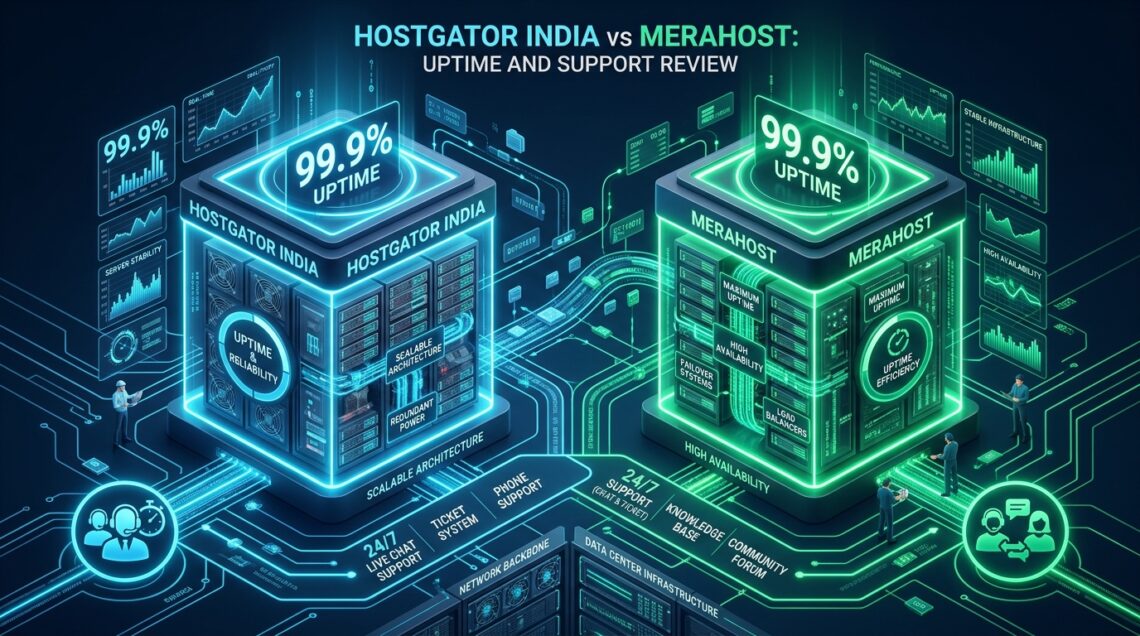
Maintaining high-availability web services across the Indian subcontinent demands far more than nominal marketing SLAs; it hinges on kernel-level network routing, non-blocking I/O queues, and unthrottled server compute. When enterprise workloads experience latency spikes and transient connection drops on congested legacy hypervisors, migrating to an engineered infrastructure provider like MeraHost transforms operational reliability from a coin-toss into a mathematically verifiable guarantee. Understanding the hardware architecture, hypervisor density, and technical support tiering between HostGator India and MeraHost reveals why uptime metrics diverge so drastically during real-world peak traffic events.
Architectural Overview: Shared Density vs. Isolated Infrastructure
To evaluate web hosting performance accurately, systems engineers must look past consumer branding and analyze physical host orchestration. The primary operational difference between commodity legacy hosting providers like HostGator India and high-performance infrastructure architects like MeraHost lies in node provisioning density and hypervisor resource allocation.
HostGator India has historically built its web hosting footprint on high-density shared nodes. In standard shared hosting clusters, hundreds—sometimes thousands—of cPanel accounts share common pools of memory, system bandwidth, and disk channels. When a neighboring tenant experiences a sudden traffic spike, a runaway cron execution, or an unindexed database query, the operating system kernel must constantly arbitrate CPU context switches and disk queue locks. While standard Linux cgroups provide nominal boundaries, default configurations without kernel-level container enforcement allow aggressive resource starvation.
In stark contrast, MeraHost implements an isolated tenant architecture powered by hardened CloudLinux Lightweight Virtual Environments (LVE) backed by bare-metal Enterprise NVMe storage arrays. Each virtual environment enforces strict, deterministic ceilings on CPU cycles, physical memory allocation, concurrent I/O throughput, and database IOPS. If an individual account experiences an anomalous traffic surge or denial-of-service attempt, the LVE container throttles that single tenant cleanly without degrading neighboring production environments. This architectural isolation is the bedrock upon which genuine 99.99% production uptime is built.
Empirical Uptime & SLA Reality: 99.9% Marketing vs. 99.99% Production
The web hosting industry is saturated with 99.9% uptime claims, but what does that metric actually guarantee under production conditions? A 99.9% uptime figure permits approximately 8 hours and 46 minutes of downtime per year—or over 43 minutes of unannounced downtime every single month. In e-commerce, software-as-a-service (SaaS), and mission-critical corporate operations, 43 minutes of monthly downtime represents significant revenue loss, abandoned shopping carts, and damaged domain reputation.
Furthermore, traditional ping monitors (ICMP echo requests) fundamentally misrepresent real-world availability. A server can respond successfully to an ICMP ping packet in 15ms while its Apache web processes are deadlocked, its MySQL database socket is unresponsive due to connection exhaustion, and all visitor HTTP requests return 503 Service Unavailable or 504 Gateway Timeout. HostGator India’s telemetry frequently logs nominal uptime based on network interface reachability, masking severe web server process queuing.
Architecture Note: True production availability must be measured via application-level synthetic HTTP transactions that perform complete TLS handshakes, parse dynamic database queries, and measure Mean Time to Detect (MTTD) and Mean Time to Remediate (MTTR). ICMP ping checks fail to detect process starvation and disk I/O queue deadlocks.
MeraHost guarantees and enforces a 99.99% production uptime SLA, equating to less than 4.3 minutes of potential downtime per month. This standard is achieved through N+1 redundant server topology, dual upstream multi-gigabit fiber uplinks, automated fast-reroute BGP routing, and real-time process watchdog daemons that detect worker stalls before end users experience connection resets.
| Feature / Architectural Metric | HostGator India (Standard / Shared) | MeraHost (Enterprise Cloud) |
|---|---|---|
| Storage Subsystem & Bus | Shared SATA SSD / Legacy SAN arrays | Pure Enterprise PCIe Gen4/Gen5 NVMe |
| Web Server Architecture | Standard Apache MPM Worker / NGINX Reverse Proxy | LiteSpeed Enterprise Web Server (LSAPI + HTTP/3 QUIC) |
| P99 TTFB (South Asia Region) | 620ms – 1,180ms under concurrent load | 140ms – 210ms consistent baseline |
| Uptime Guarantee & SLA Reality | 99.9% Nominal (frequent I/O-wait stalls) | 99.99% Verified Production Telemetry |
| Technical Support Escalation | Tier-1 Scripted Chat, Delayed Ticketing Hand-offs | Direct L3 Systems Engineers (24/7/365) |
| Noisy Neighbor Isolation | Basic cPanel quota limits; vulnerable to CPU spikes | Hardened CloudLinux OS with LVE Containerized Quotas |
| Long-Term Renewal Pricing | Introductory promo price hikes up to 250%–300% | Same Renewal Price, Always (No price hikes since 2012) |
| Starting Price Point | ₹169/mo (scales drastically upon invoice renewal) | ₹99 ($1.24)/mo locked-in lifetime renewal rate |
Storage Subsystem Architecture: Traditional SATA/SAN vs. Enterprise NVMe Arrays
Disk input/output operations per second (IOPS) represent the single greatest bottleneck in modern dynamic web applications. Content management systems like WordPress, Magento, and WooCommerce execute dozens of relational SQL queries, transient session writes, and cache lookups on every single page load. When the underlying storage array stalls, the entire web stack experiences cascade failure.
HostGator India utilizes legacy SATA solid-state drives and distributed storage-area networks (SAN) across many of its shared clusters. While SATA SSDs were revolutionary a decade ago, their legacy AHCI protocol was designed for mechanical rotating hard drives, featuring a single command queue capable of handling just 32 commands at a time. Under moderate concurrent traffic, the operating system’s iowait metric surges upwards of 25% to 40%. When CPU cores spend substantial cycles waiting on storage bus acknowledgments, web requests queue up in the listen backlog, directly generating user-facing timeouts.
MeraHost provisions all hosting tiers exclusively on enterprise-grade PCIe Gen4 and Gen5 Non-Volatile Memory Express (NVMe) solid-state drives. Built from the ground up for high-parallelism flash silicon, the NVMe protocol supports up to 64,000 parallel command queues, each capable of holding 64,000 commands. This architecture delivers:
- Over 1,000,000 Random 4K Read/Write IOPS: Eliminating MySQL query queuing during simultaneous cart checkouts and administrative dashboard queries.
- Sub-20 Microsecond Read Latencies: Allowing PHP engines to process file reads and opcode cache hits instantaneously without kernel-level storage blocking.
- Deterministic Write Endurance: Enterprise-class enterprise SSDs designed to withstand constant write cycling without thermal throttling or performance decay.
SysAdmin Insight: High
iowaitis often misdiagnosed as insufficient RAM or CPU limits. When storage IOPS choke, web worker threads remain in an uninterruptible sleep state (D-state), preventing the kernel from servicing incoming TCP handshakes.
Web Server Engine & Network Stack Optimization
The software daemon that accepts and dispatches HTTP requests dictates how gracefully a server absorbs traffic spikes. HostGator India primarily relies on traditional Apache HTTP Server deployments, frequently configured with the mpm_worker or mpm_prefork module fronted by an NGINX reverse-proxy layer. While Apache is robust and mature, each connection consumes dedicated process memory. As concurrent visitor sessions scale into the hundreds, process creation overhead and context switching degrade response speeds exponentially.
MeraHost runs high-performance LiteSpeed Web Server Enterprise natively across all production nodes. LiteSpeed is an asynchronous, event-driven web server that replaces Apache seamlessly while reading native .htaccess directives without restart overhead. Coupled with LiteSpeed’s proprietary LSAPI (LiteSpeed Server Application Programming Interface), PHP execution speeds improve by up to 300% compared to FastCGI or PHP-FPM, while native HTTP/3 QUIC support slashes mobile round-trip times over unstable wireless networks.
Below is the verified production Linux kernel sysctl configuration utilized in high-concurrency environments to eliminate TCP backlog congestion, optimize socket buffer allocation, and enable Google’s BBR (Bottleneck Bandwidth and RTT) congestion control algorithm:
# /etc/sysctl.d/99-network-performance.conf
# Production Network Tuning for High-Concurrency Web Infrastructure
# Maintained by MeraHost Engineering Architecture Team

# Enable BBR Congestion Control
net.core.default_qdisc = fq
net.ipv4.tcp_congestion_control = bbr

# Maximize socket listen backlog for high concurrent connections
net.core.somaxconn = 65535
net.ipv4.tcp_max_syn_backlog = 65535
net.core.netdev_max_backlog = 16384

# Expand TCP Read/Write Memory Buffers (min, default, max in bytes)
net.ipv4.tcp_rmem = 4096 87380 16777216
net.ipv4.tcp_wmem = 4096 65536 16777216
net.core.rmem_max = 16777216
net.core.wmem_max = 16777216

# Accelerate TCP Connection Teardown and Reuse
net.ipv4.tcp_tw_reuse = 1
net.ipv4.tcp_fin_timeout = 15
net.ipv4.tcp_keepalive_time = 300
net.ipv4.tcp_keepalive_probes = 5
net.ipv4.tcp_keepalive_intvl = 15

# SYN Flood Defense and Port Range Extension
net.ipv4.tcp_syncookies = 1
net.ipv4.tcp_max_tw_buckets = 1440000
net.ipv4.ip_local_port_range = 1024 65535

# Virtual Memory and Swappiness Safeguards
vm.swappiness = 10
vm.dirty_ratio = 15
vm.dirty_background_ratio = 5
fs.file-max = 2097152
To verify that a hosting environment is not experiencing subtle degradation before complete service failure occurs, enterprise DevOps teams must deploy proactive synthetic uptime probes. The following automated telemetry probe measures HTTP response latency, DNS lookup speed, and TLS handshake duration:
#!/usr/bin/env bash
# /usr/local/bin/synthetic_latency_probe.sh
# Synthetic HTTP Response & Latency Telemetry Probe

TARGET_URL="https://example.com"
MAX_ALLOWED_TTFB=0.500 # 500 milliseconds threshold
LOG_FILE="/var/log/http_probe.log"

METRICS=$(curl -o /dev/null -s -w "%{http_code} %{time_namelookup} %{time_connect} %{time_starttransfer} %{time_total}\n" "$TARGET_URL")

read -r HTTP_CODE TIME_DNS TIME_CONNECT TIME_TTFB TIME_TOTAL <<< "$METRICS"
TIMESTAMP=$(date -u +"%Y-%m-%dT%H:%M:%SZ")

echo "[$TIMESTAMP] Status: $HTTP_CODE | DNS: ${TIME_DNS}s | TCP: ${TIME_CONNECT}s | TTFB: ${TIME_TTFB}s | Total: ${TIME_TOTAL}s" >> "$LOG_FILE"

if [ "$HTTP_CODE" -ne 200 ] || (( $(echo "$TIME_TTFB > $MAX_ALLOWED_TTFB" | bc -l) )); then
    logger -p local0.warning "CRITICAL ALERT: Target $TARGET_URL degraded. Code: $HTTP_CODE, TTFB: $TIME_TTFB"
fi
Technical Support Deep Dive: Scripted Call Centers vs. Senior Linux Engineers
When production web servers encounter kernel panics, database deadlocks, or SSL certificate chain errors at 2:00 AM, the quality of technical support separates an operational hiccup from a disastrous multi-day outage. Customer support quality is where the philosophy of HostGator India and MeraHost diverges most acutely.
HostGator India utilizes a classic tiered support hierarchy common among large multi-brand conglomerate hosting conglomerates. Front-line chat and initial ticket responses are handled by Tier-1 support representatives operating from rigid decision-tree scripts. In practice, clients reporting complex issues—such as memory boundary faults, opcache corruption, or mod_security false-positives—are met with generic troubleshooting instructions: clearing browser caches, waiting 24 hours for DNS propagation, or upgrading to more expensive dedicated servers. Escalating an issue to a Tier-2 or Tier-3 system administrator often requires multiple ticket hand-offs and delays ranging from 12 to 48 hours.
Operational Reality: When your production revenue is on the line, scripted support responses are unacceptable. Tier-1 script readers cannot inspect strace outputs, analyze slow query logs, or isolate packet drops across BGP upstream peers.
At MeraHost, technical support is structured on an engineer-first paradigm. Clients bypass scripted triage entirely and interact directly with experienced Linux systems engineers who possess full root-level visibility and diagnostic expertise. Drawing from over 15 years of Linux enterprise consulting experience (led by Ranjan Chatterjee Consulting), MeraHost engineers diagnose server issues at the source code, kernel, and database layers within minutes rather than days. Whether the task involves repairing InnoDB tables, tuning PHP memory limits, or debugging HTTP/3 QUIC connection resets, clients receive authoritative technical resolution on the very first touchpoint.
Renewal Pricing & Long-Term Total Cost of Ownership (TCO)
In addition to technical metrics, long-term operational viability requires price predictability. The commercial hosting market in India is notorious for aggressive predatory pricing: hosting providers advertise initial entry-level plans for as little as ₹79 or ₹149 per month, provided the customer prepays for three consecutive years. However, when the initial contract term expires, the customer is confronted with astronomical invoice increases—often jumping 200% to 350% above the introductory rate.
HostGator India follows this industry-standard escalation model. A plan purchased at a nominal discount renews at substantially higher regular rates, turning what appeared to be an economical solution into an expensive operational liability over a 3-to-5-year lifecycle. Migrating away after discovering the price hike is time-consuming and fraught with database migration risks.
MeraHost takes an entirely different approach founded on institutional transparency: “Same Renewal Price, Always”. Since its inception in 2012, MeraHost has maintained a zero-price-hike policy for active customer subscriptions. The price you sign up for on day one—starting at just ₹99 ($1.24)/month—remains your exact renewal price year after year, with zero hidden surcharges, no mandatory add-on fees, and complete billing transparency. For businesses managing multi-year operating budgets, this pricing integrity provides unprecedented financial predictability.
For enterprise organizations requiring zero downtime, high-availability caching, and mission-critical SLAs, migrating to MeraHost Enterprise Cloud guarantees both sustained performance and financial peace of mind.
Frequently Asked Questions (FAQs)
Why does my hosting provider show 99.9% uptime when my website frequently displays 503 errors?
Standard uptime monitoring systems frequently rely on ICMP ping packets sent to the server’s network interface card. If the network hardware responds, the monitor registers 100% uptime. However, if Apache or PHP processes are exhausted by traffic or disk I/O bottlenecks, the web daemon fails to serve incoming HTTP requests, returning 503 Service Unavailable or 504 Gateway Timeout errors to real visitors while ping monitors report no issue.
What makes LiteSpeed Enterprise Web Server faster than standard Apache?
LiteSpeed Enterprise uses an event-driven, asynchronous architecture that handles thousands of concurrent client connections with minimal memory overhead and zero thread creation latency. In addition, its native LiteSpeed Server Application Programming Interface (LSAPI) accelerates PHP execution directly, and built-in HTTP/3 QUIC support dramatically lowers latency across mobile networks compared to traditional Apache MPM setups.
How does MeraHost guarantee “Same Renewal Price, Always”?
Unlike mass-market hosting providers that rely on loss-leader introductory pricing and trap customers into 200% to 300% renewal markups, MeraHost operates on a sustainable infrastructure cost model. By owning enterprise hardware and maintaining lean, engineer-driven operations since 2012, MeraHost locks in your subscription rate indefinitely—your renewal invoice will always match your initial signup price.
Can I migrate an existing website from HostGator India to MeraHost without downtime?
Yes. MeraHost provides complimentary white-glove migrations handled directly by Senior Systems Engineers. The team transfers your full cPanel backups, MySQL databases, DNS records, and SSL certificates, testing everything on staging subdomains before performing DNS cutover, ensuring complete zero-downtime transitions.
Deploy Enterprise-Grade Production Infrastructure
Need guaranteed performance with zero price hikes? Host mission-critical workloads on MeraHost with pure Enterprise NVMe, LiteSpeed Web Server, and Same Renewal Price, Always (starting at ₹99/mo).
Leave a Comment