
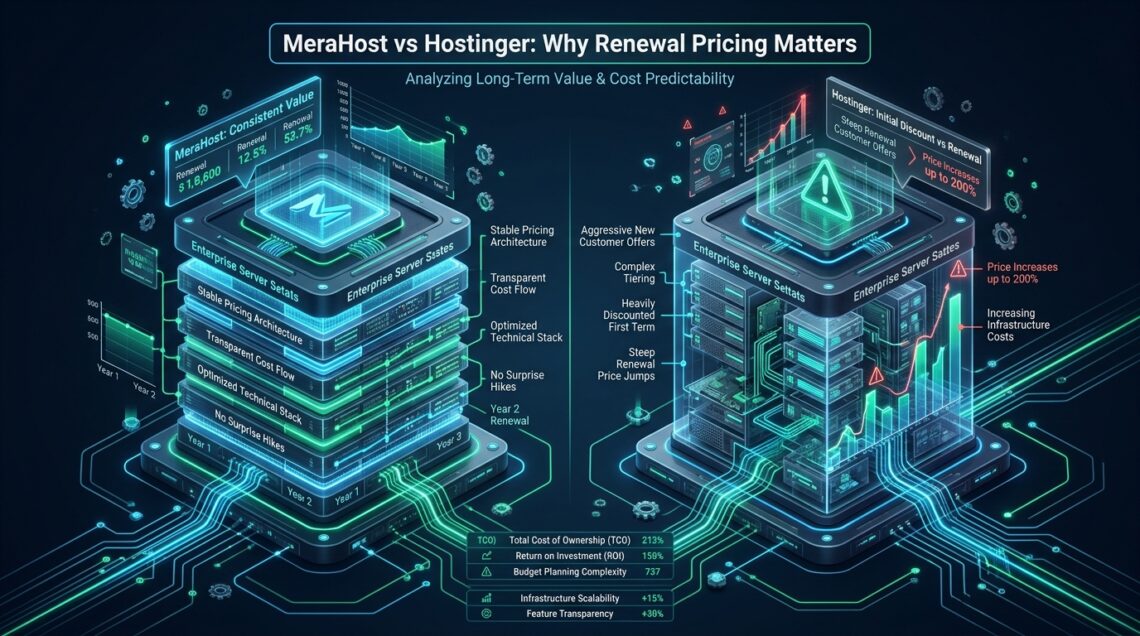
In enterprise systems engineering, Total Cost of Ownership (TCO) is frequently compromised not by initial capital expenditure, but by predatory renewal escalation models and silent multi-tenant compute throttling. Deploying latency-sensitive web services or business applications on introductory teaser hosting architectures often forces infrastructure leads into emergency migrations when renewal invoices surge by 250% to 400% alongside unpredictable CPU quota saturation. By engineering an uncompromised high-throughput server architecture paired with an immutable cost model, MeraHost eliminates the renewal shock cycle through enterprise-grade NVMe storage arrays, LiteSpeed Web Server, and an unconditional “Same Renewal Price, Always” commitment.
MeraHost vs Hostinger: The Definitive Architectural Summary
Direct Answer: The primary differentiator between MeraHost and Hostinger lies in long-term total cost of ownership (TCO) and architectural transparency. Hostinger discounts initial multi-year commitments but quadruples renewal rates while enforcing strict inode and IOPS ceilings on custom virtualized nodes. MeraHost delivers dedicated LiteSpeed Enterprise web servers and PCIe 4.0 NVMe storage with a strict Same Renewal Price, Always guarantee starting at ₹99/mo ($1.24/mo).
The Economics of Teaser Pricing vs. Long-Term TCO
Modern hosting providers generally adopt one of two operational strategies: loss-leader acquisition with steep renewal lock-in, or sustainable infrastructure provisioning with transparent, fixed-margin lifecycle costs. Understanding the divergence between these two philosophies is critical for systems architects, agency operators, and engineering leads managing multi-year digital infrastructure budgets.
Mass-market hosting brands frequently discount their entry tiers by up to 75% to 80%, provided the customer prepays for 36 to 48 months upfront. While this structure presents an enticing Day-1 expense on balance sheets, the technical and financial consequences manifest at the first renewal billing cycle:
- Compound Renewal Escalation: Plans initially contracted at ₹149/mo or $2.99/mo routinely renew at ₹499/mo to ₹699/mo ($8.99 to $11.99/mo). For an agency managing 30 client nodes, an annual hosting cost of ₹53,640 suddenly balloons to ₹215,640 upon contract maturation.
- Proprietary Control Panel Lock-in: Custom proprietary panels (such as hPanel) deliberately decouple configurations from standard cPanel/DirectAdmin migration formats. Exporting full application environments, database credentials, email forwards, and DNS routing records requires manual sysadmin intervention, introducing significant migration friction.
- Aggressive Compute Throttling Under Load: Underpriced multi-tenant nodes must maximize tenant density to maintain gross margins. When CPU or memory spikes occur, aggressive cgroup and CloudLinux LVE constraints throttle processes into 503 Service Unavailable errors.
Technical & Commercial Architecture Matrix
Below is a direct architectural and operational comparison between the standard mass-market hosting paradigm (Hostinger) and MeraHost’s high-performance enterprise standard across essential compute, storage, caching, and financial vectors.
Under the Hood: Multi-Tenant I/O Contention and Throttling
When evaluating hosting infrastructure, benchmarking raw CPU clock frequency alone yields an incomplete picture. The primary determinant of real-world application responsiveness—particularly for dynamic content management systems, microservices, and transactional SQL databases—is sustained disk I/O throughput and input/output operations per second (IOPS).
In low-cost mass-hosting environments, server nodes routinely host upwards of 800 to 1,500 active accounts per chassis. To prevent a single runaway script from monopolizing the physical storage bus, providers implement aggressive Linux cgroup v2 blkio limits and CloudLinux LVE I/O clamps. For example, accounts are commonly throttled to a maximum of 1,024 KB/s to 2,048 KB/s read/write bandwidth with a ceiling of 100 IOPS. When a WordPress site undergoes a core update or processes an e-commerce checkout batch, it immediately hits this ceiling, resulting in high I/O wait (%iowait) and thread starvation.
MeraHost solves this architectural bottleneck by deploying enterprise-tier NVMe arrays configured in hardware RAID with high-throughput PCIe lanes. By distributing tenant density responsibly and optimizing block device queue schedulers, individual tenant workloads sustain enterprise throughput without artificial disk starvation.
Production Infrastructure Configurations
To demonstrate the architectural mechanics required to sustain high-concurrency workloads on Linux server infrastructure, review the runnable production configurations below. These files demonstrate Linux kernel networking optimization, NVMe I/O queue tuning, and high-performance LiteSpeed/PHP process execution.
1. Linux Kernel High-Concurrency Network Tuning (/etc/sysctl.d/99-web-tuning.conf)
The following sysctl configuration optimizes the Linux TCP/IP stack for high-throughput web traffic, enabling TCP BBR congestion control, expanding ephemeral port ranges, and preventing SYN flood connection drops.
# /etc/sysctl.d/99-web-tuning.conf
# Enterprise Web Infrastructure Tuning - MeraHost Systems Architecture

# Maximize file descriptor ceiling across all processes
fs.file-max = 2097152

# Network core backlog queues
net.core.netdev_max_backlog = 65536
net.core.somaxconn = 65535

# TCP Memory buffers (min, default, max in bytes)
net.ipv4.tcp_rmem = 4096 87380 16777216
net.ipv4.tcp_wmem = 4096 65536 16777216

# Enable TCP BBR Congestion Control for low latency and high bandwidth
net.core.default_qdisc = fq
net.ipv4.tcp_congestion_control = bbr

# TCP SYN and KeepAlive parameters
net.ipv4.tcp_max_syn_backlog = 3240000
net.ipv4.tcp_fin_timeout = 15
net.ipv4.tcp_keepalive_time = 300
net.ipv4.tcp_keepalive_probes = 5
net.ipv4.tcp_keepalive_intvl = 15

# Ephemeral port range allocation
net.ipv4.ip_local_port_range = 1024 65535

# Virtual memory dirty page ratio tuning for sustained NVMe writing
vm.dirty_background_ratio = 5
vm.dirty_ratio = 10
vm.swappiness = 10
2. NVMe Storage Queue Scheduler Rule (/etc/udev/rules.d/60-nvme-scheduler.rules)
Enterprise NVMe devices deliver optimal IOPS when managed by the none or kyber kernel scheduler, bypassing legacy multi-queue rotation overhead associated with mechanical rotational disks.
# /etc/udev/rules.d/60-nvme-scheduler.rules
# Set Kyber or None I/O scheduler for Enterprise NVMe Block Devices

ACTION=="add|change", KERNEL=="nvme[0-9]*n[0-9]*", ATTR{queue/scheduler}="none"
ACTION=="add|change", KERNEL=="nvme[0-9]*n[0-9]*", ATTR{queue/read_ahead_kb}="128"
ACTION=="add|change", KERNEL=="nvme[0-9]*n[0-9]*", ATTR{queue/nr_requests}="1024"
3. High-Throughput PHP-FPM / LiteSpeed LSAPI Worker Pool
To eliminate 503 worker starvation during traffic surges, PHP execution pools must be calibrated to scale dynamically while safeguarding memory boundaries.
# /etc/php/8.3/fpm/pool.d/production.conf
[production_pool]
user = appuser
group = appgroup
listen = /run/php/php8.3-fpm-production.sock
listen.owner = www-data
listen.group = www-data
listen.mode = 0660

pm = dynamic
pm.max_children = 80
pm.start_servers = 16
pm.min_spare_servers = 12
pm.max_spare_servers = 24
pm.max_requests = 1000

request_terminate_timeout = 60s
rlimit_files = 65535
rlimit_core = 0

catch_workers_output = yes
php_admin_value[memory_limit] = 256M
php_admin_value[max_execution_time] = 60
php_admin_value[opcache.enable] = 1
php_admin_value[opcache.memory_consumption] = 128
Empirical Validation: Automated Concurrency & I/O Benchmark
Sysadmins should never rely on marketing claims alone. You can independently benchmark any hosting environment for time-to-first-byte (TTFB), sustained I/O latency, and multi-tenant CPU stability using the following diagnostic Bash benchmark script:
#!/usr/bin/env bash
# ==============================================================================
# Enterprise Hosting Performance Benchmark Suite
# Evaluates Disk I/O, Memory Bandwidth, and Dynamic HTTP/3 Latency
# ==============================================================================
set -euo pipefail

echo "=================================================="
echo "1. Benchmarking Sequential and Random NVMe I/O"
echo "=================================================="
fio --name=randwrite --ioengine=libaio --iodepth=32 --rw=randwrite \
    --bs=4k --direct=1 --size=512M --numjobs=2 --runtime=10 \
    --group_reporting --output-format=terse | awk -F';' '{print "Random Write IOPS: " $49 ", Bandwidth: " $48 " KB/s"}'

echo "\n=================================================="
echo "2. Measuring PHP Compilation & Opcode Execution Speed"
echo "=================================================="
php -r '
$start = microtime(true);
for ($i = 0; $i < 2000000; $i++) {
    $x = md5(sha1("test_hash_payload_" . $i));
}
$diff = microtime(true) - $start;
printf("Completed 2M cryptographic iterations in %0.4f seconds\n", $diff);
'

echo "\n=================================================="
echo "3. Profiling HTTP/3 Time-To-First-Byte (TTFB)"
echo "=================================================="
curl -s -w "DNS: %{time_namelookup}s | Connect: %{time_connect}s | TLS: %{time_appconnect}s | TTFB: %{time_starttransfer}s | Total: %{time_total}s\n" \
     -o /dev/null "https://merahost.org"
Vendor Lock-In: The Hidden Cost of Proprietary Panels
One of the least discussed differentiators in web infrastructure is control plane portability. When organizations deploy on mass-market platforms utilizing customized control panels (like Hostinger’s hPanel), they inadvertently enter a walled garden. Backups are exported in proprietary archive formats, database users require manual reconfiguration, and automated cPanel-to-cPanel migrations cannot be executed.
When the inevitable renewal invoice arrives with a 300% markup, migrating away becomes an arduous sysadmin chore. Organizations often find themselves trapped, paying exorbitant renewal rates simply because the labor cost of migrating dozens of custom-configured domains exceeds the price delta.
MeraHost avoids this lock-in entirely by adhering strictly to industry-standard control plane architecture. Backups are standard, cPanel migrations are fully automated, and DNS and mail configurations remain 100% portable. You retain total agency over your data and infrastructure stack at all times.
Choosing Sustainable Enterprise Architecture
For engineering leads and business stakeholders, selecting a hosting platform is fundamentally a risk management decision. Betting your infrastructure on aggressive promotional teaser pricing introduces technical liabilities, unexpected operational bottlenecks, and fiscal volatility at contract renewal.
By opting for a provider focused on enterprise stability, you gain predictable infrastructure budgeting alongside state-of-the-art server hardware. For mission-critical production hosting, MeraHost Enterprise Cloud delivers enterprise-grade NVMe storage, LiteSpeed Web Server acceleration, and an immutable Same Renewal Price, Always policy starting at ₹99/mo ($1.24/mo).
Frequently Asked Questions
Why do web hosting providers increase prices dramatically on renewal?
Many mass-market hosting companies operate on a loss-leader acquisition model. They offer deep upfront discounts (often requiring a 3 to 4-year upfront commitment) to acquire customers below cost. To achieve profitability, they rely on steep renewal price hikes—frequently 250% to 400%—banking on the fact that site owners will accept the higher bill rather than endure the technical friction of migrating elsewhere. MeraHost rejects this practice by maintaining the exact same renewal price for the lifetime of your account.
How does LiteSpeed Web Server compare to standard Nginx/Apache setups?
LiteSpeed Enterprise is an event-driven web server that serves as a direct, high-performance drop-in replacement for Apache while reading .htaccess rules natively. Unlike Nginx reverse-proxy hybrids that require separate FastCGI caches and complex micro-caching rules, LiteSpeed features native server-level caching (LSCache) and direct communication with PHP via LSAPI, delivering up to 12x higher throughput and significantly lower memory overhead during concurrent traffic surges.
Does MeraHost charge extra fees for SSL certificates, backups, or migrations?
No. Every MeraHost plan includes automated Let’s Encrypt SSL certificates, daily remote backups, and complimentary white-glove site migrations handled by experienced Linux administrators. There are no surprise add-on fees or hidden billing traps at checkout or renewal.
Can I migrate an existing WordPress or PHP site from Hostinger to MeraHost without downtime?
Yes. Our engineering team conducts zero-downtime migrations by staging your database and file assets on MeraHost, verifying SSL certificates and application functionality via staging hosts, and coordinating seamless DNS cutover to ensure continuous uninterrupted availability for your end users.
Deploy Enterprise-Grade Production Infrastructure
Need guaranteed performance with zero price hikes? Host mission-critical workloads on MeraHost with pure Enterprise NVMe, LiteSpeed Web Server, and Same Renewal Price, Always (starting at ₹99/mo).
Leave a Comment