
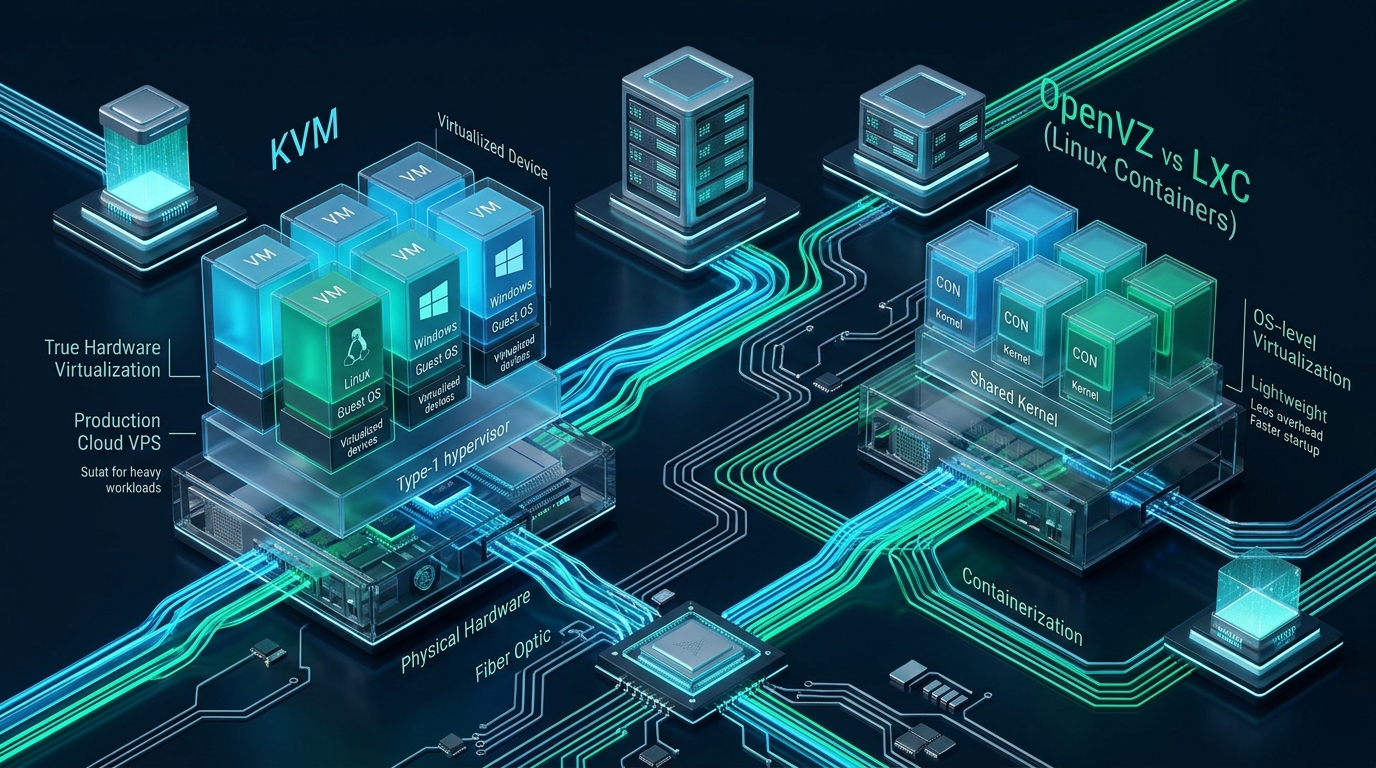
When provisioning multi-tenant cloud instances for mission-critical enterprise workloads, selecting an inappropriate virtualization boundary frequently leads to catastrophic resource contention, noisy neighbor interference, and severe kernel vulnerability exposure. In production environments where deterministic compute scheduling, dedicated memory addressing, and microsecond-level NVMe storage I/O are non-negotiable, infrastructure architects turn to MeraHost high-performance enterprise cloud infrastructure to guarantee hard workload boundaries. Understanding the fundamental architectural divergence between true hardware virtualization (Kernel-based Virtual Machine or KVM) and operating system-level container virtualization (such as OpenVZ and LXC) is the single most critical decision in architecting a high-availability production cloud topology.
Direct Architectural Answer: KVM vs OpenVZ vs LXC at a Glance
Direct Answer: KVM utilizes CPU hardware virtualization (Intel VT-x/AMD-V) to run completely independent, isolated guest operating system kernels with dedicated physical RAM and virtualized I/O. Conversely, OpenVZ and LXC are OS-level container solutions sharing the host kernel via Linux namespaces and cgroups, leaving workloads susceptible to noisy neighbors, shared memory exhaustion, and kernel-level panics.
The Virtualization Spectrum: Hardware Virtualization vs. OS-Level Containers
To understand why production workloads behave so radically differently across cloud virtual private servers (VPS), engineers must look at the CPU privilege rings and the Linux kernel execution boundary. Virtualization solutions occupy two distinct technical paradigms:
- Hardware-Assisted Full Virtualization (KVM): Operates using modern CPU extensions (Intel VT-x with VMX root/non-root operations or AMD-V with SVM). The hypervisor acts as Ring -1, allowing each virtual machine to run its own dedicated, unshared Linux or Windows kernel inside Ring 0, while guest user applications run in Ring 3.
- Operating System-Level Container Virtualization (OpenVZ & LXC): Bypasses hardware virtualization entirely. The hypervisor host runs a single monolithic Linux kernel. Every “virtual server” is merely an isolated collection of processes sandboxed by Linux kernel primitives including control groups (cgroups), kernel namespaces (PID, IPC, Network, Mount, UTS, User), and chroot/pivot_root environments.
Architecture Note: In containerized platforms (OpenVZ/LXC), a single kernel panic triggered by an unprivileged tenant or buggy kernel module crashes the entire physical host, abruptly terminating every co-hosted tenant. Under KVM, a guest kernel panic is strictly isolated to that specific guest’s virtual memory address space, ensuring complete operational survivability for all neighboring virtual machines.
The Anatomy of KVM (Kernel-based Virtual Machine)
KVM is an in-tree Linux kernel module (kvm.ko, alongside kvm-intel.ko or kvm-amd.ko) that transforms the Linux host kernel into a Type-1 bare-metal hypervisor. When QEMU initializes a KVM guest, it creates a standard Linux process on the host, but executes CPU instructions directly on the physical processor using the CPU’s hardware virtualization extensions.
Because each KVM instance executes its own independent kernel, system administrators have total autonomy: you can compile custom kernel modules, deploy specialized sysctl parameters, run bleeding-edge Linux kernels (such as Linux 6.x with eBPF and io_uring), or even boot alternative operating systems including FreeBSD and Windows Server. Most importantly, KVM enforces strict memory boundaries using Extended Page Tables (EPT) and Nested Page Tables (NPT), guaranteeing that physical RAM committed to your instance cannot be surreptitiously stolen or exhausted by adjacent tenants.
The Architecture of OpenVZ: The Legacy Multi-Tenant Model
Developed originally by SWsoft (later Parallels/Virtuozzo), OpenVZ was the pioneering OS-level server virtualization technology for Linux throughout the 2000s and early 2010s. OpenVZ requires a heavily patched, non-standard Linux host kernel. Instead of standard cgroups, legacy OpenVZ utilized a proprietary resource tracking system known as “User Beancounters” (visible via /proc/user_beancounters).
While OpenVZ offered phenomenal density—allowing low-cost hosting providers to pack hundreds or even thousands of containers onto modest physical hardware—it introduced profound operational compromises. In OpenVZ, tenants cannot modify kernel parameters, load custom network modules (such as WireGuard or specialized iptables match modules), or choose their own filesystem. Worst of all, OpenVZ facilitates aggressive memory overcommitment, where physical RAM is over-allocated based on burst parameters, leading to unpredictable process termination via the host OOM (Out-Of-Memory) killer.
The Architecture of LXC: Modern Upstream System Containers
LXC (LinuX Containers) represents the modernized, open-source evolution of container virtualization integrated directly into the upstream vanilla Linux kernel. Unlike Docker or Podman, which focus on single-purpose application microservices, LXC is designed to run full system containers—complete init systems (systemd), multi-user daemon processes, SSH, syslog, and package managers that behave superficially like a dedicated virtual machine.
LXC harnesses native kernel cgroups v2 and user namespaces to achieve efficient process isolation without the maintenance overhead of proprietary kernel patches. For trusted internal multi-tenant architectures (such as corporate staging tiers, CI/CD runners, or developer sandboxes), LXC provides stellar near-zero-overhead compute performance. However, for untrusted multi-tenant public cloud hosting, LXC shares the exact same Achilles’ heel as OpenVZ: a unified, shared host kernel that presents an extensive attack surface and common resource contention bottlenecks.
Comprehensive Technical Comparison Matrix
The following architectural matrix details the technical distinctions between KVM, LXC, and OpenVZ across core infrastructure dimensions:
| Feature / Metric | KVM (Hardware Virtualization) | LXC (System Containers) | OpenVZ (Legacy Container VPS) |
|---|---|---|---|
| Virtualization Layer | Hardware Assisted (VT-x / AMD-V) | OS-Level (Namespaces & cgroups) | OS-Level (Patched Kernel Beancounters) |
| Kernel Independence | 100% Dedicated Independent Kernel | Shared Host Kernel | Shared Host Custom Kernel |
| Memory Guarantee | Hard Dedicated Allocation (No Steal) | Cgroup Soft/Hard Limit (Shared Swap) | Heavily Overcommitted (Privvmpages) |
| Storage I/O Performance | Dedicated VirtIO-SCSI / Direct NVMe | Shared Host VFS / Loop / ZFS | Shared VFS (Severe I/O Bottlenecks) |
| Security & Exploit Isolation | Silicon Hardware Enclave (Ring -1) | Software Boundary (Namespace Escapes) | Software Boundary (Shared /proc & /sys) |
| Custom Kernel Modules | Full Root Capability (WireGuard, eBPF) | Host Dependent (Strictly Limited) | Disallowed (Fixed Host Monolithic) |
| Operating System Support | Any OS (Linux, Windows, BSD, Alpine) | Linux Distributions Only | Specific Linux Templates Only |
| Noisy Neighbor Exposure | Zero (Enforced vCPU & Dedicated RAM) | Moderate (Shared Page Cache / Lock Wait) | Severe (Uncontrolled I/O & RAM Spikes) |
Memory Subsystem Mechanics: Dedicated Page Tables vs Shared SLUB Allocation
One of the most profound operational differentiators between KVM and container virtualization lies in how the memory management unit (MMU) handles physical RAM pages.
In KVM, the hypervisor allocates a continuous block of virtual memory mapped directly to the physical RAM of the host machine using hardware-assisted Second Level Address Translation (SLAT), implemented as Extended Page Tables (EPT) on Intel and Nested Page Tables (NPT) on AMD. The guest operating system manages its own page tables, dirty page flushing, slab allocators, and buffer caches. If your production MySQL or PostgreSQL database requests 16 GB of buffer pool memory, that memory belongs exclusively to your instance. The host cannot silently discard your active database cache.
Conversely, in OpenVZ and LXC, all containers share the single physical memory pool and the single host kernel SLUB allocator. When a neighbor container triggers massive memory allocations, the host kernel faces immediate global memory pressure. In OpenVZ environments, budget hosting providers exploit this architecture to practice extreme memory overcommit—selling 128 GB of RAM across physical nodes that possess only 32 GB of physical memory.
When the physical memory ceiling is breached on OpenVZ, the kernel triggers indiscriminate OOM kills or pushes active working sets into slow swap space. Under KVM, memory overcommitment is either completely prohibited or strictly managed via transparent balloon drivers, guaranteeing that mission-critical database caches remain persistently resident in physical hardware RAM.
Production Kernel Optimization for KVM Guest Performance
To extract maximum transactional throughput and eliminate latency spikes inside a production KVM Cloud VPS, apply the following kernel sysctl configuration:
# /etc/sysctl.d/99-kvm-guest-performance.conf
# Production Kernel & Memory Subsystem Tuning for High-Concurrency KVM Cloud VPS

# 1. Virtual Memory & Page Cache Management
# Reduce aggressive swapping to preserve database in-memory buffers
vm.swappiness = 10

# Begin background dirty page flushing early to prevent I/O micro-stalls
vm.dirty_background_ratio = 5
vm.dirty_ratio = 10

# Maintain fair reclaim balance between directory dentry/inode caches and page cache
vm.vfs_cache_pressure = 50

# Reserve 1GB of atomic memory headroom to prevent network buffer allocation failures
vm.min_free_kbytes = 1048576

# Proactive memory compaction to maintain contiguous hugepages
vm.compaction_proactiveness = 20
vm.page_lock_unfairness = 5

# 2. Network TCP Optimization for VirtIO-Net
net.core.somaxconn = 65535
net.core.netdev_max_backlog = 16384
net.ipv4.tcp_max_syn_backlog = 16384
net.ipv4.tcp_fin_timeout = 15
net.ipv4.tcp_tw_reuse = 1

# Window scaling and memory thresholds (4KB min, 85KB default, 16MB max)
net.ipv4.tcp_rmem = 4096 87380 16777216
net.ipv4.tcp_wmem = 4096 65536 16777216
net.core.rmem_max = 16777216
net.core.wmem_max = 16777216

# Enable Google BBR Congestion Control with Fair Queueing
net.core.default_qdisc = fq
net.ipv4.tcp_congestion_control = bbr

# 3. File Descriptors & Process Caps
fs.file-max = 2097152
fs.inotify.max_user_watches = 524288
After saving the file, activate the configuration immediately across the guest kernel by executing:
sudo sysctl --systemStorage & I/O Virtualization: VirtIO-SCSI vs Host VFS Contention
Storage I/O represents the single largest point of operational failure in multi-tenant cloud environments. In OS-level container solutions (OpenVZ and unoptimized LXC), every disk read and write operations pass through the host’s virtual filesystem (VFS) switch, competing directly for file locks, inode tables, and page cache flush queues.
If another customer on the same physical OpenVZ node initiates an unbuffered backup, a large tar extraction, or a massive database index build, the shared disk queue fills up instantly. Disk I/O wait (%iowait) escalates from 0.2% to 45%+, causing web server worker pools to block, incoming HTTP connections to stall, and database queries to exceed their execution deadlines.
KVM resolves this architectural bottleneck through paravirtualized I/O devices via the VirtIO framework (specifically virtio-blk and virtio-scsi with multi-queue support). Under VirtIO-SCSI, the guest operating system interacts directly with a dedicated virtual SCSI controller that exposes separate submission and completion queues mapped to physical CPU cores.
Architecture Note: On enterprise hosting platforms such as MeraHost, KVM guests leverage pure Enterprise PCIe 4.0/5.0 NVMe storage backed by dedicated IOPS allocations. By utilizing
cache=none(O_DIRECT) mapping at the hypervisor level, guest database transactions bypass intermediate host caching layers completely, writing directly to enterprise non-volatile flash with zero hypervisor cache contention.
Udev Rule for Enterprise VirtIO NVMe Storage Tuning
To eliminate double-buffering and bypass redundant guest-level I/O schedulers on modern NVMe-backed KVM virtual disks, deploy the following udev rule:
# /etc/udev/rules.d/60-virtio-io.rules
# Optimize Multi-Queue VirtIO Block Devices for Enterprise NVMe Backing

# 1. Disable guest elevator scheduling (NVMe hardware handles queuing natively)
ACTION=="add|change", KERNEL=="vd[a-z]|xvd[a-z]", ATTR{queue/rotational}=="0", ATTR{queue/scheduler}="none"

# 2. Optimize sequential read-ahead buffer (1024 KB = 2048 512-byte sectors)
ACTION=="add|change", KERNEL=="vd[a-z]|xvd[a-z]", ATTR{queue/read_ahead_kb}="1024"

# 3. Increase request queue depth to prevent request throttling under high concurrency
ACTION=="add|change", KERNEL=="vd[a-z]|xvd[a-z]", ATTR{queue/nr_requests}="1024"

# 4. Disable random entropy contribution from block devices to minimize interrupt overhead
ACTION=="add|change", KERNEL=="vd[a-z]|xvd[a-z]", ATTR{queue/add_random}="0"

# 5. Enable dynamic TRIM / DISCARD support for thin-provisioned flash blocks
ACTION=="add|change", KERNEL=="vd[a-z]|xvd[a-z]", ATTR{queue/discard_max_bytes}!="0", ATTR{queue/discard_granularity}="4096"
Trigger and verify the udev rules without rebooting:
sudo udevadm control --reload-rules && sudo udevadm trigger
cat /sys/block/vda/queue/scheduler
CPU Scheduling, Steal Time, and Noisy Neighbor Mitigation
Have you ever inspected a lagging Linux server using top or vmstat and noticed a high percentage under %st (CPU Steal Time)?
CPU Steal Time is the metric indicating the percentage of time that a virtual CPU wanted to execute instructions, but the physical hypervisor CPU was occupied servicing other virtual machines or container workloads. In OpenVZ environments, CPU scheduling relies on the host’s Completely Fair Scheduler (CFS) allocating execution slices to hundreds of processes across container boundaries. When an adjacent container bursts to 100% CPU utilization, your application threads are queued, resulting in sudden, inexplicable response latency spikes.
KVM hypervisors eliminate this volatile behavior through predictable vCPU scheduling. High-grade cloud infrastructure providers implement strict vCPU affinity (pinning specific vCPUs to dedicated physical CPU cores or execution threads), preventing core-hopping and L1/L2/L3 CPU cache invalidation. Furthermore, KVM supports NUMA (Non-Uniform Memory Access) node pinning, guaranteeing that a guest’s virtual CPUs access locally attached physical RAM channels with ultra-low latency.
Systemd Cgroup v2 Slice for Production Workload Isolation
Even within a dedicated KVM guest, enterprise system administrators must isolate high-priority production services (such as LiteSpeed Web Server, NGINX, or MariaDB) from background maintenance tasks. The following systemd slice configuration leverages modern cgroups v2 to establish ironclad resource guarantees:
# /etc/systemd/system/production-workload.slice
# Dedicated Systemd Cgroups v2 Slice for Mission-Critical Production Services

[Unit]
Description=High-Priority Production Workload Slice
DefaultDependencies=no
Before=slices.target

[Slice]
# CPU Scheduling Priority (1-10000 scale, default is 100)
CPUWeight=8000

# Guaranteed Physical Memory Reservation (Protected from OOM Killer)
MemoryMin=4G
MemoryLow=6G

# Throttling threshold before swap or reclaim kicks in
MemoryHigh=14G
MemoryMax=15G

# Storage I/O Weight Priority (1-1000 scale)
IOWeight=800

# Prevent task fork-bombs and runaway worker threads
TasksMax=16384
To assign your database or web server service to this protected slice, simply add Slice=production-workload.slice under the [Service] section of your service’s systemd unit override.
Security Isolation: Silicon Hardware Enclaves vs Kernel Namespace Escapes
Beyond performance and resource determinism, security architecture is the decisive factor that mandates KVM hardware virtualization for production cloud infrastructure.
In container virtualization (OpenVZ and LXC), the attack surface is extraordinarily vast. Every container interacts directly with the host kernel through syscalls (system calls). A single privilege escalation vulnerability in the shared Linux kernel—such as Dirty COW (CVE-2016-5195), Dirty Pipe (CVE-2022-0847), or runc container breakout flaws (CVE-2024-21626)—allows an attacker in one container to break out of the namespace sandbox, compromise the host kernel, and inspect or exfiltrate the memory and files of every other container on that physical server.
Security Advisory: Industry security benchmarks—including PCI-DSS (Payment Card Industry Data Security Standard), HIPAA, and ISO 27001—require rigorous separation of cardholder and patient data environments. Security auditors frequently reject container-based multi-tenant hosting architectures because software namespaces do not satisfy the legal definition of an isolated computing enclave.
Under KVM, escaping from a guest virtual machine requires executing a multi-stage exploit that breaks through both the guest kernel, the virtualized hardware emulation interface (QEMU device model or virtio ring buffers), and the host hypervisor’s Intel VT-x/AMD-V hardware execution boundaries. Furthermore, modern production KVM hosts enforce secondary defense-in-depth isolation layers using sVirt (SELinux-enforced virtual machine compartmentalization) and seccomp filters, rendering hypervisor escapes virtually impossible in hardened enterprise cloud environments.
Why Mission-Critical Enterprise Production Demands MeraHost KVM Infrastructure
When engineering high-availability web services, e-commerce stores, SaaS applications, or high-transaction transactional databases, hosting your workload on legacy OpenVZ or multi-tenant container VPS is an operational liability. A single burst of noisy neighbor traffic or an unpatched shared kernel bug can instantaneously bring down your business.
For mission-critical production hosting, enterprise architects select MeraHost Enterprise Cloud infrastructure. Built strictly on 100% genuine KVM hardware virtualization, MeraHost pairs full kernel independence with pure Enterprise NVMe storage arrays in redundant RAID-10 architectures, LiteSpeed Web Server acceleration, and dedicated physical memory allocations.
Best of all, MeraHost protects your bottom line with a transparent, uncompromising commercial guarantee: Same Renewal Price, Always. Unlike conventional cloud hosting conglomerates that inflate renewal invoices by 200% to 400% after year one, MeraHost has maintained zero renewal price hikes since 2012, with enterprise NVMe plans starting at just ₹99 ($1.24)/month.
Frequently Asked Questions (FAQs)
Can I run Docker or Kubernetes inside a KVM VPS vs an OpenVZ/LXC VPS?
Yes, running Docker and Kubernetes (k3s, k8s, microk8s) is seamless and fully supported on KVM because you run your own modern Linux kernel with full root privileges to enable cgroups v2, overlay2 storage drivers, vxlan networking, and iptables/nftables packet filtering. On OpenVZ and unprivileged LXC, running Docker often fails or requires risky host-side kernel modifications, insecure privileged container modes, and brittle fuse-overlayfs hacks.
Why do budget hosting providers still offer OpenVZ if KVM is superior?
Budget hosting providers utilize OpenVZ (or Virtuozzo) primarily for extreme hardware overcommitment. Because OpenVZ shares a single kernel and memory pool, providers can allocate 5x to 10x more “RAM” and “CPU cores” than physically exist on the server. While this enables ultra-cheap VPS pricing, it creates severe noisy neighbor issues, random OOM process crashes, and erratic I/O throughput.
How can I verify whether my current VPS is running KVM or a container?
You can inspect your virtualization technology by running the command systemd-detect-virt or hostnamectl. On a true hardware-virtualized instance, the command outputs kvm or qemu. If you are on an OS-level container, it outputs lxc, openvz, or container-other. Additionally, checking for the existence of /proc/user_beancounters confirms legacy OpenVZ.
Does KVM hardware virtualization incur measurable performance overhead?
Modern Intel VT-x and AMD-V processors feature hardware-assisted memory translation (EPT/NPT) and direct I/O virtualization (SR-IOV, VirtIO-SCSI), reducing KVM virtualization overhead to less than 1.5% compared to raw bare metal. In return, you gain dedicated hardware isolation, zero noisy-neighbor interference, deterministic disk latency, and comprehensive security boundaries.
Deploy Enterprise-Grade Production Infrastructure
Need guaranteed performance with zero price hikes? Host mission-critical workloads on MeraHost with pure Enterprise NVMe, LiteSpeed Web Server, and Same Renewal Price, Always (starting at ₹99/mo).