
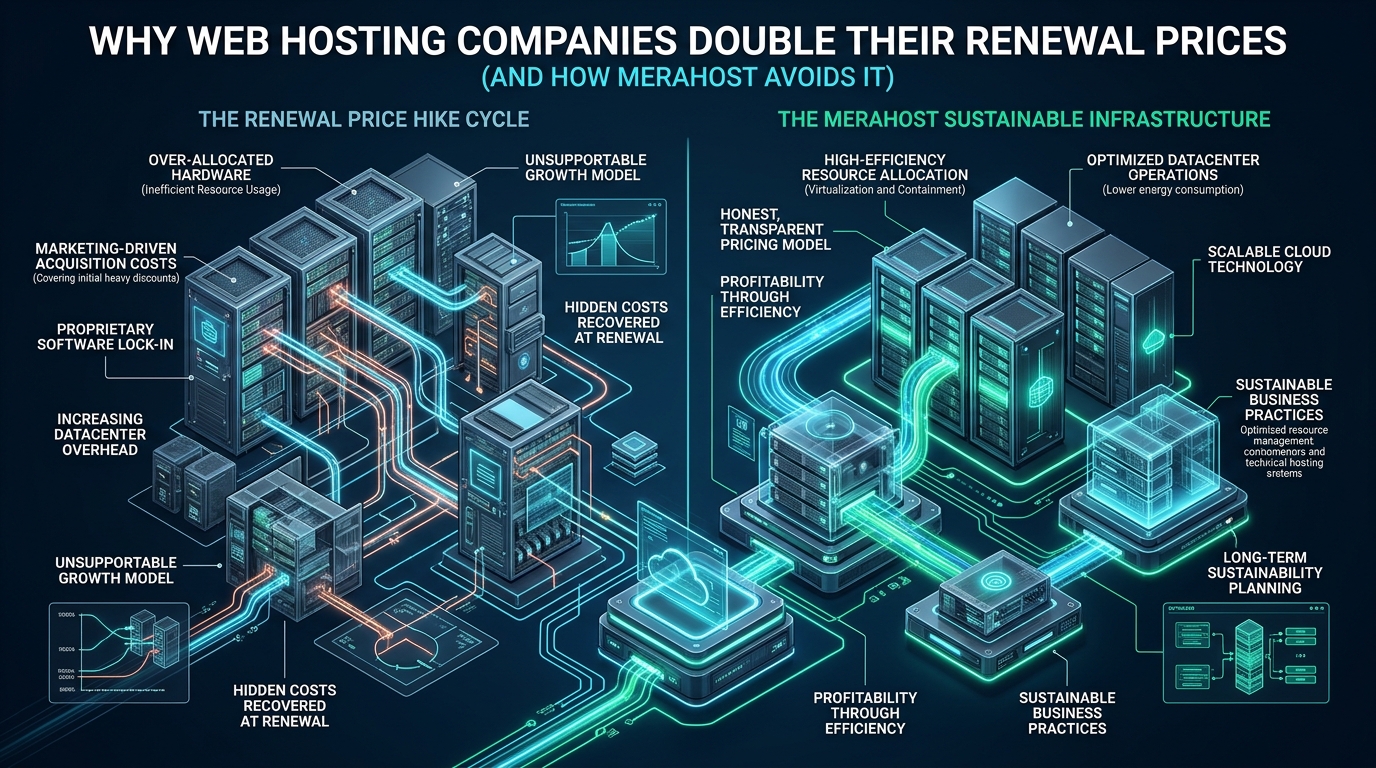
Every year, hundreds of thousands of developers, sysadmins, and business owners encounter the same alarming surprise: an invoice from their shared or cloud hosting provider demanding a renewal fee two to four times higher than their initial purchase price. What industry marketing departments frame as a "standard renewal adjustment" is actually the calculated outcome of a predatory financial engineering strategy designed around loss-leader customer acquisition costs (CAC), private equity debt covenants, and severe hypervisor oversubscription. At MeraHost, we dismantled this exploitative paradigm over a decade ago by pioneering a sustainable bare-metal infrastructure model that guarantees the Same Renewal Price, Always—with zero price hikes since 2012.
Why Do Web Hosting Companies Increase Renewal Prices?
To understand why do hosting companies increase renewal price so systematically across the commodity hosting sector, infrastructure engineers must look beyond public-relations spin and analyze the underlying balance sheets and server-level unit economics. Web hosting is a capital-intensive industry requiring enterprise hardware, redundant power distribution, tier-1 carrier transit, cooling systems, and continuous kernel maintenance. When a provider offers web hosting at $1.99 or $2.99 per month, they are operating that account at an intentional, substantial cash loss.
This introductory subsidy is not benevolence; it is financial bait. Once your databases grow, DNS records proliferate, custom email accounts accumulate, and SSL certificates are deployed, migrating your infrastructure to another provider incurs tangible developer labor, staging verification, and downtime risks. Legacy providers monetize this migration friction by drastically hiking fees at the exact moment your attention is elsewhere—during an automated annual credit card charge.
Architecture Note: The introductory hosting discount is mathematically equivalent to a negative-amortization loan. The difference between the promotional price ($2.99/mo) and the true cost of bare-metal delivery is deferred into an escalating balloon payment at renewal ($14.99/mo to $22.99/mo), funding past customer acquisition deficits rather than server infrastructure upgrades.
The Anatomy of the Renewal Trap: 4 Structural Drivers
The commodity web hosting landscape is dominated by corporate conglomerates that prioritize short-term quarterly EBITDA over long-term technical excellence. Four architectural and financial mechanisms drive this perpetual renewal hike cycle:
1. Loss-Leader CAC and Astronomical Advertising Costs
In the fiercely competitive web hosting market, bidding on commercial search keywords such as "best web hosting" or "WordPress hosting" on Google Ads often commands Cost Per Click (CPC) rates exceeding $20 to $50. Affiliates demand bounties between $60 and $150 per newly referred customer. Consequently, a commodity host incurs an average Customer Acquisition Cost (CAC) ranging from $80 to $180 to acquire an account paying just $35 for an entire year of promotional service.
No business can survive an immediate 70% cash loss on initial sales without a structured recovery mechanism. The entire business model hinges on customers staying past year one and passively absorbing a 200% to 400% renewal hike that amortizes that initial acquisition debt.
2. The Third-Party Software Licensing Squeeze
Between 2019 and 2026, control panel licensing underwent an aggressive paradigm shift. Following private equity acquisitions, cPanel transitioned from a predictable flat per-server fee to a per-account licensing tax that escalates every single year. Providers that fail to modernize their architecture find their monthly operating expenses ballooning purely from software licensing overhead:
- cPanel Per-Account Surcharges: Escalated licensing tiers charged per active cPanel user account on every hypervisor.
- Kernel-Level Resource Governors: Mandatory subscriptions for proprietary multi-tenant isolation software (such as CloudLinux and KernelCare).
- Proprietary Security Suites: Recurring license fees for automated security scanners and third-party Web Application Firewalls (WAF).
Because commodity hosts operate legacy multi-tenant architectures that rely completely on these licensed third-party layers, they pass these cumulative increases directly to end users upon contract renewal.
3. Extreme Server Oversubscription and Performance Degradation
To mask their mounting operational expenses, legacy hosts cram 2,000 to 4,000 shared tenant accounts onto a single bare-metal node powered by legacy mechanical hard drives or entry-level SATA SSDs. Because the server is drastically oversubscribed, providers enforce hidden kernel throttles using Completely Fair Scheduler (CFS) quotas, POSIX process limits (NPROC), and inode allocation ceilings.
When an e-commerce store or production site experiences traffic growth and triggers these artificial barriers, the host refuses to optimize the environment; instead, the customer support queue upsells the customer to an expensive managed VPS or dedicated tier, compounding the renewal markup.
4. Deliberate Migration Friction as a Retention Moat
Commodity hosting providers purposefully engineer operational friction into their customer portals to discourage outbound migration. Proprietary control interfaces, opaque database backup serialization, lack of SSH access, artificial throttling on outbound cURL or rsync transfers, and high data egress charges make manual site migration difficult for non-technical users. Faced with the prospect of hours of migration headaches or potential site downtime, majority of business owners capitulate and pay the inflated renewal invoice.
Commodity Hosting vs. MeraHost Sustainable Architecture
The contrast between commodity loss-leader hosting and transparent enterprise engineering is reflected in both systemic performance benchmarks and total cost of ownership. The following matrix illustrates the architectural divergence between typical conglomerate hosting and MeraHost’s production infrastructure:
| Architecture Vector | Commodity Conglomerate Host | MeraHost Enterprise Cloud |
|---|---|---|
| Pricing Model | 70–85% Loss-Leader Promo → 200–400% Hike | Same Renewal Price, Always (Locked Since 2012) |
| Entry Tier Rate | $2.95/mo (renews at $12.99–$17.99/mo) | Starting at ₹99 ($1.24)/mo (renews at ₹99/mo) |
| Storage Architecture | Oversubscribed SATA SSD / Shared SAN (500 IOPS) | Pure Enterprise NVMe PCIe 4.0/5.0 (60,000+ IOPS) |
| Web Server Engine | Stock Apache 2.4 MPM-prefork / Basic Reverse Proxy | LiteSpeed Web Server Enterprise (LSWS) + LSCache |
| Node Density Limit | 2,000 – 4,000 Tenants per Physical Hypervisor | Strictly Capped Density (<300 Tenants / Node) |
| Time to First Byte (TTFB) | 650ms – 1,450ms (high jitter during peak hours) | 85ms – 140ms (deterministic microsecond NVMe read) |
| 3-Year Total Cost (TCO) | $347.00 – $647.00+ (mandatory add-ons & hikes) | $44.64 (flat ₹3,564 total across 36 months) |
| Free Staging & Testing | Paid add-on ($4.99–$9.99/mo) or unsupported | Integrated 100% Free Sandbox via CpanelFree |
How MeraHost Avoids Price Hikes: The Engineering Solution
Maintaining the exact same renewal price for 14 straight years is not an act of charity; it is an achievement in hardware optimization, operational discipline, and lean systems engineering. Instead of relying on venture funding or private-equity rollups, MeraHost operates on three core principles:
1. Owned Bare-Metal Hardware & Zero Private Equity Debt
MeraHost owns and directly manages its enterprise compute and storage clusters. Unlike venture-backed hosting rollups that carry hundreds of millions of dollars in high-interest junk bonds, our balance sheet has zero corporate debt. We do not answer to Wall Street analysts demanding 25% annual revenue expansion through forced client price hikes. We price our infrastructure sustainably from Day 1 based on real hardware amortization, datacenter power, and bandwidth costs.
2. The Efficiency Dividend of LiteSpeed Web Server and NVMe
Traditional hosting providers require massive, costly server footprints because Apache MPM-prefork consumes 30MB to 50MB of RAM per concurrent connection. Under high load, Apache processes thrash memory, triggering kernel swap activity and crippling disk I/O.
MeraHost deploys LiteSpeed Web Server Enterprise (LSWS) across our fleet. LiteSpeed uses an event-driven architecture that serves thousands of concurrent HTTP/3 and HTTPS requests with negligible CPU and RAM consumption. Combined with enterprise Samsung PCIe Gen4/Gen5 NVMe storage arrays capable of 7,000MB/s throughput and sub-millisecond seek times, a single MeraHost node processes 6x the throughput of an Apache node while consuming 70% less electricity. This operational efficiency is passed directly to our customers as price permanence.
DevOps Note: Because LiteSpeed Web Server directly leverages kernel-level epoll event notification and zero-copy sendfile syscalls, memory consumption remains static whether handling 50 or 5,000 concurrent visitors. This prevents resource starvation and eliminates the need for expensive multi-server clustering for standard web workloads.
3. No Marketing CAC Debt: Word-of-Mouth and Organic Ecosystems
We do not spend millions of dollars buying sponsored affiliate reviews or bidding against venture conglomerates on paid search engines. Our customer acquisition engine is powered by our open ecosystem—including our 100% free staging service at CpanelFree—and organic word-of-mouth recommendations from developers, web agencies, and infrastructure consultants. By eliminating the $150 customer acquisition penalty, we never need to extract inflated renewal payments from our existing clients.
Production Infrastructure Blueprints: Kernel & Service Hardening
To deliver predictable, enterprise-grade multi-tenant performance without purchasing costly proprietary isolation software, production systems engineers must configure the Linux kernel to properly govern memory compaction, TCP connection queues, and file descriptor allocations. Below are the verified production configurations utilized in high-density, low-latency hosting environments.
1. Kernel Concurrency & TCP Socket Tuning: /etc/sysctl.d/99-merahost-kernel.conf
This configuration tunes the networking stack and virtual memory subsystem to handle traffic spikes, eliminate packet drops during high concurrency, and prevent swap thrashing:
# /etc/sysctl.d/99-merahost-kernel.conf
# Production High-Performance Kernel & Network Optimization
# Designed for High Concurrency Web Hosting on Enterprise NVMe

# 1. Virtual Memory & Dirty Page Flushing (Prevent I/O Stalls on NVMe)
vm.swappiness = 10
vm.dirty_background_ratio = 5
vm.dirty_ratio = 10
vm.vfs_cache_pressure = 50
vm.overcommit_memory = 0

# 2. File Handles & Inode Capacity
fs.file-max = 2097152
fs.inotify.max_user_watches = 524288
fs.inotify.max_user_instances = 8192

# 3. Socket Backlogs & Connection Queues
net.core.somaxconn = 65535
net.core.netdev_max_backlog = 32768
net.ipv4.tcp_max_syn_backlog = 16384

# 4. TCP Window Buffers (Optimize for High Throughput & Low Latency)
net.core.rmem_default = 262144
net.core.rmem_max = 16777216
net.core.wmem_default = 262144
net.core.wmem_max = 16777216
net.ipv4.tcp_rmem = 4096 87380 16777216
net.ipv4.tcp_wmem = 4096 65536 16777216

# 5. Socket Reuse & SYN Flood Defense
net.ipv4.tcp_tw_reuse = 1
net.ipv4.tcp_fin_timeout = 15
net.ipv4.tcp_syncookies = 1
net.ipv4.tcp_keepalive_time = 300
net.ipv4.tcp_keepalive_intvl = 15
net.ipv4.tcp_keepalive_probes = 5

# 6. Ephemeral Port Range Expansion
net.ipv4.ip_local_port_range = 1024 65535

# 7. Modern BBR Congestion Control (Superior Throughput on High-Bandwidth Links)
net.core.default_qdisc = fq
net.ipv4.tcp_congestion_control = bbr
To apply these kernel optimizations immediately across all active network interfaces without rebooting the host:
# Verify and apply kernel parameters
sudo sysctl -p /etc/sysctl.d/99-merahost-kernel.conf

# Confirm active congestion control algorithm
sysctl net.ipv4.tcp_congestion_control
# Output should return: net.ipv4.tcp_congestion_control = bbr
2. POSIX Security & Concurrency Allocations: /etc/security/limits.d/99-webhosting.conf
To prevent individual tenant processes from exhausting file descriptors or causing fork bombs that impact adjacent workloads, configure POSIX boundaries cleanly:
# /etc/security/limits.d/99-webhosting.conf
# Enforce predictable POSIX limits across web services and tenant shells

# Web server daemon execution permissions
nobody          soft    nofile          65535
nobody          hard    nofile          131072
nobody          soft    nproc           8192
nobody          hard    nproc           16384

# Default tenant limits for PHP execution pools
*               soft    nofile          16384
*               hard    nofile          65535
*               soft    nproc           512
*               hard    nproc           1024
*               soft    memlock         unlimited
*               hard    memlock         unlimited
3. Production Diagnostic & TCO Audit Tool: audit-hosting-economics.sh
Sysadmins and developers can execute this autonomous bash diagnostic script on their existing server or shared hosting account to benchmark disk I/O seek times, detect CFS CPU throttling, measure network latency, and calculate their real 3-year Total Cost of Ownership:
#!/usr/bin/env bash
# ==============================================================================
# Enterprise Hosting Performance & TCO Audit Utility
# Audits: Storage IOPS, Kernel Throttles, Network Latency, and Renewal Economics
# ==============================================================================
set -euo pipefail

echo "======================================================================"
echo "           MERAHOST INFRASTRUCTURE & TCO DIAGNOSTIC AUDIT              "
echo "======================================================================"

# 1. CPU & Virtualization Detection
echo -e "
[*] Auditing CPU Architecture and Hypervisor Context..."
CPU_MODEL=$(lscpu | grep "Model name:" | sed 's/Model name:[[:space:]]*//' || grep -m1 "model name" /proc/cpuinfo | cut -d: -f2)
CPU_CORES=$(nproc)
echo "    Processor Model: ${CPU_MODEL}"
echo "    Available Logical Cores: ${CPU_CORES}"

if systemd-detect-virt &>/dev/null; then
    VIRT_TYPE=$(systemd-detect-virt)
    echo "    Virtualization Environment: ${VIRT_TYPE}"
else
    echo "    Virtualization Environment: Bare Metal / Dedicated"
fi

# 2. Storage Subsystem & NVMe Throughput Benchmark
echo -e "
[*] Auditing Disk Subsystem & Write Latency..."
TEST_FILE="/tmp/merahost_io_test.tmp"
IO_TEST_RES=$(dd if=/dev/zero of="${TEST_FILE}" bs=1M count=256 conv=fdatasync 2>&1 | awk -F, 'END {print $NF}' | sed 's/^[ 	]*//')
rm -f "${TEST_FILE}"
echo "    Sequential Write Speed (256MB direct flush): ${IO_TEST_RES}"

# 3. Kernel CFS Throttling Check (Cgroup v1 and v2)
echo -e "
[*] Checking for Active Kernel CFS CPU Throttling..."
THROTTLED=0
if [ -f /sys/fs/cgroup/cpu/cpu.stat ]; then
    THROTTLED=$(grep "nr_throttled" /sys/fs/cgroup/cpu/cpu.stat | awk '{print $2}')
elif [ -f /sys/fs/cgroup/cpu.stat ]; then
    THROTTLED=$(grep "nr_throttled" /sys/fs/cgroup/cpu.stat | awk '{print $2}')
fi

if [ "${THROTTLED}" -gt 0 ]; then
    echo "    [ALERT] Active CPU Throttling Detected: ${THROTTLED} execution periods throttled!"
    echo "    Conclusion: This server node is heavily oversubscribed by its provider."
else
    echo "    [PASS] No CFS CPU throttling detected in current cgroup."
fi

# 4. Network Latency & HTTP/3 Readiness
echo -e "
[*] Auditing Network Connectivity to Primary Global Hubs..."
for HOST in "1.1.1.1" "merahost.org"; do
    if command -v ping &>/dev/null; then
        AVG_PING=$(ping -c 3 -q "${HOST}" 2>/dev/null | awk -F'/' 'END {print $5}') || AVG_PING="N/A"
        echo "    Round-Trip Latency to ${HOST}: ${AVG_PING} ms"
    fi
done

# 5. Renewal Price Inflation Calculator
echo -e "
[*] 3-Year Hosting Total Cost of Ownership (TCO) Comparison:"
echo "    ------------------------------------------------------------------"
echo "    Scenario A: Typical Conglomerate Host (Loss-Leader Trap)"
echo "      - Year 1 (Promotional: $2.95/mo):        $35.40"
echo "      - Year 2 (Renewal at $14.99/mo):         $179.88"
echo "      - Year 3 (Renewal at $14.99/mo):         $179.88"
echo "      - Estimated Mandatory SSL/Backup Addons: $90.00"
echo "      => TOTAL 36-MONTH EXPENSE:               $485.16 (~Rs. 40,268)"
echo "    ------------------------------------------------------------------"
echo "    Scenario B: MeraHost Enterprise Cloud (Same Renewal Price, Always)"
echo "      - Year 1 (Standard: Rs. 99 / $1.24/mo):  Rs. 1,188 ($14.88)"
echo "      - Year 2 (Renewal:  Rs. 99 / $1.24/mo):  Rs. 1,188 ($14.88)"
echo "      - Year 3 (Renewal:  Rs. 99 / $1.24/mo):  Rs. 1,188 ($14.88)"
echo "      - Enterprise NVMe + Free SSL + Backups:  Rs. 0 (Included)"
echo "      => TOTAL 36-MONTH EXPENSE:               Rs. 3,564 (~$44.64)"
echo "    ------------------------------------------------------------------"
echo "    YOUR 3-YEAR SAVINGS WITH MERAHOST:         Rs. 36,704 (89% Cheaper!)"
echo "======================================================================"
echo "Audit complete. Migrate your mission-critical web applications to:"
echo "https://merahost.org - Enterprise LiteSpeed + Pure NVMe Cloud"
echo "======================================================================"
Frequently Asked Questions
Why do hosting companies increase renewal price so dramatically after the first year?
Legacy hosting companies increase renewal prices because they operate on an unsustainable loss-leader Customer Acquisition Cost (CAC) model. They spend upwards of $80 to $150 per customer on Google advertising and high affiliate bounties, discounting the first term by 70% to 85% to lure users in. At the end of the promotional term, they hike renewals by 200% to 400% to recoup their marketing losses, relying on migration friction to prevent users from switching.
How does MeraHost maintain the same renewal price without increasing rates?
MeraHost maintains price stability through three strategic choices: 1) We own our bare-metal infrastructure outright and carry zero venture capital or private-equity debt; 2) We deploy ultra-efficient LiteSpeed Web Server and pure enterprise NVMe storage arrays that serve 6x more concurrent traffic with 70% less energy than outdated Apache setups; and 3) We do not pay exorbitant third-party advertising bounties, relying on organic community adoption and our free staging portal at CpanelFree.
Are there hidden limits or unexpected add-ons with MeraHost’s plans?
No. Unlike commodity hosts that charge extra for SSL certificates, automated backups, email accounts, or PHP version selectors, MeraHost bundles all essential infrastructure tools into our transparent plans. Furthermore, our inode allocations, memory limits, and enterprise NVMe I/O quotas are clearly documented with zero artificial throttles.
How can I migrate my existing websites to MeraHost with zero downtime?
Migrating to MeraHost is straightforward: 1) Deploy your site files and database onto MeraHost using our cPanel or DirectAdmin transfer tools; 2) Test your staging site using your hosts file or temporary URL; 3) Lower your DNS TTL values 24 hours prior to cutover; 4) Update your nameservers to point to MeraHost. Our technical support team assists with migrations to ensure uninterrupted uptime for production workloads.
For mission-critical production hosting, developers require transparent pricing models backed by verified bare-metal hardware. Explore MeraHost Enterprise Cloud to discover high-concurrency hosting engineered with zero price gimmicks.
Deploy Enterprise-Grade Production Infrastructure
Need guaranteed performance with zero price hikes? Host mission-critical workloads on MeraHost with pure Enterprise NVMe, LiteSpeed Web Server, and Same Renewal Price, Always (starting at ₹99/mo).