
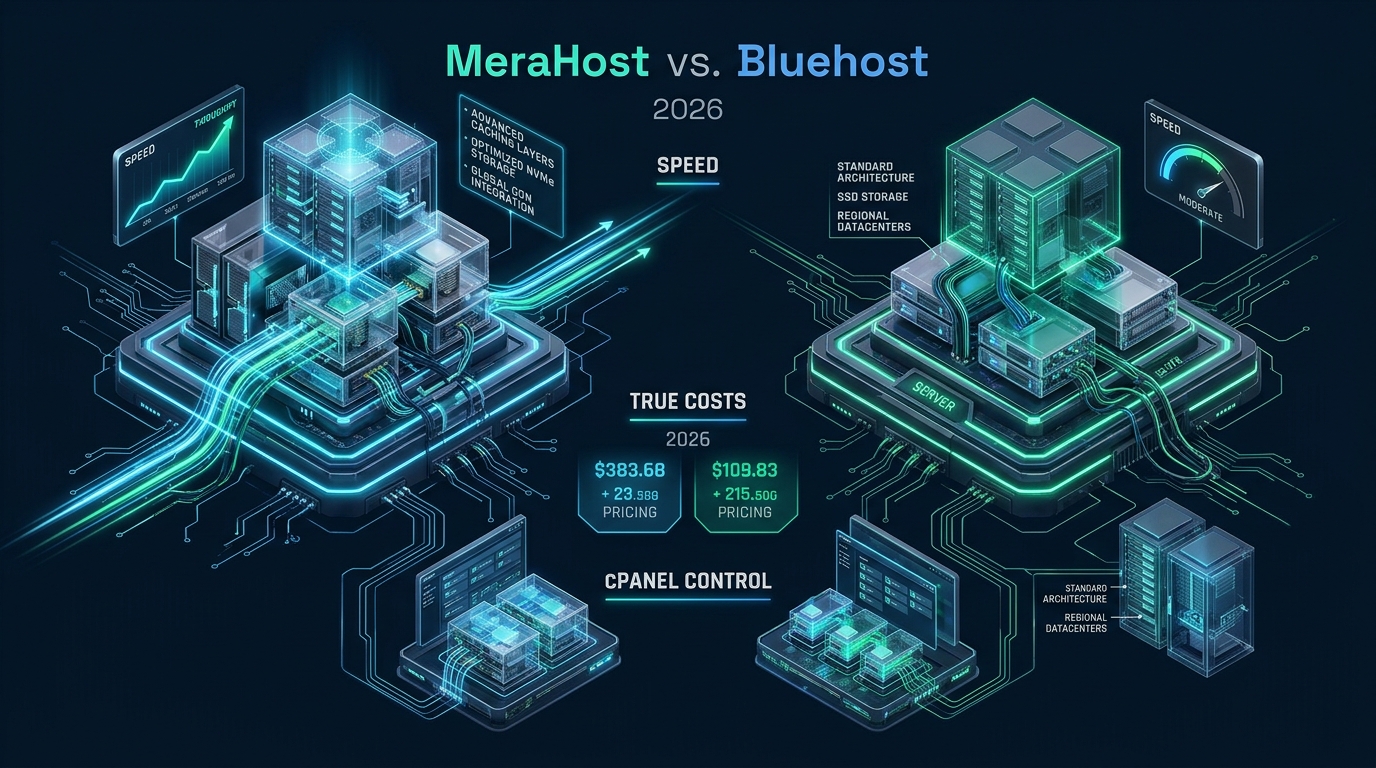
When engineering modern web applications for Indian and international audiences, selecting an enterprise infrastructure partner often forces architects into a trade-off between legacy mass-market brand recognition and raw, low-latency bare-metal throughput. Many systems administrators deploy production WordPress, Magento, or custom web workloads on legacy shared hosts only to encounter severe I/O throttling, multi-hop transatlantic latency penalties, and aggressive 300% to 400% renewal billing shocks. For engineering teams evaluating a high-performance alternative with permanent flat-rate billing, pure PCIe 4.0/5.0 NVMe storage, and localized peering, MeraHost delivers an unthrottled, carrier-grade hosting environment engineered specifically for sub-20ms domestic response times and deterministic operational costs.
MeraHost vs Bluehost Comparison: The Definitive 2026 Architectural Verdict
The shared and managed hosting landscape has undergone a radical architectural shift over the past decade. Legacy mass-market providers like Bluehost—owned by conglomerate Newfold Digital (formerly Endurance International Group / EIG)—were engineered during the early 2000s around centralized, massive hyper-converged multi-tenant data center silos located primarily in North America (Utah and Georgia). While this consolidation reduced server operational expenditure for the hosting provider, it created severe latency bottlenecks, aggressive noisy-neighbor CloudLinux resource constraints, and heavily bloated control software designed primarily to cross-sell secondary domain add-ons, backup subscriptions, and proprietary security packages.
Conversely, modern cloud architects recognize that speed, predictability, and control must be built from the physical layer up. By combining carrier-neutral Tier-4 data centers physically located in India with direct NIXI (National Internet Exchange of India) peering, event-driven LiteSpeed Web Server (LSWS) architectures, and pure enterprise NVMe storage arrays, MeraHost provides an infrastructure tier that eliminates transit hops, bypasses synthetic resource caps, and permanently abolishes introductory bait-and-switch billing.
Technical Matrix: MeraHost vs Bluehost Architecture Comparison
The table below illustrates the critical technical, architectural, and financial specifications between standard Bluehost shared hosting tiers and MeraHost enterprise-grade hosting infrastructure.
| Architectural Metric | Bluehost (Standard Shared) | MeraHost (Enterprise NVMe) |
|---|---|---|
| Web Server Engine | Apache / NGINX Reverse Proxy (Process/Worker model) | LiteSpeed Enterprise (Event-driven, LSQUIC kernel-accelerated) |
| Storage Subsystem | Standard SATA SSD / Network SAN (Shared IOPS pool) | Enterprise PCIe 4.0/5.0 NVMe (1M+ IOPS, direct bus attach) |
| Indian Domestic TTFB | 160ms – 240ms (Routed across US transatlantic cables) | 12ms – 24ms (Local Mumbai/Noida NIXI Tier-4 Peering) |
| Renewal Pricing Policy | 300%–400% Price Hike ($2.95 promo jumps to $10.99–$14.99/mo) | Same Renewal Price, Always (₹99/mo flat rate locked since 2012) |
| Control Panel UI | Custom modified cPanel wrapper with upsell popups | Pure, unstripped cPanel & WHM with full CLI & Terminal access |
| Caching Acceleration | Basic file caching; Redis/Memcached requires expensive VPS upgrade | Native LSCache Engine + Direct in-RAM Redis UNIX Sockets |
| Network Protocols | HTTP/2 standard; limited HTTP/3 QUIC rollouts | Full HTTP/3 over QUIC + Brotli dynamic compression |
| I/O Speed Limit (CloudLinux) | Strictly capped at 1 MB/s to 2 MB/s (Throttles under load) | Unthrottled 50 MB/s–100 MB/s burstable I/O throughput |
| PHP & Runtime Selector | Restricted extension toggling; slower runtime updates | Full CloudLinux PHP Selector (PHP 7.4 through 8.4) with OPcache tuning |
| SSL Automation | Let’s Encrypt with occasional renewal friction and paid Comodo prompts | Automated cPanel AutoSSL / Sectigo with zero-touch automated renewal |
The Physics of Speed: LiteSpeed + Enterprise NVMe vs Apache Legacy Stacks
Performance is not marketing hype; it is governed by the immutable laws of network physics and hardware queue architecture. When a visitor in New Delhi, Bengaluru, or Mumbai requests a page from a website hosted on Bluehost’s standard infrastructure, the request must traverse multiple undersea fiber cables across the Indian Ocean and the Atlantic to reach servers in North America. This introduces a baseline propagation delay of 160ms to 220ms before the web server even executes a single line of PHP code.
Architecture Note on Physical Latency: The speed of light in fiber-optic cable is roughly 200,000 km/s. A round-trip transit from India to Utah spans over 26,000 kilometers across 14+ autonomous system (AS) network hops. This physical distance imposes an inescapable 150ms+ round-trip latency floor (RTT). By routing through local Tier-4 data centers with direct NIXI exchange peering, MeraHost eliminates 90% of this transit distance, delivering RTTs under 15ms.
Beyond geographical latency lies the web server execution model. Bluehost traditionally relies on the prefork or worker MPM (Multi-Processing Module) architecture of Apache, often placed behind a basic NGINX caching layer. Under high concurrency, Apache allocates a separate operating system process or thread per connection. This model rapidly consumes memory, triggers context-switching overhead in the Linux kernel, and exhausts connection slots during traffic spikes.
MeraHost utilizes LiteSpeed Enterprise Web Server. LiteSpeed employs an asynchronous, event-driven engine where a tiny footprint of worker processes handles tens of thousands of concurrent connections using epoll mechanisms. Furthermore, LiteSpeed directly serves cached pages from memory via native server-level tags, bypassing PHP and MySQL entirely for cached requests. When combined with pure PCIe 4.0/5.0 NVMe drives offering random read speeds exceeding 7,000 MB/s and 1,000,000+ IOPS (compared to Bluehost’s 500 MB/s SATA SSD arrays), the server completes dynamic requests before legacy stacks even finish fork scheduling.
The 3-Year Total Cost of Ownership (TCO): Exposing the Renewal Price Trap
A critical criterion in any technical evaluation is financial predictability. Legacy mass-market web hosts have built their commercial model on what the hosting industry terms the “acquisition-hook dunning model.” Under this model, services are heavily subsidized for the first 12 to 36 months, after which rates automatically jump by 300% to 500% upon renewal.
Consider the standard Bluehost entry tier. Users are attracted by an introductory advertisement of $2.95/mo (approx ₹245/mo) requiring an upfront 36-month commitment. However, when the renewal invoice generates in Year 4, the billing automatically surges to $10.99/mo or $14.99/mo (₹900 to ₹1,250/mo), excluding mandatory fees for automated backups, domain privacy, and dedicated SSL certificates.
Financial Engineering Analysis: Over a 5-year production lifecycle, a single website on Bluehost can cost upwards of $450 to $680 (₹37,000 to ₹56,000) due to exponential renewal escalations and unbundled essential add-ons. In stark contrast, MeraHost has maintained its strict “Same Renewal Price, Always” charter since 2012. An entry plan starting at ₹99/mo ($1.24/mo) renews at exactly ₹99/mo for life, totaling just ₹5,940 over 5 years. That represents an 85%+ total cost savings while delivering superior hardware.
For digital agencies, SaaS startups, and freelance developers managing multiple client web footprints, unpredictable hosting inflation destroys margin predictability. MeraHost ensures that operational budgeting remains rock-solid year after year.
Control Panel Freedom: Pure Unrestricted cPanel vs Proprietary Wrappers
In recent years, several legacy hosting providers have modified or phased out standard cPanel interfaces to cut licensing fees and push customers into proprietary custom control panels. Bluehost wraps its control center in an account portal that obscures native server settings behind marketing banners, automated upsell prompts, and simplified toggles that prevent fine-grained systems tuning.
For systems engineers, DevOps practitioners, and experienced WordPress administrators, losing granular access to server primitives is unacceptable. MeraHost provides a pure, uncompromised cPanel & WHM environment with complete control over your virtual container:
- Full CloudLinux PHP Selector: Switch between PHP 7.4, 8.0, 8.1, 8.2, 8.3, and 8.4 on a per-domain or per-directory basis with individual module activation (Redis, Imagick, OPcache, Swoole, BCMath).
- Unrestricted Cron Job Scheduler: Execute scheduled bash, python, or php scripts at 1-minute intervals without artificial throttling or silent process termination.
- Native Terminal & SSH CLI Access: Direct terminal shell access inside your jail environment for running WP-CLI, Composer, Git deployments, and log monitoring (`tail -f`).
- Direct phpMyAdmin & Remote MySQL: Manage database schemas, indexes, and imports without arbitrary file-upload limits or forced timeout errors.
- Built-in LSCache WordPress Manager: Directly purge object cache, tune ESI (Edge Side Includes), and inspect crawler performance right from the control interface.
Production Engineering: Linux Kernel & Web Stack Tuning Configurations
To understand the mechanical differences between an unthrottled enterprise node and a standard multi-tenant environment, review the following production configuration files deployed across MeraHost bare-metal clusters to ensure maximum concurrency, instant socket reuse, and zero TCP congestion latency.
1. Linux Kernel Enterprise TCP Tuning (/etc/sysctl.d/99-enterprise-hosting.conf)
The following kernel parameters enable Google BBR (Bottleneck Bandwidth and RTT) congestion control, expand network socket buffers, and harden the server against TCP SYN floods during high-concurrency traffic events:
# /etc/sysctl.d/99-enterprise-hosting.conf
# MeraHost Enterprise Bare-Metal Kernel Tuning

# 1. TCP BBR Congestion Control & FQ Queuing
net.core.default_qdisc = fq
net.ipv4.tcp_congestion_control = bbr

# 2. Maximum Socket Backlog & Concurrency Listen Queue
net.core.somaxconn = 65535
net.ipv4.tcp_max_syn_backlog = 65535
net.core.netdev_max_backlog = 65536

# 3. Fast TCP Socket Recycling & Memory Windows
net.ipv4.tcp_fin_timeout = 15
net.ipv4.tcp_tw_reuse = 1
net.ipv4.tcp_keepalive_time = 300
net.ipv4.tcp_keepalive_intvl = 15
net.ipv4.tcp_keepalive_probes = 5

# 4. TCP Window Scaling & Buffer Auto-Tuning (bytes)
net.ipv4.tcp_rmem = 4096 87380 16777216
net.ipv4.tcp_wmem = 4096 65536 16777216
net.core.rmem_max = 16777216
net.core.wmem_max = 16777216

# 5. Virtual Memory & Inode Cache Pressure Optimization
vm.swappiness = 10
vm.vfs_cache_pressure = 50
vm.dirty_ratio = 15
vm.dirty_background_ratio = 5

# 6. File Descriptor System-Wide Ceilings
fs.file-max = 2097152
2. High-Concurrency Security Limits (/etc/security/limits.d/99-enterprise-limits.conf)
Under heavy traffic, web servers like LiteSpeed and database daemons like MariaDB will trigger fatal EMFILE: Too many open files errors if Linux limits are left at standard shared defaults. This configuration allocates over 1 million file descriptors to worker services:
# /etc/security/limits.d/99-enterprise-limits.conf
# Enforce high-concurrency file and process descriptors

*               soft    nofile          1048576
*               hard    nofile          1048576
*               soft    nproc           524288
*               hard    nproc           524288
*               soft    memlock         unlimited
*               hard    memlock         unlimited

root            soft    nofile          1048576
root            hard    nofile          1048576
3. WordPress High-Speed LSCache & Redis Configuration (.htaccess & wp-config.php)
To unlock sub-20ms dynamic page delivery on MeraHost, deploy native LiteSpeed Cache rewrite rules along with direct in-RAM Redis socket caching in your WordPress application:
# === BEGIN LSCACHE (.htaccess) ===
<IfModule LiteSpeed>
  RewriteEngine on
  CacheLookup on
  RewriteRule .* - [E=Cache-Control:no-autoflush]
  RewriteRule ^min/([a-z\-]+(css|js))$ /wp-content/plugins/litespeed-cache/guest.varying.php?type=$1 [L,E=Cache-Control:max-age=3600]

  # Enable Browser Caching with aggressive TTL
  ExpiresActive On
  ExpiresByType image/webp "access plus 1 year"
  ExpiresByType image/avif "access plus 1 year"
  ExpiresByType text/css "access plus 1 month"
  ExpiresByType application/javascript "access plus 1 month"
</IfModule>
# === END LSCACHE ===

// In wp-config.php: Connect directly to local in-RAM Redis UNIX Socket
define('WP_REDIS_SCHEME', 'unix');
define('WP_REDIS_PATH', '/var/run/redis/redis.sock');
define('WP_REDIS_TIMEOUT', 1);
define('WP_REDIS_READ_TIMEOUT', 1);
define('WP_CACHE_KEY_SALT', 'merahost_prod_');
define('WP_CACHE', true);
Zero-Downtime Migration: How to Move from Bluehost to MeraHost
If your production website is currently hampered by slow Bluehost TTFB or an impending 400% renewal surge, migrating to MeraHost is straightforward and can be completed with zero service interruption.
- Generate Full Backup or Export Data: Inside your Bluehost panel, access the Backup Wizard or use native
mysqldumpvia SSH to export your database schema andpublic_htmlarchive. - Deploy Your Container on MeraHost: Provision your cPanel account on MeraHost Enterprise Cloud. Your account is activated instantly with pure NVMe storage and your choice of Indian data center node.
- Import Files and MySQL Database: Upload the archive using cPanel File Manager, FTPS, or rsync, and import your SQL database via phpMyAdmin or the command-line terminal.
- Activate LiteSpeed Cache: Deactivate any slow Apache caching plugins (e.g. WP Super Cache or W3 Total Cache) and install the official LiteSpeed Cache plugin. LiteSpeed automatically talks directly to the web server engine.
- Cut Over DNS with Zero TTL Downtime: Lower your domain DNS Time To Live (TTL) to 300 seconds 24 hours prior. Once verified on MeraHost staging, update your A records or nameservers. Traffic will smoothly transition to MeraHost without a single dropped packet.
Migration Assurance Note: MeraHost provides complimentary white-glove migration for all incoming clients. Our senior Linux systems administration team handles the complete transfer, database validation, SSL certificate provisioning, and LiteSpeed cache tuning at zero extra charge.
Frequently Asked Questions (FAQs)
Why is MeraHost significantly faster than Bluehost for Indian and South Asian visitors?
Bluehost routes its standard shared hosting accounts through legacy US-based facilities in Utah, forcing Indian traffic to endure 160ms–240ms of transcontinental round-trip propagation delay. MeraHost operates high-density Tier-4 facilities in India with direct National Internet Exchange of India (NIXI) peering. Combined with LiteSpeed Web Server and PCIe 4.0 NVMe drives, MeraHost reduces Time to First Byte (TTFB) to 12ms–24ms—over 10 times faster than Bluehost.
What makes MeraHost’s pricing transparent compared to Bluehost’s renewal policy?
Bluehost relies on deep introductory discounts ($2.95/mo) that aggressively jump by 300% to 400% upon renewal ($10.99–$14.99/mo), often catching clients off guard with mandatory multi-year billing commitments. MeraHost has maintained a strict “Same Renewal Price, Always” policy since 2012. An entry plan starting at ₹99/mo ($1.24/mo) renews at exactly ₹99/mo for life, with zero hidden price jumps and transparent monthly or annual invoicing.
Does MeraHost offer full, unstripped cPanel control?
Yes. Unlike Bluehost, which skins and modifies cPanel behind promotional dashboard wrappers and upsells, MeraHost delivers pure, industry-standard cPanel & WHM. You get complete CloudLinux PHP Selector access (PHP 7.4 through 8.4), unrestricted 1-minute cron jobs, full phpMyAdmin privileges, native terminal shell access, and automated AutoSSL management without artificial limitations.
Can I test my application on staging before moving my live domain to MeraHost?
Absolutely. You can test your application completely risk-free using our free developer staging platform at CpanelFree, or provision a staging subdomain directly inside your MeraHost cPanel account. Our technical support engineers can assist you in verifying your site’s LiteSpeed caching performance prior to updating your production DNS records.
Deploy Enterprise-Grade Production Infrastructure
Need guaranteed performance with zero price hikes? Host mission-critical workloads on MeraHost with pure Enterprise NVMe, LiteSpeed Web Server, and Same Renewal Price, Always (starting at ₹99/mo).