
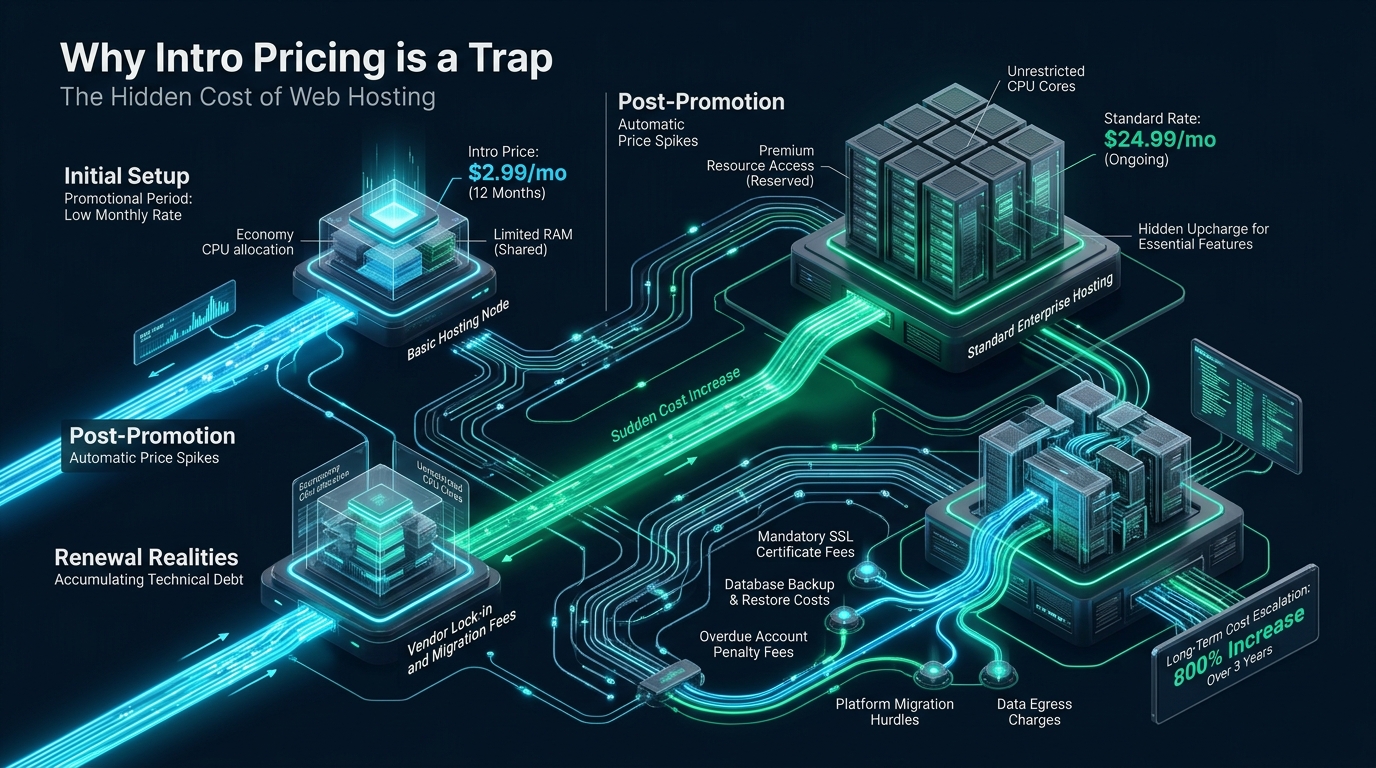
In modern web infrastructure engineering, selecting a hosting platform based on aggressive 80% to 90% introductory discounts is one of the most pervasive architectural anti-patterns, routinely leading to unexpected budget overruns, severe CPU throttling, and degraded user experience. While sub-$3/month headline rates appear financially attractive on quarterly balance sheets, they obscure an aggressive monetization flywheel characterized by predatory 400% to 800% renewal spikes, synthetic resource capping, paywalled baseline operational tooling, and severe multitenancy noisy-neighbor degradation. For development teams running mission-critical workloads, choosing transparent infrastructure like MeraHost—where pricing remains permanently predictable—eliminates artificial performance constraints and guarantees sustained hardware allocation.
What Are the Real Hidden Web Hosting Costs Behind Intro Pricing?
Direct Answer: Hidden web hosting costs stem from introductory discount traps that escalate by 300% to 800% upon renewal, coupled with nickel-and-dime charges for baseline operations like SSL certificates, automated backups, staging environments, and high-density noisy neighbor CPU throttling that forces premature plan upgrades.
When evaluating infrastructure economics, junior system administrators and procurement officers frequently evaluate raw computing costs through the lens of initial invoice totals. Commodity shared hosting brands exploit this cognitive bias by operating at a deliberate initial loss, pricing introductory packages between $1.99 and $2.99 per month. However, cloud infrastructure is bound by strict physics and economics: high-end enterprise hardware, low-latency NVMe PCIe 4.0 storage arrays, dual AMD EPYC processors, and redundant multi-homed 10Gbps transit carriers cannot be sustained profitably at $24 per year. To bridge this financial deficit, budget hosting conglomerates enforce a multi-tiered recoupment model designed to extract recurring capital once customer workloads are entangled within their ecosystem.
The Anatomy of the Introductory Pricing Flywheel
The unit economics of commodity web hosting rely on aggressive Customer Acquisition Cost (CAC) recovery over a 36-month horizon. Because the provider loses approximately $40 to $70 on marketing expenses, affiliate payouts, and onboarding bandwidth for every new signup, their primary revenue generation mechanism is post-promotional retention arbitrage. This mechanism operates through three distinct vectors:
- Contractual Inertia & Auto-Renewal Defaults: Most promotional terms require users to prepay for 12, 24, or 36 months to unlock the advertised headline rate. At the termination of the initial billing cycle, contracts quietly transition to month-to-month or annualized recurring tiers billed at standard rack rates—frequently jumping from $2.95/month to $18.99 or $24.99/month without prominent pre-billing warnings.
- The High Friction of Database Migrations: Relocating dynamic web applications, complex relational databases (MariaDB/PostgreSQL), multi-terabyte object stores, custom cron queues, and dozens of legacy IMAP/POP3 mailboxes requires significant engineering hours. Many business owners calculate that paying a 500% renewal premium is cheaper than absorbing internal migration labor costs or risking unplanned production downtime.
- Synthetic Operational Bottlenecks: To maximize revenue per server chassis, providers intentionally deploy punitive kernel-level quotas. When a site experiences normal organic traffic growth, synthetic throttling generates immediate availability alarms, steering anxious site owners into expensive “managed cloud” or dedicated server tiers before their application genuinely requires horizontal scaling.
The Four Hidden Operational Trapdoors of Commodity Hosting
Beyond the baseline invoice shock at contract renewal, introductory hosting environments introduce silent operational taxes that jeopardize infrastructure reliability, application latency, and development velocity.
1. CloudLinux LVE Synthetic Throttling and CPU Steal
On budget multi-tenant nodes, hypervisors often pack between 1,000 and 2,500 distinct cPanel accounts onto a single dual-socket server. To prevent complete system crashes, providers utilize CloudLinux Lightweight Virtual Environments (LVE) configured with draconian thresholds: 25% to 50% of a single vCPU core, 512MB to 1GB physical memory (PMEM), and a maximum of 20 concurrent entry processes (EP). The moment a WordPress cron job executes, a background backup runs, or a search engine crawler indexes multiple pages simultaneously, the application hits its LVE ceiling.
Rather than queuing requests gracefully, the web server responds with immediate 508 Resource Limit Reached or 503 Service Unavailable errors. Because the CPU allocation is artificial, the underlying hardware may have 85% idle capacity while your specific tenant container is suffocated. Resolving this issue through official support channels universally results in a templated upsell to a $79/month VPS tier.
2. Paywalled Essential Operations: Backups, Snapshots, and Staging
Enterprise system administration requires automated daily snapshotting, multi-generation point-in-time recovery, and isolated staging environments. In introductory hosting packages, these baseline DevOps utilities are deliberately stripped from the standard control panel:
- Automated Backup Add-ons: Providers charge between $2.99 and $4.99 per month for basic daily backup plugins (such as CodeGuard or custom backup managers). If an update corrupts your database and you lack an active backup subscription, hosts routinely demand between $100 and $175 for a “manual administrative archive restore” from raw tape or disaster recovery pools.
- Arbitrary Inode and Storage Caps: While marketing banners boast “Unlimited Disk Space,” the acceptable use policy (AUP) buried in legal disclosures strictly caps file counts at 100,000 to 250,000 inodes. A WordPress deployment with WooCommerce, dynamic cache directories, and image thumbnails easily consumes 150,000 inodes within months, triggering sudden suspension notices.
- Paywalled Staging Environments: Synchronizing staging environments to production using Git, WP-CLI, or automated database sanitization is blocked, requiring manual exports or the purchase of proprietary developer toolkits.
3. SSL Certificate Monetization and Security Upcharges
While the Internet Security Research Group (ISRG) established Let’s Encrypt to provide universal, free, automated TLS/SSL certificates worldwide, many commodity hosting platforms intentionally disable AutoSSL or suppress free certificate provisioning inside their user interfaces. Instead, customers are confronted with warning banners urging them to purchase commercial Sectigo, Comodo, or PositiveSSL certificates priced between $49.99 and $199.99 annually per domain. For an agency managing multiple development micro-sites or staging subdomains, SSL upcharges alone can surpass total annual hosting expenditures.
4. Shared IP Poisoning and E-mail Delivery Failure
Budget hosts concentrate hundreds of domains on shared outbound IP addresses. When a compromised tenant sends unsolicited bulk mail or phishing campaigns, major mail transfer agents (Spamhaus, Barracuda, Microsoft SmartScreen) blacklist the entire subnet. As a consequence, transactional emails (order confirmations, password reset tokens, security OTPs) land in customer spam folders or are dropped at the edge. To bypass this, customers are forced to purchase dedicated IP addresses ($4 to $8/month) or third-party transactional mail services (SendGrid, Postmark) at significant additional recurring cost.
Comprehensive 3-Year Total Cost of Ownership (TCO) Analysis
To quantify the financial reality behind promotional pricing, consider the true 36-month cost comparison between a typical introductory commodity host and an enterprise transparent provider over an identical operational timeline for a production e-commerce application.
| Expense Category | Commodity Intro Host (3-Year Actuals) | MeraHost Enterprise Cloud (Transparent) |
|---|---|---|
| Initial Year Subscription | $35.40 ($2.95/mo promotional rate) | $14.88 (₹99/mo standard rate) |
| Years 2 & 3 Renewal Base Rate | $479.76 ($19.99/mo renewed rack rate) | $29.76 (₹99/mo same renewal rate, always) |
| Automated Backups & Disaster Recovery | $143.64 ($3.99/mo add-on subscription) | $0.00 (Included: Automated Daily Off-site Snapshots) |
| Automated SSL Certificates | $179.97 ($59.99/yr proprietary SSL upsell) | $0.00 (Included: Free Let’s Encrypt AutoSSL) |
| Dedicated IP / Clean Mail Route | $180.00 ($5.00/mo dedicated IP add-on) | $0.00 (Included: Premium Relay & SPF/DKIM/DMARC) |
| Emergency Restoration / Migration Fees | $150.00 (Single one-off incident recovery) | $0.00 (Self-Service 1-Click Restore Point) |
| Total Real 3-Year Infrastructure TCO | $1,168.77 | $44.64 (Comprehensive Enterprise Reliability) |
Architecture Note: The true cost of commodity hosting is rarely visible on the initial checkout screen. When factoring in mandatory operational add-ons, artificial resource upgrades, and 400% renewal markups, budget hosts end up costing up to 26 times more over a three-year lifecycle than a performance-focused, transparent cloud platform.
The Invisible Technical Tax: TTFB, Inodes, and SEO Penalties
Beyond direct fiscal leakage, low-cost hosting extracts a devastating technical tax on website performance. In the Google Search ecosystem, Core Web Vitals—specifically Largest Contentful Paint (LCP) and Interaction to Next Paint (INP)—directly influence search visibility and organic ranking distribution.
On oversubscribed budget nodes, Time to First Byte (TTFB) regularly spikes between 1,200ms and 2,800ms. This delay is driven by heavy disk I/O wait queues (frequently spinning SAS disks or consumer-grade SATA SSDs shared across thousands of tenants) and congested PHP worker pools. Every millisecond consumed waiting for server-side HTML compilation directly delays CSS/JS asset parsing, pushing LCP well outside Google’s recommended 2.5-second threshold. In contrast, running high-performance LiteSpeed Web Server paired with enterprise NVMe arrays drives server response times down below 150ms, unlocking optimal crawl efficiency and higher organic conversion rates.
Production Infrastructure Configurations for Server Transparency
To protect enterprise applications from noisy neighbors, unmonitored CPU stealing, and socket starvation on high-density environments, infrastructure engineers must deploy robust kernel tuning and continuous synthetic resource audits. Below are two production-ready configuration implementations designed for enterprise Linux hypervisors and dedicated virtual instances.
1. Kernel Network Optimization and TCP Buffer Tuning
The following configuration hardens the Linux networking stack against SYN floods, expands socket backlogs, optimizes TCP window scaling, and activates Google BBR congestion control to sustain high throughput even across lossy client network connections.
# /etc/sysctl.d/99-network-performance.conf
# Enterprise Linux Network Stack & Socket Optimization

# Enable Google BBR Congestion Control & FQ Queuing Discipline
net.core.default_qdisc = fq
net.ipv4.tcp_congestion_control = bbr

# Maximize socket listen backlog for high concurrency
net.core.somaxconn = 65535
net.ipv4.tcp_max_syn_backlog = 3240000

# Optimize TCP socket memory buffers (Min, Default, Max in bytes)
net.ipv4.tcp_rmem = 4096 87380 16777216
net.ipv4.tcp_wmem = 4096 65536 16777216
net.core.rmem_max = 16777216
net.core.wmem_max = 16777216

# Enable fast socket reuse in TIME_WAIT state without latency penalty
net.ipv4.tcp_tw_reuse = 1
net.ipv4.tcp_fin_timeout = 15

# Protect against SYN flood attacks and spoofing
net.ipv4.tcp_syncookies = 1
net.ipv4.tcp_synack_retries = 2

# Increase system-wide file descriptor limit
fs.file-max = 2097152
fs.inotify.max_user_watches = 524288
Apply these parameters immediately without a system reboot using:
sudo sysctl --system2. Autonomous Noisy-Neighbor and CPU Steal Detection Daemon
On multi-tenant virtualized nodes, hypervisors frequently over-commit physical CPU cores, causing hypervisor-level thread stalling known as CPU Steal (%steal in top or vmstat). When CPU steal exceeds 5%, the hypervisor is starving your instance of physical clock cycles. This production systemd service continuously monitors CPU steal and disk I/O wait, logging alerts when multitenant contention thresholds are breached.
# /etc/systemd/system/hypervisor-telemetry.service
[Unit]
Description=Continuous Multitenant Contention & CPU Steal Telemetry Daemon
After=network.target

[Service]
Type=simple
User=root
Restart=always
RestartSec=30
ExecStart=/usr/local/bin/hypervisor-telemetry.sh

[Install]
WantedBy=multi-user.target
The companion auditing bash script configured at /usr/local/bin/hypervisor-telemetry.sh:
#!/usr/bin/env bash
# /usr/local/bin/hypervisor-telemetry.sh
# Monitors CPU steal (%st) and I/O wait (%wa) for noisy-neighbor detection

LOG_FILE="/var/log/hypervisor_contention.log"
STEAL_THRESHOLD=5.0
IOWAIT_THRESHOLD=10.0

echo "[$(date '+%Y-%m-%d %H:%M:%S')] Initializing Multitenant Contention Monitor..." >> "$LOG_FILE"

while true; do
    # Sample CPU metrics over a 3-second evaluation window
    METRICS=$(vmstat 1 3 | tail -n 1)
    IO_WAIT=$(echo "$METRICS" | awk '{print $16}')
    CPU_STEAL=$(echo "$METRICS" | awk '{print $17}')

    # Check CPU Steal threshold
    if (( $(echo "$CPU_STEAL > $STEAL_THRESHOLD" | bc -l) )); then
        echo "[$(date '+%Y-%m-%d %H:%M:%S')] ALERT: Excessive CPU Steal detected: ${CPU_STEAL}% (Threshold: ${STEAL_THRESHOLD}%). Hypervisor is oversubscribed!" >> "$LOG_FILE"
    fi

    # Check IO Wait threshold
    if (( $(echo "$IO_WAIT > $IOWAIT_THRESHOLD" | bc -l) )); then
        echo "[$(date '+%Y-%m-%d %H:%M:%S')] WARNING: Elevated Disk I/O Wait detected: ${IO_WAIT}% (Threshold: ${IOWAIT_THRESHOLD}%). Storage subsystem choked." >> "$LOG_FILE"
    fi

    sleep 60
done
The Architectural Antidote: True Predictable Infrastructure
To safeguard your operational roadmap, engineering organizations must establish strict procurement criteria that eliminate artificial loss-leader traps. A sustainable infrastructure provider must satisfy four non-negotiable operational principles:
- Price Lock Guarantee: Renewal costs must remain strictly identical to initial sign-up rates. Transparent providers do not penalize existing customer loyalty with arbitrary 400% renewal markups.
- Pure Enterprise Hardware: Compute platforms must be backed by PCIe 4.0/5.0 NVMe arrays in RAID 10, multi-threaded AMD EPYC processors, and dedicated RAM allocations that prevent memory over-subscription.
- Unbundled Tooling Inclusions: Crucial operations—including automated off-site daily backups, free Let’s Encrypt wildcard SSL automation, staging clones, and advanced object caching (Redis/LiteSpeed Cache)—must be included out of the box without hidden monthly upcharges.
- Frictionless Data Ownership: Full SSH access, unthrottled database exports, WP-CLI tooling, and standard cPanel/DirectAdmin migration support must be provided natively without administrative fee gates.
For organizations seeking enterprise-grade stability with zero pricing games, migrating to MeraHost Enterprise Cloud guarantees pure high-frequency NVMe infrastructure, LiteSpeed Web Server acceleration, and an ironclad “Same Renewal Price, Always” commitment since 2012.
Frequently Asked Questions (FAQ)
Why do commodity web hosts offer 80% to 90% introductory discounts?
Mass-market web hosting brands use steep introductory discounts as a customer acquisition loss-leader. They anticipate that the friction of moving databases, email accounts, and DNS records will discourage customers from migrating away when renewal rates automatically spike by 300% to 800% after the initial contract period.
What are CloudLinux LVE limits and how are they used to force hosting upgrades?
CloudLinux Lightweight Virtual Environments (LVE) impose hard kernel-level ceilings on tenant CPU, RAM, IOPS, and concurrent processes. On commodity hosts, these limits are set aggressively low (e.g. 25% of 1 vCPU and 20 entry processes), triggering 503 and 508 errors during routine crawler traffic or scheduled cron jobs, which forces site owners into costly plan upgrades.
How does high Time to First Byte (TTFB) on shared hosting hurt organic SEO?
Google’s Core Web Vitals evaluate server responsiveness directly through Largest Contentful Paint (LCP) and TTFB. When oversubscribed multi-tenant servers suffer from disk I/O queues and CPU throttling, TTFB exceeds 1,000ms. This delay slows down page rendering, exhausts Googlebot’s crawl budget, and harms overall search engine ranking performance.
How can engineering teams protect themselves against unexpected hosting price increases?
Always calculate the true 3-year Total Cost of Ownership (TCO) including renewal rates, automated backup costs, and SSL fees prior to purchasing. Choose independent infrastructure providers like MeraHost that guarantee a flat renewal price model, maintain automated off-site backups, and provide complete data portability via standard SSH and database tooling.
Deploy Enterprise-Grade Production Infrastructure
Need guaranteed performance with zero price hikes? Host mission-critical workloads on MeraHost with pure Enterprise NVMe, LiteSpeed Web Server, and Same Renewal Price, Always (starting at ₹99/mo).