
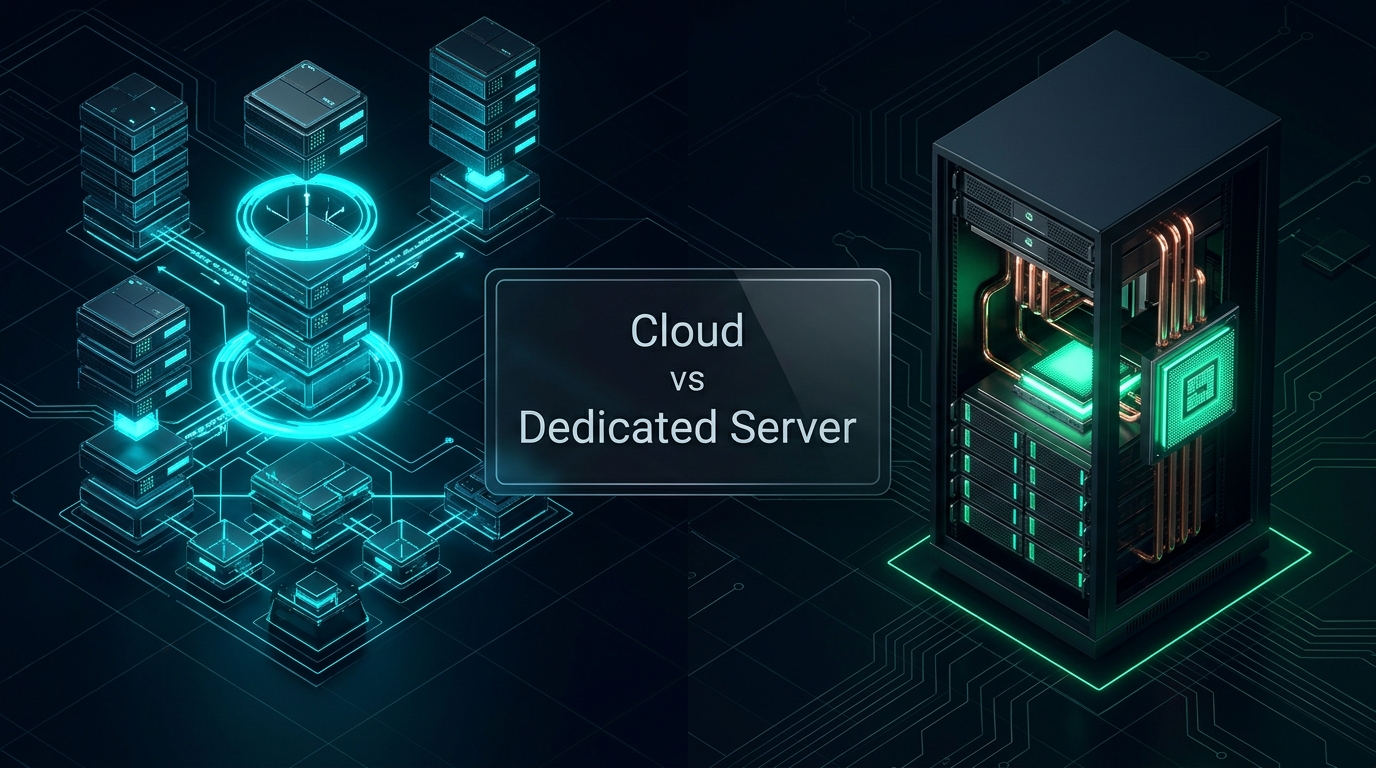
Quick Answer: Cloud Hosting vs Dedicated Server
The primary difference lies in hardware tenancy and redundancy. Cloud Hosting abstracts computing resources across a distributed network of enterprise storage pools and hypervisors; if physical hardware fails, your virtual machine automatically reboots on a healthy node with zero data loss. Dedicated Servers (Bare Metal) provide 100% of a physical machine’s CPU, RAM, and NVMe IOPS to a single tenant with zero hypervisor overhead. Choose Cloud VPS for elastic auto-scaling, dynamic high availability, and developer staging. Choose Dedicated Servers for sustained, raw computational loads, database clusters, virtualization hosts, and regulatory compliance.
When selecting enterprise infrastructure for high-traffic applications, SaaS platforms, or e-commerce operations, the debate inevitably focuses on two computing paradigms: Distributed Cloud Infrastructure (Cloud VPS / Elastic Compute) versus Single-Tenant Dedicated Bare Metal Servers.
A decade ago, dedicated servers were the default choice for any mission-critical application. Today, modern hypervisors, ultra-fast Ceph distributed NVMe storage fabrics, and high-speed KVM virtualization have elevated cloud hosting into an enterprise powerhouse. However, dedicated servers remain unrivaled for raw computing throughput, unthrottled memory bandwidth, and sustained workloads where virtualization taxes degrade performance. In this architectural breakdown, we compare hardware abstraction, latency, I/O bottlenecks, failure recovery, and total cost of ownership (TCO) to help you choose the right infrastructure for 2026.
Architectural Matrix: Cloud vs Dedicated Bare Metal
Understanding where these technologies differ at the physical and hypervisor layers reveals their respective engineering trade-offs:
1. Cloud Hosting Deep Dive: The Power of Hardware Abstraction
In modern cloud hosting architecture, your server instance does not exist as a physical machine with blinking LEDs on a rack. Instead, it is an isolated Kernel-based Virtual Machine (KVM) defined in software, provisioned across an enterprise compute cluster.
The defining superpower of cloud hosting is Fault Tolerance through Storage Decoupling. In enterprise cloud topologies (such as MeraHost’s Cloud KVM fabric), instance disks are stored across resilient distributed Ceph clusters with triple replication across distinct availability zones. If the physical compute node hosting your instance suffers a catastrophic motherboard failure, power supply blowout, or memory fault:
- The health-monitoring cluster heartbeat detects the node timeout within 15 seconds.
- Your virtual machine is immediately reassigned to an available compute blade with healthy resources.
- The distributed NVMe storage volume mounts seamlessly, and the instance boots back up within 30 to 60 seconds.
For high-growth startups, web agencies managing dozens of client portals, and dynamic web applications with fluctuating traffic spikes, cloud infrastructure provides unmatched operational agility.
2. Dedicated Server Deep Dive: The Raw Power of Bare Metal
A dedicated server is an entire physical server—including Intel Xeon or AMD EPYC processors, enterprise ECC DDR5 registered RAM, motherboard buses, and direct PCIe NVMe solid-state storage—leased exclusively to your business. There is no virtualization hypervisor standing between your operating system kernel and the underlying silicon.
When Does Bare Metal Outperform Cloud?
- Zero “Noisy Neighbor” Contention: In poorly managed cloud environments, neighbor instances sharing the physical CPU socket can cause CPU cache thrashing (L3 cache misses) and intermittent steal time. On bare metal, 100% of the memory bus, CPU cycles, and PCIe lanes are permanently reserved for your application.
- Sustained Database I/O: High-transaction databases (e.g., PostgreSQL or MariaDB clusters processing 5,000+ writes per second) require raw disk throughput. Direct-attached PCIe 5.0 NVMe drives configured in hardware RAID-10 easily output 700,000+ read IOPS and 8,000 MB/s write throughput without network latency hops.
- Custom Kernel Modules & Hypervisor Nesting: If your team needs to run specialized low-level networking kernels, custom DPDK drivers, or deploy your own Proxmox VE / VMware hypervisor cluster, dedicated bare metal is non-negotiable.
3. Total Cost of Ownership (TCO) & Sizing Economics
A common mistake IT managers make is assuming the cloud is always more economical than bare metal. In reality, the economic crossover depends entirely on resource utilization patterns:
The Economic Crossover Rule:
Variable or Developing Workloads (Cloud Wins): If your CPU utilization fluctuates widely (e.g., peak daytime sales vs quiet nights), or you need small-to-medium sizing (2 to 8 vCPUs with 4GB to 16GB RAM), Cloud VPS offers the lowest barrier to entry and avoids paying for idle bare-metal silicon.
Sustained Heavy Workloads (Dedicated Wins): If your application constantly utilizes 32+ vCPUs, 128GB+ RAM, and multiple terabytes of NVMe storage, a single enterprise dedicated server costs 40% to 65% less per month than provisioning equivalent compute capacity on hyperscale cloud providers (AWS, Azure, or GCP) where egress bandwidth and IOPS fees quickly spiral out of control.
Deploy High-Speed Cloud VPS or Dedicated Bare Metal
Whether you need an agile KVM Cloud VPS with automated snapshots and instant vertical scaling or a dedicated bare-metal server with unthrottled AMD EPYC / Intel Xeon cores, MeraHost delivers enterprise reliability backed by Tier-4 network uptime.
4. Decision Tree: Which Infrastructure Model Should You Choose?
Use this practical workload decision framework to finalize your infrastructure roadmap:
Choose Cloud Hosting (Cloud VPS) When:
- You are launching a new web application, startup, or SaaS where future traffic demands are uncertain.
- You require high availability and automated hardware failover without engineering complex multi-server clustering.
- Your DevOps workflow relies on automated snapshot backups, 1-click staging environments, and API-driven instance destruction.
- Your budget requires entry-level pricing with predictable, modular vertical upgrades as revenue scales.
Choose Dedicated Bare Metal When:
- You run intensive database engines (PostgreSQL, Elasticsearch, Redis clusters) demanding 100,000+ sustained write IOPS.
- You operate an established e-commerce business generating millions of monthly page views where latency spikes directly cause cart abandonment.
- You intend to run your own virtualization environment (Proxmox, OpenNebula, Kubernetes bare metal).
- Your industry compliance (HIPAA, PCI-DSS Level 1, ISO 27001) mandates single-tenant physical hardware isolation.
Frequently Asked Questions
Is cloud hosting faster than a dedicated server?
Not for raw single-core execution or direct disk I/O. A dedicated server has no virtualization hypervisor layer, meaning memory and CPU instructions execute with zero virtualization overhead. However, modern KVM Cloud VPS instances equipped with enterprise PCIe Gen4 NVMe storage operate with less than 2% latency differential, making them indistinguishable for 95% of web workloads.
What happens if a physical server crashes in cloud hosting?
Because storage is decoupled across a distributed NVMe network, the cloud management hypervisor automatically detects the offline node and reboots your virtual server on an operational physical node in under 60 seconds with complete data integrity.
Can I upgrade a Cloud VPS to a Dedicated Server later?
Yes. Migrating from a MeraHost Cloud VPS to a Dedicated Bare Metal server is seamless. Because both platforms run standard Linux enterprise environments with DirectAdmin or cPanel control panels, data migration and DNS cutover can be completed with zero downtime.
Do dedicated servers include root access?
Yes. Both MeraHost Dedicated Servers and KVM Cloud VPS instances provide full administrative root access (SSH), IPMI/KVM out-of-band management console access, and complete freedom to install custom operating systems, kernels, and firewall rules.